














Step into any beautifully designed Atlanta home, and your eye will likely land on a piece that does more than just fill a space—it tells a story. More often than not, that piece is an antique French side table. It’s the ultimate accent, the perfect whisper of history that elevates a room from simply decorated to truly curated.
The Enduring Allure of French Antique Side Tables
Think of an antique French side table as the perfect piece of jewelry for your interior. It completes the look with a kind of elegance that modern furniture just can’t replicate.
This guide is your exclusive look into the world of these treasures. We'll walk through the iconic styles, from the romantic curves of Louis XV to the bold, clean lines of the Empire period. Most importantly, we'll give you practical advice for bringing one into your own home, whether you're in Buckhead or Alpharetta.
This isn't just about buying old furniture. It's about welcoming a piece of history into your life, something that adds real depth and character to your space. Unlike mass-produced items, these tables carry a sense of artistry and craftsmanship that feels both personal and permanent. They create a beautiful link between a modern Marietta or Roswell home and a rich European legacy.
What Makes These Pieces So Timeless?
So, what’s the secret? It’s the story held within each piece.
The incredible value of antique French side tables, especially those from the 18th and 19th centuries, lies in how they represent major artistic movements. These tables were often brought to life from rich materials like mahogany and walnut, sometimes finished with gilded bronze mounts and stunning marble tops. This variety reflects France's ever-changing tastes, from the flowing Rococo of Louis XV to the more restrained neoclassical Louis XVI designs.
Their appeal really comes down to their versatility and one-of-a-kind character.
- A Statement of Quality: Every table is a testament to the incredible skill of master artisans.
- Unmatched Character: The natural patina and subtle imperfections tell a story no new piece ever could.
- An Investment in Style: These pieces hold their value and aesthetic appeal, effortlessly transcending fleeting trends.
In the world of high-end furniture here in Atlanta, an authentic antique is more than just an object—it's a conversation starter. It signals a real commitment to quality and a thoughtful, curated approach to design.
Whether you're an interior designer sourcing for a client on West Paces Ferry or a homeowner in Milton searching for that perfect accent, understanding these tables is key. While they are distinct, the principles of adding character with a unique accent piece are universal. In fact, you can explore similar ideas in our guide to antique corner tables and see how different shapes can achieve the same stunning goal.
Consider this your personal consultation. We'll give you the confidence to select, style, and care for a piece that will bring you joy for decades, connecting you to a legacy of impeccable design.
Decoding the Iconic Styles of French Design
Not all antique French side tables speak the same design language. Think of this as your personal decoder ring, helping you translate the distinct personalities of each major era you'll encounter in high-end furniture stores in Buckhead and beyond.
Walking into a showroom should feel like an adventure, not an exam. By the end of this, you’ll be able to spot the playful, curvaceous lines of a Louis XV piece, recognize the structured symmetry of Louis XVI, and feel the powerful presence of the Empire style. It’s all about seeing the story each exquisite piece has to tell.
Louis XV: The Age of Rococo Curves
Imagine the opulent, carefree salons of mid-18th-century France. The furniture from this period, known as Louis XV or Roco, is all about movement, nature, and asymmetry. It’s playful, romantic, and unapologetically ornate.
An antique French side table from this era completely rejects straight lines. Instead, it embraces sinuous, S-shaped curves. The most telling feature is the cabriole leg, which curves outward and then tapers down to a delicate foot, often shaped like a scroll or hoof. These pieces feel light and graceful, almost as if they're about to dance.
Key identifiers include:
- Asymmetrical Designs: Carvings and ornamentation are beautifully balanced but not perfectly mirrored.
- Nature-Inspired Motifs: Look for intricate carvings of shells, flowers, leaves, and vines.
- Ornate Hardware: Gilded bronze mounts, known as ormolu, are common and used to accentuate the table's curves.
Louis XVI: A Return to Classical Order
After the exuberance of Rococo, French design took a sharp turn toward restraint. The Louis XVI style is a complete aesthetic shift, inspired by the rediscovery of Pompeii and a renewed interest in ancient Greece and Rome. Think less playful romance, more refined, intellectual elegance.
Here, symmetry and straight lines are king. A Louis XVI antique French side table will feature straight, fluted, or tapered legs, often topped with classical details like acanthus leaves or rosettes. The overall feeling is one of calm, structure, and geometric precision. It's a style that feels perfectly at home in a sophisticated Roswell or Marietta interior, bridging history with modern clean lines.
This Neoclassical style is defined by its restraint and harmony. It’s the quiet confidence of perfect proportions, a stark contrast to its predecessor’s flamboyant curves.
The evolution of French side tables beautifully reflects the broader social and artistic shifts happening in Europe. The move from Louis XV's Rococo curves to Louis XVI's neoclassical straight lines wasn’t just a change in taste; it reflected the ideals of the Enlightenment. Later, 19th-century styles like the Empire period introduced bolder designs using luxurious materials like tulipwood, kingwood, and gilded bronze mounts. You can discover more insights about this historical furniture evolution and see how these trends took shape.
This visual shows the core elements that make these antique tables so compelling to designers and homeowners in places like East Cobb and Alpharetta.
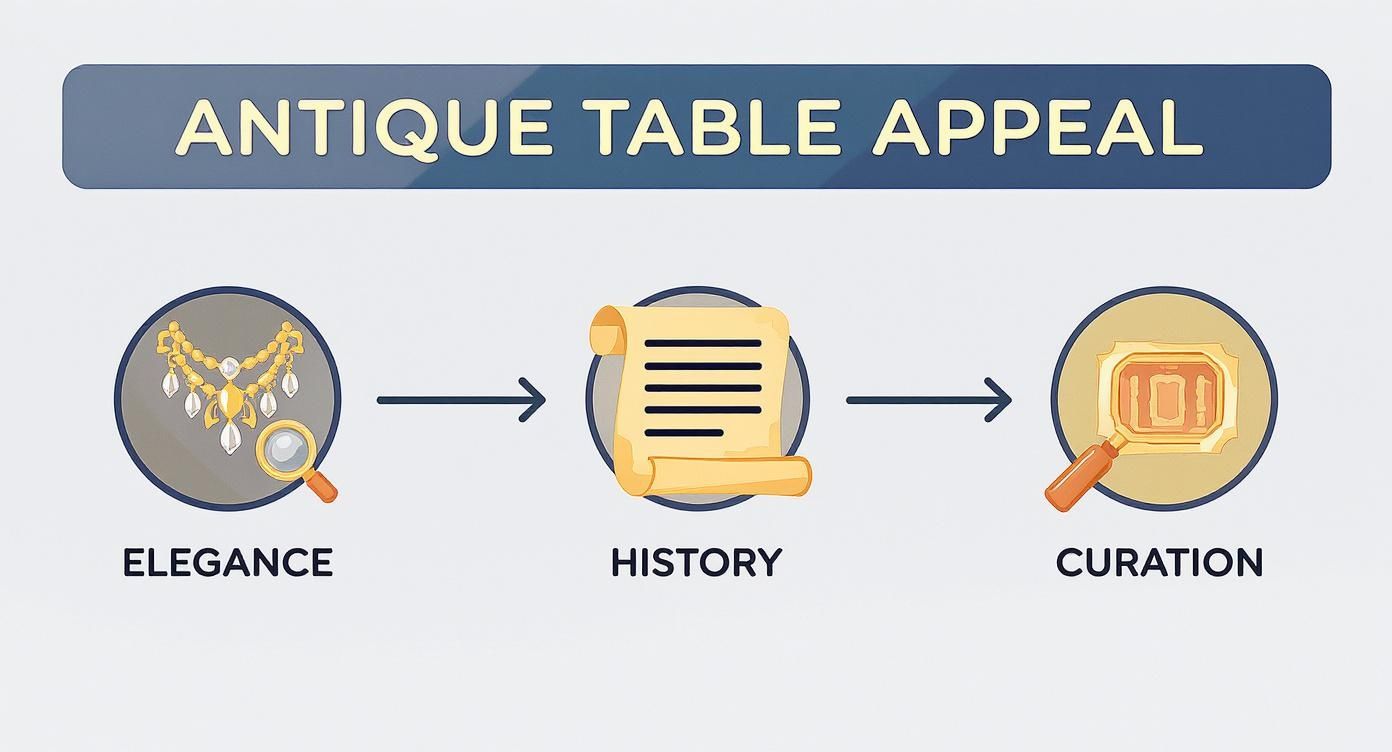
The combination of inherent elegance, deep historical roots, and the thrill of curating the perfect piece is what makes this luxury furniture so sought-after in Atlanta.
Empire Style: Bold and Theatrical Presence
Following the French Revolution, Napoleon Bonaparte ushered in the Empire style. This design movement is all about power, authority, and grandeur. It’s dramatic, masculine, and draws heavily from Roman, Greek, and Egyptian antiquity.
An antique French side table in the Empire style is built to make a statement. These pieces are often larger and more architectural, featuring dark, rich woods like mahogany. Legs are typically straight or shaped like columns, and decorative elements are bold and symbolic. You'll find motifs like eagles, swans, laurel wreaths, and sphinxes rendered in gilded bronze.
This style is perfect for creating a focal point. It commands attention and brings a sense of monumental history to a room, making it an incredible find for anyone seeking luxury furniture in Atlanta that truly stands apart.
Identifying Key French Antique Table Styles
To make spotting these styles even easier, here’s a quick-reference guide that breaks down the defining characteristics of each major period.
| Style (Era) | Key Characteristics | Common Materials | Overall Feel |
|---|---|---|---|
| Louis XV (c. 1730–1760) | S-curves, cabriole legs, asymmetry, nature motifs (shells, flowers). | Walnut, oak, exotic wood veneers, gilded bronze (ormolu). | Playful, ornate, romantic, graceful. |
| Louis XVI (c. 1760–1790) | Straight lines, tapered/fluted legs, symmetry, classical motifs (rosettes). | Mahogany, satinwood, ebony, marble tops. | Refined, elegant, structured, harmonious. |
| Empire (c. 1804–1815) | Bold, architectural forms, straight legs, symbolic motifs (eagles, sphinxes). | Dark mahogany, gilded bronze, marble. | Grand, powerful, dramatic, masculine. |
When you understand these key differences, you're not just shopping anymore; you're curating history. You can walk into any showroom with the confidence to identify the piece that truly speaks to you and your home.
How to Authenticate a Genuine Antique
So, how can you tell a true 18th-century treasure from a really convincing copy? It’s all about learning to read the details. The real story of an antique French side table isn't in its overall shape, but in its beautiful imperfections and the quiet signs of a long, well-lived life.
This is what Atlanta's most discerning interior designers look for when they're sourcing pieces for clients from Buckhead to Forsyth County. Think of it as insider knowledge that will give you the confidence to invest wisely in a true piece of history.
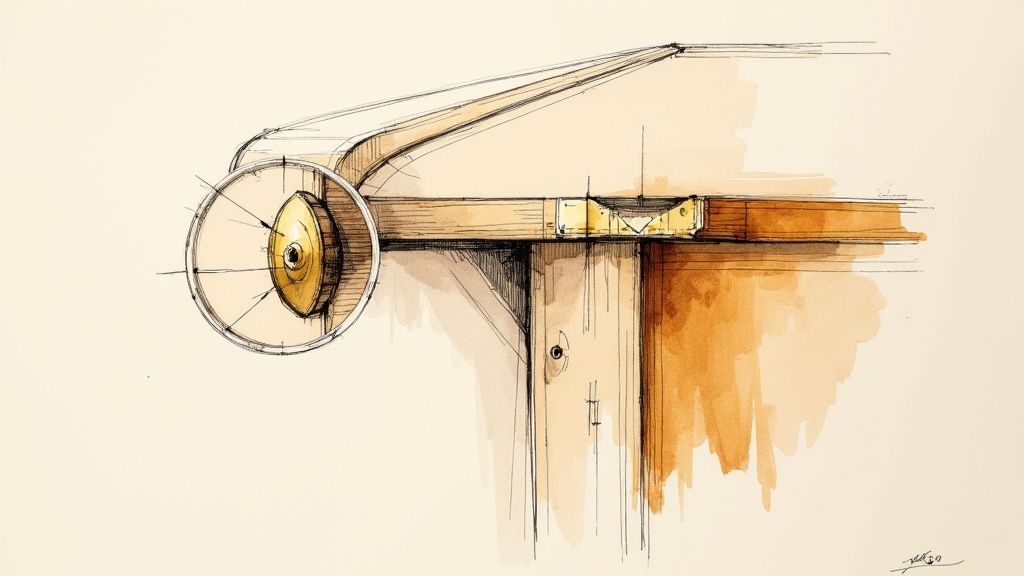
Look for the Human Touch
Long before machines and mass production, furniture was made completely by hand. This is where you’ll find the clearest proof of age. A genuine antique is perfectly imperfect because a person, not a computer-guided saw, created it.
Start by looking at the joinery—the spots where the wood connects.
- Dovetail Joints: Gently pull a drawer out and look at the corners. True antique dovetails are slightly irregular. The pins (the fan-shaped parts) will vary just a little in their size and spacing. You might even spot faint pencil marks where the artisan marked the wood for cutting. Machine-cut dovetails, in contrast, are perfectly identical and sharp.
- Screws and Hardware: Original screws usually have a single slot that might be a bit off-center, and the head is rarely perfectly flat. A modern Phillips-head screw is an immediate giveaway. Similarly, original brass pulls and keyholes should have a soft, deep patina from centuries of hands touching them.
Appreciate the Patina and Finish
Patina is that lovely sheen and subtle color shift that develops on a surface over many, many years. It’s the combined effect of polishing, sunlight, air, and daily life. You simply cannot fake this deep, mellow glow.
A real patina is never uniform. It’s naturally darker in the crevices and a bit lighter on exposed edges where it was touched the most. Before the 1920s, the most common finishes were shellac, varnish, and wax, and each one ages differently. Shellac, for example, can develop a fine, web-like cracking pattern called "crazing," which is a beautiful testament to its age.
The finish on an antique is its soul. A piece that has been stripped and refinished loses a huge part of its history and, often, its value. Whenever you can, preserve the original finish.
Feel the Wood and Weight
The materials themselves tell a story. Antique French side tables were typically made from solid hardwoods like oak, walnut, and mahogany, or they used thick veneers sawn by hand. These woods are dense and heavy. Try lifting a corner of the table—it should feel surprisingly substantial.
Run your hand along the underside of the tabletop or the back of a drawer. You should feel the slight texture and unevenness left by a hand plane, not the slick, flawless surface from a modern power sander. You might even find circular saw marks on furniture made from the mid-19th century onward, but any piece from before 1830 will show straight, up-and-down saw marks.
Understanding Repairs and Provenance
Don’t be put off by honest repairs. A well-done, period-appropriate repair can add to a piece's character. A replaced drawer bottom or a stabilized leg just shows the piece was loved enough to be maintained. The trick is telling the difference between a thoughtful restoration and a heavy-handed overhaul that erases the piece’s identity.
Finally, look for any markings, stamps, or labels. While they aren't always there, finding a maker's mark (an estampille) can be a thrilling discovery, linking the piece directly to a specific Parisian workshop and significantly boosting its value. This is where provenance—the documented history of ownership—becomes priceless, tracing the journey of your side table from the day it was made to its new home in Atlanta.
Understanding the Value of Your Investment
When you’re looking at an antique French side table, the price tag tells a story. It’s a direct reflection of the piece’s history, its rarity, and the incredible artistry that went into its creation. Once you understand what drives that price, you can see your purchase not just as a beautiful object, but as a real, tangible asset.
This isn't about finding a bargain; it's about appreciating the investment. A charming provincial piece might be perfect for a home in Milton, while a museum-quality table is destined for a grand Buckhead estate—but the core principles of value are the same. Here at Lewis and Sheron, our job is to guide clients toward pieces that fit their design vision and their investment goals.
The Key Drivers of Worth
So, what separates a good find from a genuine treasure? It really boils down to a few key factors that every designer and collector in Atlanta should have on their radar.
- Age and Rarity: It’s simple, really. The older a piece is, the fewer of its kind have survived the centuries. A table from the Louis XV period is naturally going to be rarer than something from the late 19th century, and that has a direct impact on its value.
- Condition: Originality is everything. A table that still has its original finish and hardware, even with the gentle wear of time, is often far more valuable than one that’s been heavily restored. Patina isn’t a flaw; it's proof of a life well-lived.
- Materials and Craftsmanship: Was it crafted from solid French walnut or a rare, imported mahogany? Look closer. Are there intricate marquetry inlays or gilded bronze ormolu mounts? The quality of the materials and the skill of the artisan are written all over the final price.
- Maker and Provenance: A signature or stamp (estampille) from a known master cabinetmaker can launch a piece into another stratosphere of value. In the same way, a documented history of ownership—its provenance—adds a compelling layer of desirability and authenticity.
An antique isn't just "used furniture." It's a piece of history you can live with. Recognizing its value means seeing beyond the surface to the story of craftsmanship and time it carries within its grain.
Navigating the Market
The market for these tables is alive and well, with something for a wide range of tastes and budgets. You'll see pricing that reflects their broad appeal, from collectors in Cumming to designers hunting along East Paces Ferry. A simple 19th-century Louis Philippe walnut table might be found for under a thousand dollars, while a more ornate, marble-topped piece with gilt accents can easily command prices well into the thousands, sometimes climbing above $10,000.
These figures show just how much quality and history are prized in today's market. You can explore a great range of these timeless tables to get a feel for these price points yourself.
To truly appreciate your investment, it helps to understand what influences worth in any collecting field. Consulting a practical pricing guide for collectibles can offer surprising parallels, showing how factors like rarity, condition, and origin are universal drivers of value, whether you're collecting meteorites or masterpieces of French design. At Lewis and Sheron, we bring that same discerning eye to our high-end furniture collections in Atlanta, ensuring every piece we offer is a worthy investment.
Styling and Caring for Your Timeless Piece
You’ve found it—the perfect antique French side table. It’s not just a piece of furniture; it’s a sliver of history, ready to begin its next chapter right here in your Atlanta home.
So, how do you make it shine in a modern setting without it looking like a museum artifact? The secret is all in the mix. It's that artful contrast that makes a room feel genuinely curated, not just decorated.
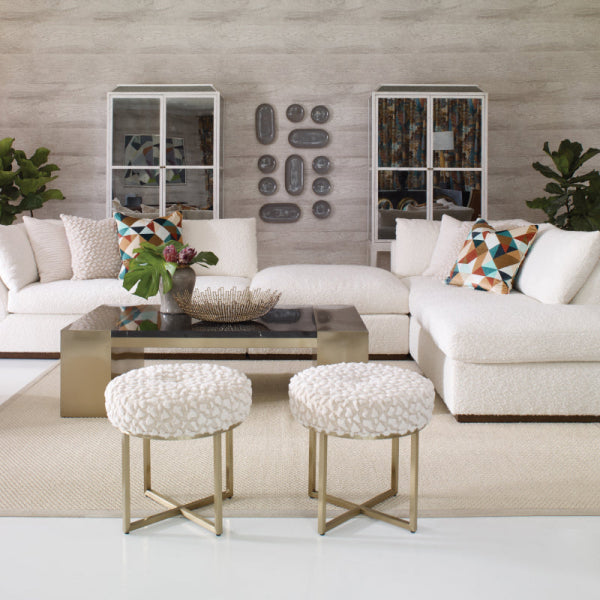
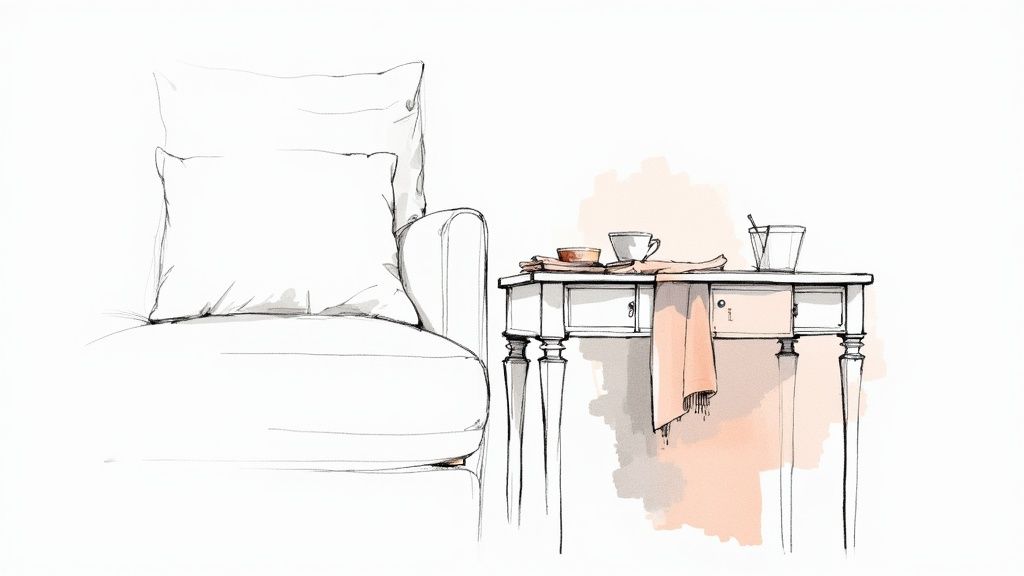
Picture a delicate, fine-boned Louis XVI table standing proudly next to a plush, clean-lined Verellen sofa in your Buckhead living room. That beautiful tension between old and new is exactly what creates a memorable space. A rustic provincial piece can feel instantly more intentional when grounded by custom upholstery in a bold, contemporary designer fabric from our showroom.
This is about creating conversations between your pieces. It’s the kind of sophisticated layering that top interior designers from Roswell to Milton use to give a home its soul.
Gentle Care for a Lasting Legacy
Caring for an antique isn’t complicated, but it does ask for a different mindset. You're not just wiping down furniture; you're preserving a finish that has taken centuries to develop. Most antique pieces from before the 1920s have shellac, varnish, or wax finishes, which are much more delicate than today’s polyurethane coatings.
Here are the essentials for day-to-day care:
- Dusting: Always reach for a soft, dry microfiber cloth. For light cleaning, a slightly damp cloth is fine, but never use harsh chemical sprays or silicone-based polishes. They can eat away at the original patina.
- Spills: Act fast. Blot spills immediately with a soft cloth. Remember, alcohol is the solvent for shellac, so a spilled glass of wine can literally dissolve the finish. Coasters are your best friends.
- Environment: Wood is a living material that responds to its surroundings. Keep your table out of direct sunlight, which can fade the wood, and away from heat sources or vents that cause dramatic swings in temperature and humidity.
While we're talking about wood, you might find some useful general antique wood maintenance tips from other perspectives, like flooring, as the core principles of wood care often overlap.
To Restore or To Preserve
This is the big question, and it's where the Lewis and Sheron difference really comes into play for our clients in Atlanta and across North Georgia. How do you know if a piece needs a gentle polish or a full professional refinishing? The answer almost always leans toward preservation.
An antique's character—and much of its value—is tied directly to its original finish. Stripping it down can erase its history and tank its worth. Most of the time, a piece just needs a professional cleaning and a careful application of conservation wax to bring back its luster and protect the wood.
Of course, there are times when restoration is the right call. Maybe a previous owner slathered on a damaging modern varnish, or the original finish is simply too far gone to save. Deciding when to take that step requires an expert eye. For a deeper look at this, we’ve put together a comprehensive guide on how to restore antique furniture that walks you through the process.
For our Trade Program members, this is a critical conversation. We help designers make informed decisions that honor the integrity of the piece while meeting the functional needs of their clients' homes.
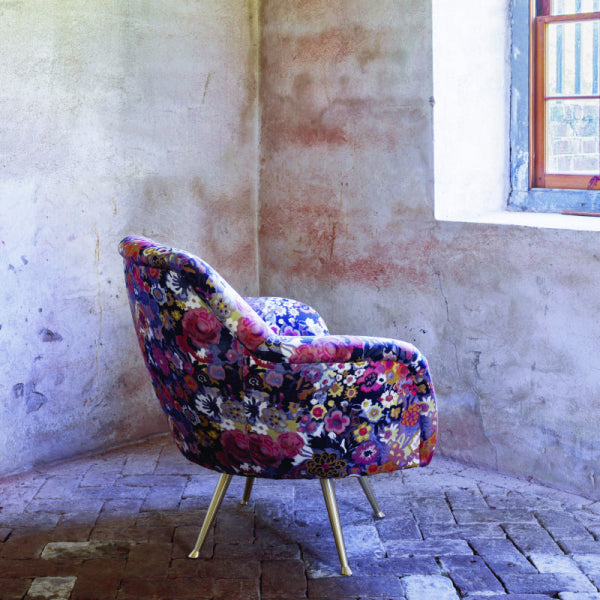
At our Atlanta fabric showroom, we see firsthand how the right textile can completely elevate an antique. Imagine a classic chair paired with your side table, brought back to life with custom upholstery in an exclusive fabric. This is how you create that cohesive, layered look that feels both historic and perfectly current—a true signature of exquisite Atlanta interior design.
Find Your Perfect Piece at Our Atlanta Showroom
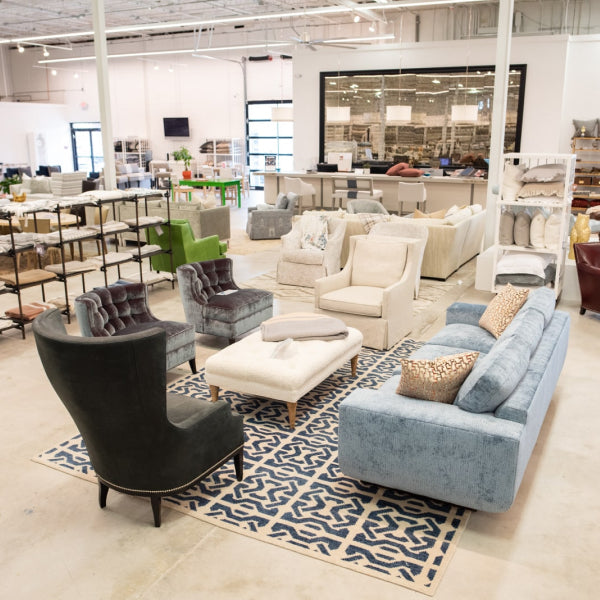
After exploring the history and learning to spot the details of a true antique, there's only one thing left to do: see them for yourself. At Lewis and Sheron, we’ve always believed that furniture should be truly exceptional. Our Buckhead showroom on Collier Rd isn't just a store—it's an experience for people who appreciate enduring quality.
Come see firsthand how the soulful character of an antique French side table can contrast beautifully with the modern craftsmanship of lines like Verellen and Wesley Hall. It's a special kind of magic when you pair a centuries-old piece with the clean lines of a new Lee Industries chair. This is how you curate a home, not just fill it.
This commitment to design mastery is what has made us Atlanta’s go-to destination for exquisite furnishings for decades. We’re proud to serve a discerning clientele, from homeowners in East Cobb and Milton looking for that one perfect find to interior designers across North Georgia who rely on us for inspiration and quality.
Your Ultimate Design Resource in Atlanta
Step inside our Buckhead showroom and you’ll understand why Lewis and Sheron has been Atlanta’s destination for exquisite furniture and fine fabrics for decades. From the handcrafted lines of Verellen and Wesley Hall to the curated textures of Lee Industries, every piece tells a story of quality, comfort, and design mastery.
We're proud to be the Atlanta home for renowned furniture makers whose commitment to quality mirrors our own.
- Verellen Furniture: Discover their Belgian-inspired, eco-conscious designs that blend a relaxed sophistication with impeccable craftsmanship.
- Wesley Hall: Experience the benchmark for high-end, American-made upholstery, where every single detail is customizable.
- Lee Industries: Explore timeless forms and sustainable practices that result in furniture built to last a lifetime.
- Ambella Furniture: Find unique, artfully designed pieces that add a layer of distinctive personality to any room.
For the interior design community, our Lewis and Sheron Trade Program is your ultimate resource. It provides unmatched access to luxury furniture Atlanta, our extensive Atlanta fabric showroom, and the dedicated support you need to serve your clients at the highest level.
A Showroom Experience Beyond the Expected
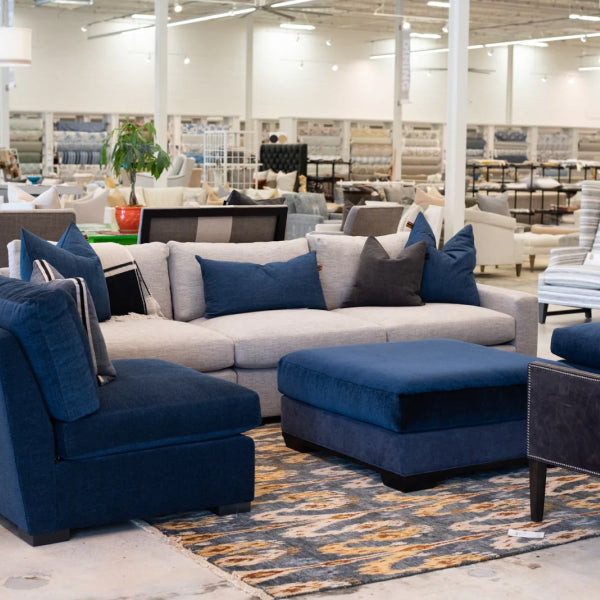
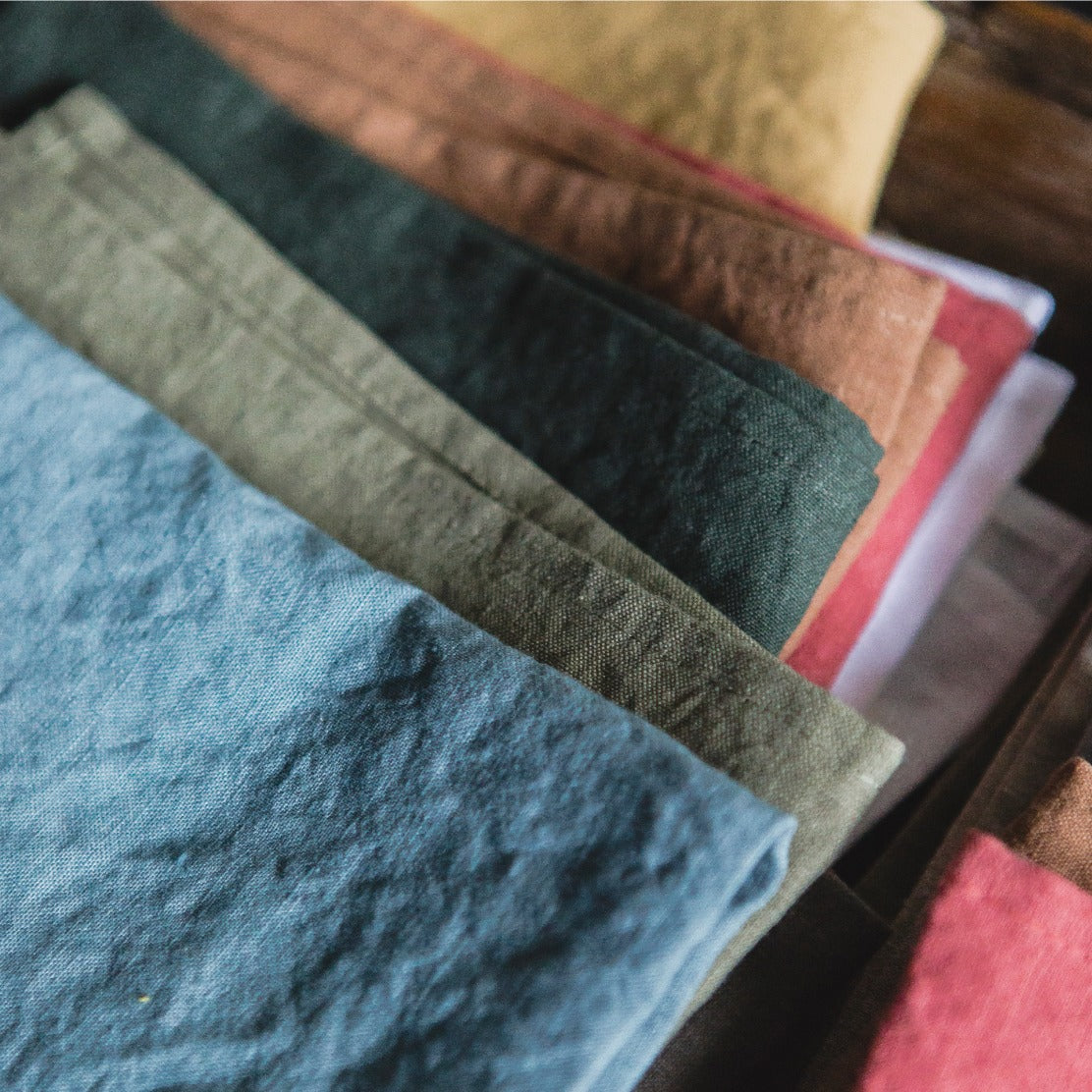
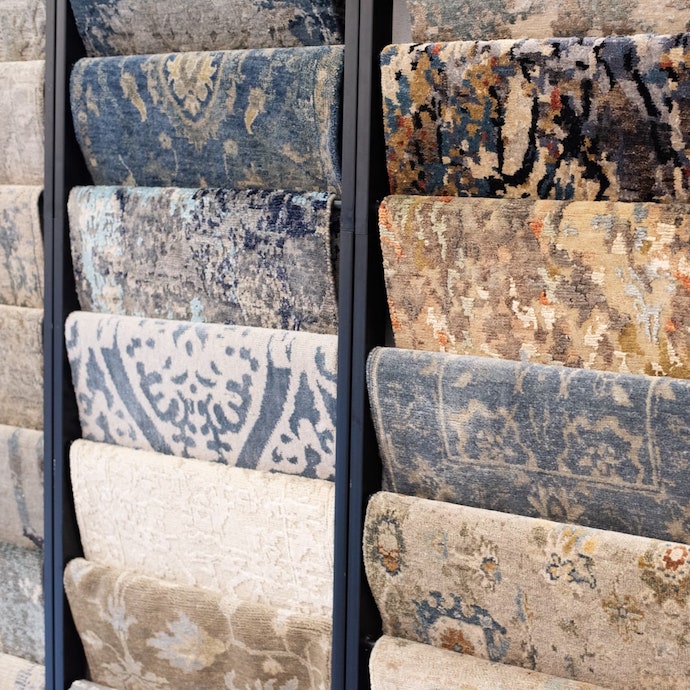
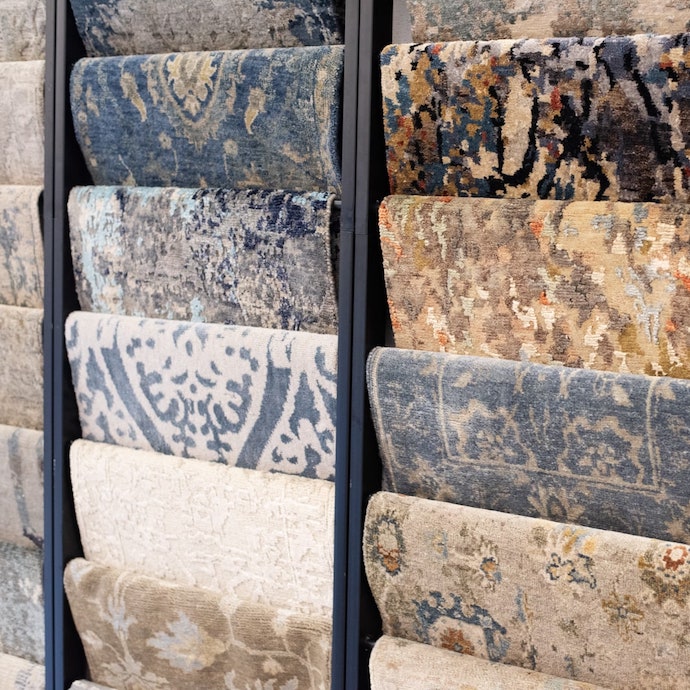
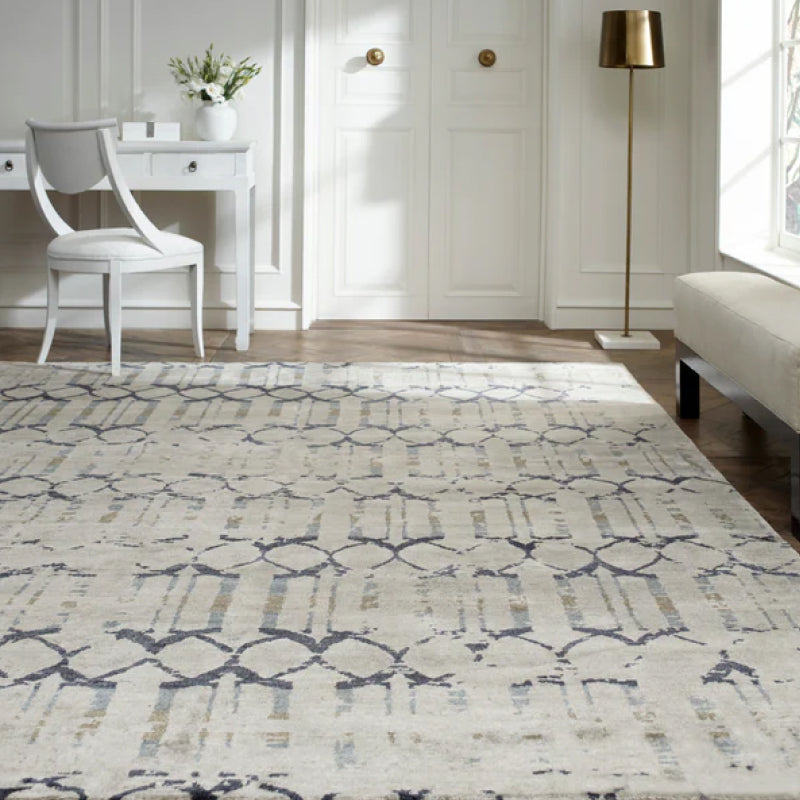
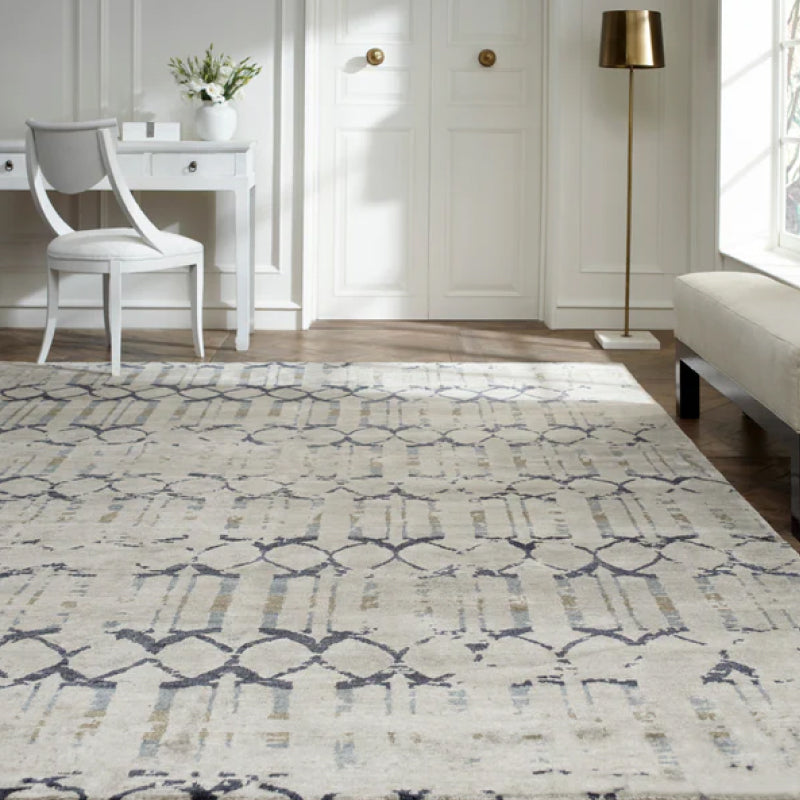
Walking through our doors on Collier Rd is an invitation to be inspired. It's a place to run your hands over thousands of designer fabrics, see how a hand-knotted rug can anchor a room, and discover how a carefully chosen antique can become the soul of your space.
Whether you're looking for guidance on pairing a specific piece—like this gorgeous antique side table with a marble top—with the perfect textile or simply want to explore what's possible, we're here to help.
Our team is always here to offer complimentary design advice, helping bridge the gap between your ideas and a beautifully finished reality. We’re not just selling furniture; we’re helping you build a legacy of style in your own home. Whether you’re from Roswell, Marietta, or right here in Buckhead, a visit to Lewis and Sheron is the natural next step in your design journey. Come discover the piece you’ve been searching for.
Visit Lewis and Sheron Textiles online or in our Atlanta showroom to explore our curated collections of fine furniture, designer fabrics, and timeless antiques. https://lsfabrics.com