











You’ve decided on custom drapes—a fantastic choice. But before you fall in love with a fabric, the most crucial step is figuring out exactly how much you'll need.
Getting the yardage right is the secret that separates a luxurious, professional finish from something that just doesn’t hang quite right. It’s the difference between a work of art and a costly mistake.
The Secret to Flawless Drapes Starts Before the First Cut
Ever walk into a beautifully designed Buckhead home and notice how the drapery seems to perfectly frame the view? That bespoke look isn't magic; it's precision.
Learning to calculate your yardage correctly is the single most important part of the process. It's what makes the difference between stunning, custom window treatments and disappointing, off-the-shelf panels.
We've been helping Atlanta's designers and homeowners with this for decades. We've refined the process down to a simple, confident science. We'll walk you through how to measure like a pro, so you understand why a few extra inches for a hem can completely change the way a drape hangs and why the right fullness makes fabric from our Atlanta fabric showroom look a million times better.

From Vision to Reality
Forget the anxiety of ordering too much of that perfect designer fabric—or worse, not enough. This is your blueprint to get it right the very first time. We want to ensure your investment in an exquisite textile results in a masterpiece for your home.
Here’s what mastering this process really does for you:
- Achieve a Professional Look: You'll finally understand the little details, like stackback and hem allowances, that give drapes that elegant, structured hang.
- Invest with Confidence: Order the exact amount of fabric you need, avoiding costly mistakes and frustrating project delays.
- Customize Your Design: You'll have the knowledge to choose the perfect fullness for any look, from breezy sheers to opulent, pleated panels.
This is more than just math; it’s about translating your vision into a concrete plan. Think of it as your personal design resource, arming you with the skills to tackle any window treatment project with total assurance.
Mastering Your Measurements for Custom Drapery
Before you fall head-over-heels for one of our beautiful designer fabrics, we need to get the groundwork right. Correct measurements are the secret to achieving that polished, high-end look you see in the finest homes across North Georgia.
Let's start with the most common mistake we see: measuring the window frame itself.
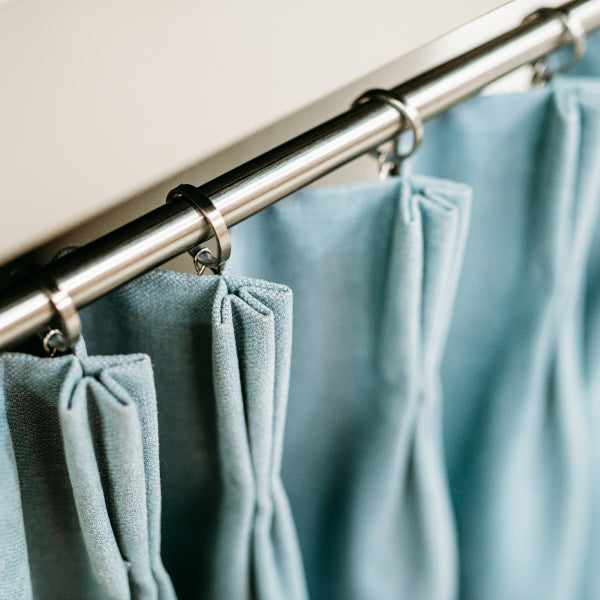
You should always measure the width of the drapery rod from end to end, excluding the decorative finials. This single measurement is the foundation for everything that follows, dictating the final width and fullness of your drapes.
Next up is the finished length. This is simply how long you want your drapes to be, measured from just underneath the curtain rod down to their final stopping point. It's a small detail that makes a huge aesthetic difference.
Defining Your Drapery Style
The length you choose can dramatically shift the mood of a room. Are you going for a crisp, modern vibe or something more lush and traditional?
- The Float: Here, the drapes hang about a half-inch above the floor. It’s a clean, no-fuss look that doesn't collect dust, making it a popular choice for busy family homes from East Cobb to Cumming.
- The Kiss: This is where the hem just perfectly grazes the floor. It's a beautifully tailored style that looks incredibly custom, but it does require a perfectly level floor. Think of it as that high-end Buckhead furniture aesthetic you see with our Lee Industries chairs.
- The Puddle: For a dose of romantic drama, add anywhere from one to eight inches to your floor-length measurement. This creates a gorgeous "puddle" of fabric, an elegant touch for formal living rooms in Roswell and Milton.
A key tip from Atlanta's top interior designers: mount your drapery rod 4 to 6 inches above the window frame and extend it 3 to 6 inches on either side. This simple trick creates the illusion of a larger window and lets in maximum light.
Understanding Stackback
Now, let's talk about stackback. This is the amount of space your drapery panels take up on the wall when they're pulled completely open. The goal is to have the fabric clear the windowpane entirely, framing your view instead of blocking it. Properly accounting for stackback means you can enjoy that beautiful natural light on your Wesley Hall sofas.
This is exactly why we insist on measuring the rod, not the window. A wider rod gives you plenty of room for that stackback without covering an inch of your view. For a deeper dive, check out our guide on how to measure windows for curtains.
Adding Professional Allowances
Finally, no professional drapery project is complete without allowances for the header (the top) and the hem (the bottom). This isn't just extra fabric; it gives the drape structure, weight, and that graceful, flowing hang.
A standard professional allowance is an extra 16 to 18 inches added to your finished length. Here's why:
- A double 4-inch bottom hem (8 inches total) gives the drape necessary weight.
- A double 4-inch header (8 inches total) provides the fabric needed to construct beautiful pleats.
Getting these measurements right is the first step toward a flawless result. With these numbers in hand, you're ready to walk into our Atlanta fabric showroom feeling completely confident.
Calculating Yardage for Solid and Small-Pattern Fabrics
This is where the math starts to feel like magic. When you're working with solid fabrics or those with small, forgiving patterns, the calculations are refreshingly straightforward.
The secret ingredient here is fullness. It's what gives drapes that lush, gathered look you see in high-end interiors. Fullness is a multiplier that tells you how much fabric to use relative to the width of your drapery rod. Skimp on fullness, and your drapes will look flat and uninspired. Nobody wants that.
This little diagram breaks down the core measurements you'll be using.

Getting these three numbers—rod width, finished length, and stackback—right is the absolute first step to getting that perfect, custom-draped look.
The Fullness Formula
Think of fullness as a design choice. A standard 2.5x ratio is perfect for classic pinch pleats, while a more dramatic 3x fullness gives sheer fabrics that beautiful, airy quality. This choice directly impacts how many "widths" of fabric you'll ultimately need.
Here’s the core formula to figure out how many widths you need per panel:
(Rod Width x Desired Fullness) ÷ Fabric Width = Total Widths Needed
Most of the designer fabrics you'll find in our Atlanta showroom are a standard 54 inches wide. For a pair of drapes, you’d take the "Total Widths Needed" and divide by two. This gives you the widths per panel. Always, always round up to the next whole or half-width—never down.
Pro Tip: Never cut a fabric width into anything smaller than a half-width. Sticking a quarter-width on the edge of a panel looks cheap and screams "DIY mistake." A half-width seam, on the other hand, can be easily hidden within a pleat, keeping everything looking seamless and professional.
Drapery Fullness Ratios by Style
Not sure what fullness to use? This quick guide will help you pick the right ratio for that luxurious finish.
| Drapery Style | Recommended Fullness Ratio | Best For |
|---|---|---|
| Pinch Pleat / Goblet Pleat | 2.5x | Creating a classic, tailored look with structured folds. |
| Grommet / Rod Pocket | 2.0x – 2.5x | Casual and contemporary styles with soft, less formal gathers. |
| Sheers / Voiles | 3.0x | Achieving a light, ethereal, and voluminous effect. |
| Ripplefold | 2.2x (fixed) | A modern, clean aesthetic with uniform S-shaped curves. |
| Flat Panel | 1.25x – 1.5x | Minimalist applications where the fabric pattern is the star. |
Choosing the right fullness is the difference between drapes that just hang there and drapes that truly dress a window.
From Widths to Final Yardage
Once you know the number of widths per panel, it’s time to calculate the final yardage. Here you factor in those crucial allowances for hems and the header. We always recommend adding a generous 16 to 18 inches to your desired finished length for this.
Here’s how you find your final cut length for each width of fabric:
Finished Length + Hem & Header Allowance (18 inches) = Cut Length
Now, just multiply that cut length by the total number of widths you need for the entire window. This gives you the total inches of fabric required.
The final step is to divide that number by 36 (the inches in a yard) to get your grand total. And just like that, you have the exact number to bring to our showroom. If you ever get confused by units of measure, our guide on whether meters and yards are the same can help.
Let’s walk through a real-world example.
Worked Example: A Marietta Living Room Window
- Rod Width: 80 inches
- Desired Fullness: 2.5x (for classic pinch pleats)
- Finished Length: 96 inches
- Fabric Width: 54 inches
- Calculate Total Widths: (80" x 2.5) ÷ 54" = 200" ÷ 54" = 3.7 widths. Round this up to 4 total widths.
- Determine Widths Per Panel: 4 total widths ÷ 2 panels = 2 widths per panel.
- Calculate Cut Length: 96" (finished length) + 18" (allowance) = 114 inches per width.
- Find Total Yardage: (114" x 4 widths) ÷ 36" = 456" ÷ 36" = 12.67 yards.
For this project, you would order 13 yards of fabric. With this calculation in hand, you're ready to confidently start your project.
The Art of the Pattern Repeat and Why It Matters
So, you've fallen for a bold, luxurious patterned fabric from Kravet or Schumacher? Fantastic choice. This is where true craftsmanship comes into play.
When you choose a fabric with a large, statement-making pattern, you're not just covering a window—you're hanging a piece of art.
But to get that high-end look you see in the most exquisite Buckhead homes, the details become non-negotiable. A pattern repeat isn't a complication; it's a design feature. And you absolutely must account for it in your calculations.

This step ensures the pattern flows seamlessly across every panel seam, creating one uninterrupted visual masterpiece. It’s the gold standard in luxury design and what separates a truly custom project from something that just misses the mark.
Finding the Vertical Repeat
What exactly is a vertical repeat? It's the distance, in inches, from the beginning of one pattern motif to the exact start of the next one down the length of the fabric. You'll find this info on the fabric swatch or listed with the fabric details here in our Atlanta showroom.
Think of it this way: for your drapes to look perfect, every panel must start at the exact same point in the pattern. This means you'll inevitably have to trim away some excess fabric from the top of each new width you cut. It's this "sacrificial" fabric that adds to your total yardage.
The larger the pattern repeat, the more extra fabric you will need. It’s a simple rule, but ignoring it is one of the most common—and costly—mistakes we see. We're here to make sure you get it right.
Forgetting this step can lead to a visual disaster, with mismatched patterns that look disjointed and cheapen the entire effect of your beautiful fabric.
How to Calculate for a Pattern Repeat
Let's break down how to build this into your yardage calculations. You're simply adjusting your "cut length" to ensure it's a perfect multiple of your pattern repeat.
Here’s the formula:
- Calculate Initial Cut Length: Start with your finished length plus your hem and header allowances (we typically use 18 inches).
- Determine Number of Repeats: Divide that initial cut length by the vertical repeat measurement. You'll almost always get a decimal—just round this number up to the next whole number.
- Find Your New Cut Length: Now, multiply that rounded-up whole number by the vertical repeat measurement. This is your final, pattern-matched cut length for each width of fabric.
This new cut length will be longer than your initial one. That's exactly what we want. It gives your workroom the necessary fabric to align everything perfectly.
A Practical Example in Alpharetta
Let’s imagine you're designing drapes for a gorgeous Alpharetta home and you’ve selected a stunning fabric with a bold floral.
- Finished Length: 102 inches
- Hem/Header Allowance: 12 inches
- Vertical Repeat: 27 inches
Here's how the math plays out:
- Initial Cut Length: 102" + 12" = 114 inches.
- Number of Repeats: 114" ÷ 27" = 4.22. We round this up to 5 complete repeats.
- New Cut Length: 5 repeats x 27" = 135 inches, or 3.75 yards per panel.
That’s a big difference. In this case, accounting for the pattern repeat adds 21 inches of fabric to every single width you cut. This critical step can increase your material needs by 15% to 40% compared to a solid fabric. For more expert tips, check out these great drapery calculations and techniques to perfect your next project.
Understanding how to calculate for a pattern repeat elevates your project from simple window coverings to true works of art. It’s a hallmark of quality design.
Defining Luxury with Linings and Professional Allowances
You’ve done the hard part—you’ve calculated your face fabric. But the project isn’t quite ready for the workroom floor. Now we need to talk about the hidden elements that give custom drapes their beautiful weight, graceful hang, and impressive longevity.
A quality drapery lining isn't an add-on; it's a non-negotiable part of any high-end window treatment. Think of it as the soul of your drapes. It’s what protects that exquisite designer fabric from the relentless Georgia sun, preventing fading and damage. It also adds crucial body and insulation, transforming a simple piece of cloth into a structured, elegant drapery panel.
The Importance of a Quality Lining
Calculating your lining yardage is usually straightforward. For most projects, the amount of lining fabric you'll need is the same as your face fabric. The type of lining you choose, however, can completely change the function and feel of your drapes.
- Cotton Sateen: This is our go-to classic. It offers a smooth finish and a soft drape that complements just about any face fabric.
- Blackout Lining: An absolute must for bedrooms or media rooms. This lining blocks nearly all light and adds a significant insulating layer.
- Interlining: This is the ultimate luxury. A flannel-like layer gets sandwiched between the face fabric and the main lining, creating drapes with incredible richness, body, and thermal properties.
Choosing the right one is a key decision. You can explore more about the role of drapery lining in custom drapes to see exactly how much it impacts the final look.
The Professional’s Secret Weapon: The Waste Factor
Here’s a detail that separates the novices from the pros. Every experienced Atlanta workroom, from Buckhead to Milton, adds what’s known as a “waste factor” or “insurance yardage” to their final order. This is typically an extra 5-10% of fabric added to your total calculated yardage.
Why? Because things happen. A slight miscalculation, a flaw in the fabric bolt, or a cutting error could bring your project to a screeching halt.
Adding this small buffer is your insurance policy. It prevents the nightmare of having to re-order fabric weeks later, only to discover the new bolt is from a different dye lot with a noticeable color variation. It’s a small step that guarantees a seamless process.
The professional drapery industry applies a standard waste factor of 5 percent to all yardage calculations to account for these irregularities. After calculating your base yardage, just multiply that figure by 1.05 and round up to the nearest quarter yard.
For instance, if your calculation is 6.2 yards, adding 5 percent yields 6.51 yards. A professional would round up to 6.75 yards to be safe. This isn’t about overspending; it’s about smart planning that prevents costly delays and potential dye-lot mismatches.
This is the final touch of foresight that ensures your investment results in a flawless, stress-free installation. It's how Atlanta's finest designers get it right every single time.
Let Us Do the Heavy Lifting
Now that you have the formulas and trade secrets, you don't have to go it alone. Honestly, this is the part we live for at Lewis and Sheron. Creating a beautiful home should feel like an exciting collaboration, not a stressful math exam.
Whether you're an interior designer sourcing for a client through our trade furniture program or a homeowner ready to finally tackle that big window, our team is here for you. Think of us as your partner, your sounding board, and your guide.
Your Atlanta Design Resource
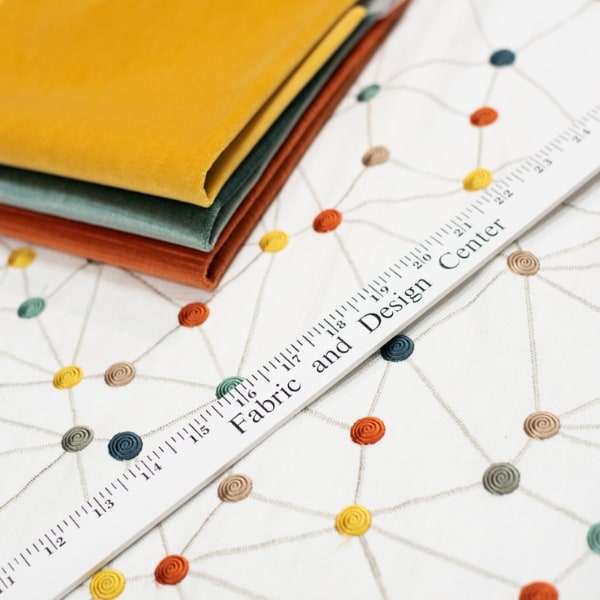
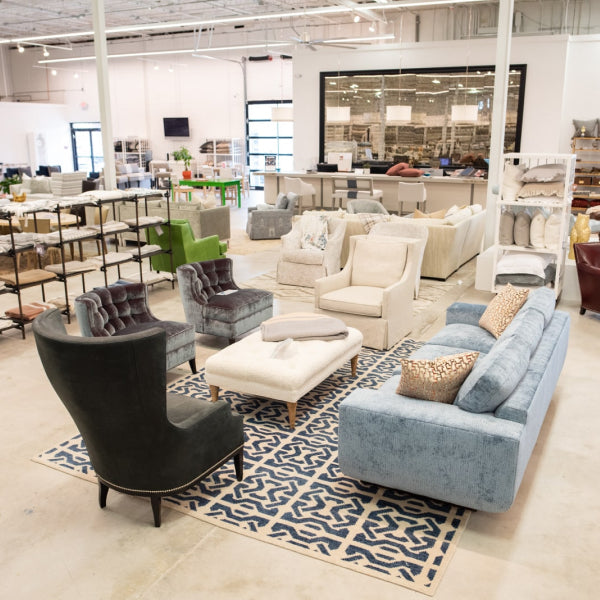
Just bring your measurements into our high-end furniture Buckhead showroom. Let's lay them out on the table together and pull fabrics that catch your eye. We can walk through our collections of exclusive textiles and designer fabrics, double-check your math on how to calculate yardage for drapes, and help you truly see how that gorgeous linen or bold print will transform your room.
It’s one thing to see a number on a page, and another to feel the fabric in your hands.
- Expert Review: We'll go over your math, making sure every detail—from tricky pattern repeats to the perfect fullness—is accounted for.
- Fabric Curation: Let us pull options! Based on your vision, we can find incredible textiles that perfectly complement the handcrafted lines of Verellen furniture or the timeless comfort of Lee Industries.
- Complimentary Design Services: Our in-house designers are here to make sure your project is a stunning success, right down to the last stitch.
Think of us as your trusted partner in creating timeless, beautiful interiors. From finding fine fabrics in Alpharetta to creating custom upholstery for a Roswell estate, we’re here to bridge the gap between your ideas and a stunning final product.
Ultimately, our goal is to give you total confidence. We want you to leave our Atlanta fabric showroom not just with the perfect material, but with the peace of mind that comes from knowing your vision is about to become a flawlessly executed reality. Your masterpiece is just a conversation away.
Questions Our Designers Hear All the Time
We get it—ordering custom drapery can feel like learning a new language. To help, we've gathered a few of the most common questions our designers hear from clients every day in our Buckhead showroom.
How Much Extra Fabric Do I Really Need for Hems and Headers?
For that truly professional, weighted hang, the industry standard is to add a total of 16 to 18 inches to your desired finished length. This isn't throwaway fabric; it’s a crucial part of the drapery's structure.
This allowance usually breaks down like this:
- An 8-inch allowance for a double 4-inch bottom hem. This gives drapes that beautiful, substantial weight so they hang perfectly.
- Another 8-inch allowance for the top header, which gives the workroom enough material to construct elegant, structured pleats.
What Happens If I Mess Up the Math and Run Short on Fabric?
This is a scenario that keeps designers up at night. If you run short, the only option is to reorder the fabric and hope the new bolt comes from the same dye lot as the original.
Different dye lots can have slight, but very noticeable, color variations. When sewn side-by-side, that difference can be jarring. This is exactly why we always recommend adding a 5% to 10% "waste factor" to your initial order. Think of it as an insurance policy against this very problem.
Does the Fabric Width Change My Yardage Calculation?
Absolutely. It’s one of the most important variables. Most designer fabrics you'll find in our Atlanta showroom come on a standard 54-inch wide bolt, and the formulas in this guide are based on that width.
But some specialty fabrics, like the beautiful linens and sheers designers in Alpharetta love, can come in double widths (up to 118 inches). A wider fabric often means you can use fewer widths of material to get the fullness you want, which can sometimes reduce your total yardage. Always confirm the fabric width before you finalize your calculations on how to calculate yardage for drapes.
Can I Use This Guide for My Roman Shades or Valances?
While some of the basics—like how to measure your window—are the same, the formulas for Roman shades and valances are a completely different beast. These styles don't rely on fullness ratios in the same way, so their calculations are unique.
This guide is specifically for drapery. If you're planning another type of window treatment, we highly recommend chatting with our design team at the high-end furniture Buckhead showroom. We can give you the precise calculations you need for a flawless result, whether your project is in Roswell or anywhere across North Georgia.
Your vision for a beautifully appointed home is within reach. At Lewis and Sheron Textiles, we’re here to provide the expertise, the exquisite materials, and the personalized service to bring it all to life. Visit us to explore our luxury furniture Atlanta collections and find the designer fabrics that will transform your space.