
















The arm has gone shiny where every hand lands. The back cushions slump into themselves. The seat has a shallow bowl where you sit, and when you drop into it, something underneath makes a soft click.
You've had a reupholstery quote, and you've also seen a new sofa online for about the same money. This is the point where buyers often compare the wrong two things. They weigh the fabric they can see against a photograph of a new piece, and they ignore the structure they can't see, which is the part that decides whether the money is well spent.
I judge the frame before the fabric, every time. A hardwood frame with tight joints and repairable suspension is worth recovering, and it will usually outperform anything new at the same budget. A staple-built frame under tired linen is a donation waiting to happen. The reupholster or buy new sofa decision gets much simpler once you know which one you own.
Reupholster or Buy New Depends on Condition
Start with condition, not price. Two sofas can carry identical quotes and deliver completely different amounts of life, because one has bones and the other has staples. Find your row before you price anything.
| Sofa condition | Likely verdict | What decides it |
|---|---|---|
| Sound hardwood frame, dowel joinery, tired fabric | Reupholster | Fabric and cushions renew without rebuilding the frame |
| Sound frame, collapsed foam, sagging seats | Reupholster with higher-density foam and new suspension | Performance is restored, not only the look |
| Loose joints, twisting or cracked load-bearing rails | Buy new | Rebuilding the frame often costs more than replacement |
| Dimensions wrong for the room or doorway | Buy new | Reupholstery cannot change proportions |
| Heirloom or antique with distinctive silhouette | Reupholster after inspection | A replacement may be impossible to match |
| Basic mass-produced sofa with weak frame | Buy new | Labor and premium fabric outweigh the piece's value |
| Old filling with unknown fire-safety documentation | Buy new, or require documented replacement components | Compliance must be verifiable before work starts |
Rows one and two are the everyday winners. If the frame is hardwood, the joints are doweled or corner-blocked, and the seat deck still holds, then worn fabric and flat cushions are surface problems. New foam and renewed suspension change how the sofa sits, not just how it looks, and the frame you already own is likely better than what a similar budget buys today.
Rows three and four close the conversation fast. A twisting frame, a cracked rail or a joint that won't tighten means rebuild work, and rebuild labor is where quotes climb. Wrong proportions are just as final. No textile makes a sofa fit a doorway it never fit.
Row five is the one worth fighting for. A silhouette nobody manufactures anymore can't be replaced at any price, so an inspection is cheap insurance. Row six is the reverse. Frames assembled with glue and staples rarely justify premium covering and skilled hours.
Row seven is a paperwork problem. Old filling and fabric with no compliance documentation have to be documented and replaced rather than reused.
Replacing feels like the default choice. In 2023, 174.8 million Americans had experienced furniture damage, according to Allstate Protection Plans' furniture damage survey, so the decision in front of you is routine. What separates a good outcome from an expensive one is how you assess the parts nobody sees.
How to Test Frame, Suspension and Cushions
Six checks tell you more than any showroom photograph, and you can run most of them in ten minutes without tools.
Here's the sequence at a glance.
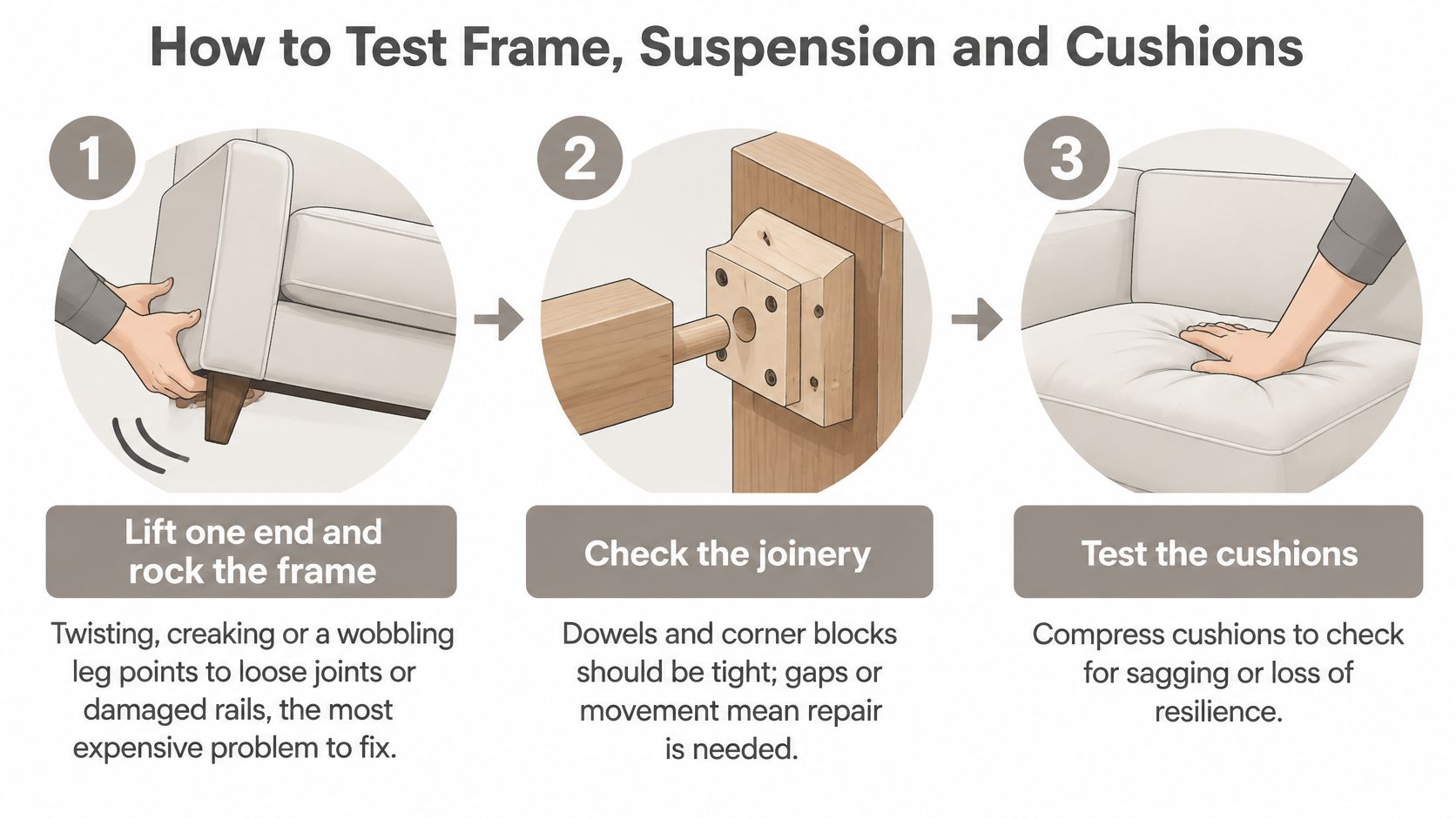
The inspection you can run yourself
- Lift one corner and rock the piece gently. A well-built sofa feels like one heavy object and resists. One that twists, creaks or lifts a leg off the floor has loose joints or a damaged rail, and that's the most expensive problem on the list.
- Look at the joinery wherever you can reach it. Corner blocks, dowels and wooden wedges tell you the frame was built to stay square. Staples alone, with no blocks and no dowels, tell you it was never designed to come apart and go back together.
- Press each seat cushion in the centre and time the rebound. A cushion that stays compressed after your hand lifts has failed foam. Check seat height now and again after a week of use if you want proof rather than an impression.
- Get under the deck with a torch. Sagging webbing, broken coils and torn straps are all repairable and worth renewing while the cover is off. Springs sitting on a cracked rail are a different story.
- Ask for foam density as a number. Replacement cores are specified by density, and a higher-density core frequently restores comfort that the old piece hasn't had in years.
- Put the findings in writing, itemised by part. Frame, joinery, suspension, cushion core and fabric should each get their own line and their own verdict.
Turning findings into a repair scope
The RAL-GZ 430 quality specification for upholstered furniture is a useful model for what an honest assessment covers. It evaluates pieces through wear testing, load and stability testing, and post-test changes in seat indentation, cushion height and hardness, and it references foam density measured under ISO 845 alongside structural safety under the relevant EN standards. Ask for those findings rather than a visual estimate.
Then assign one of three scopes. Fabric only means the deck, foam and suspension are sound and the cover is tired. Fabric plus cushions covers the very common case of a stable frame with collapsed foam and sagging seats. Full rebuild means new webbing, new decking, tightened or reinforced joints and new filling, and it's the scope that erodes the financial case fastest.
The most common mistake is judging a sofa by its fabric while ignoring a frame that rocks. The second most common is accepting a verbal "it's all solid in there" instead of an itemised scope, then discovering failed decking after the old cover comes off. Our own assessment process follows the same order, covering structure, fabric and detailing before anyone recommends work, and material selection plus details such as stitching, buttons or tufting get settled before production begins. If you want to understand how those build decisions affect service life, this explanation of furniture durability is worth reading before you choose a covering.
What Reupholstery Costs Against Buying New
The comparison most owners make is a full reupholstery quote against the cheapest new sofa they can find online, and that pairing flatters the wrong side. Here are the ranges as published.
| Route | Typical cost (USD) | What it includes |
|---|---|---|
| Professional sofa reupholstery | 600 to 4,000 | Labor, fabric and cushion work, varies by scope |
| Reupholstery labor alone | From about 1,300 | Labor only, before fabric and foam |
| Basic new sofa | From about 500 | Lowest-price new option, often with a weaker frame |
| Vintage or antique reupholstery | Can exceed the cost of a basic replacement | Craftsmanship and durability often significantly better |
| Premium made-to-order sofa | Quoted per piece, set by frame, fabric and customization | Frame, cover and detailing chosen before production |
| Delivery and old sofa removal | Usually billed separately on a new purchase | Rarely itemized inside a reupholstery quote |
The ranges overlap heavily, which is exactly why price alone can't decide it.
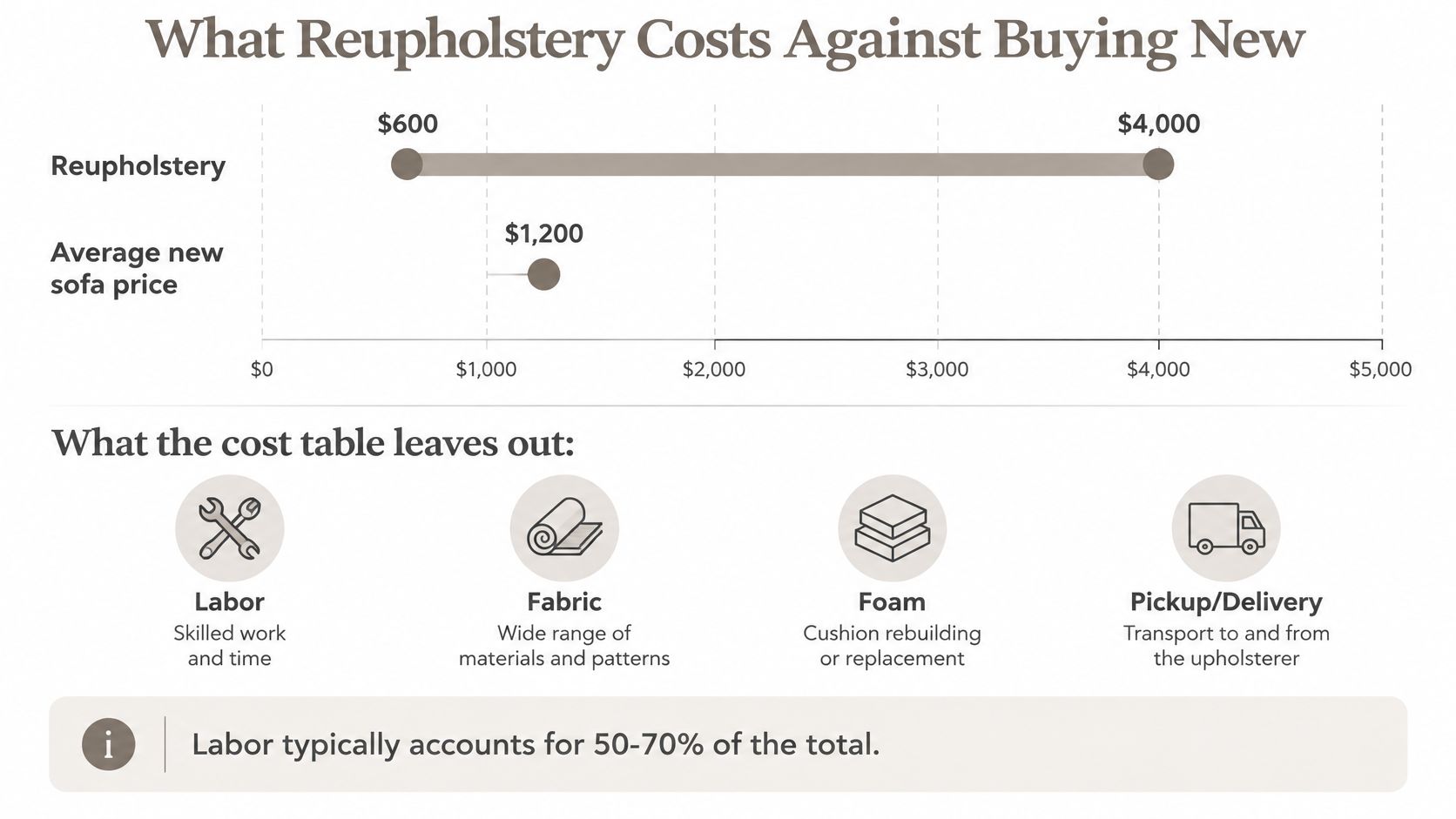
Better Homes & Gardens reports that labor alone for sofa reupholstery can begin at about $1,300, while new sofas can be found from roughly $500 at the low end, according to its comparison of reupholstery and replacement. The same report notes that vintage or antique furniture may cost more to reupholster than to replace with a basic store-bought item, but its craftsmanship and durability can be significantly better, and established furniture is often easier to repair than newer pieces. Angi's guidance on reupholstery versus replacement puts professional sofa repair or reupholstery commonly at approximately $600 to $4,000, and notes that durability depends on how the furniture was originally made, the materials used and subsequent maintenance rather than on whether it's new.
What the table leaves out matters. Add fabric yardage and pattern repeat, pickup and delivery, and any removal or disposal charge on the replacement side. A cheap new sofa and a cheap reupholstery quote are not comparable purchases, because the frame, foam and textile underneath them differ.
Then run a three-part test. Total the reupholstery quote including your chosen fabric. Total the replacement including delivery and disposal of the old sofa. Divide each by the years of service you realistically expect, using the frame and cushion findings to set that number rather than the invoice date. Use the repair scope you established during the frame inspection to decide which quote to request in the first place, and the cost breakdown for reupholstery work shows which line items drive the total.
A reupholstery bill that lands close to the price of a new sofa isn't a tie. One number buys a proven frame; the other buys an unknown one.
When Keeping the Sofa Is the Greener Choice
Replacement feels like the greener option because it's clean and new. It usually isn't. A new sofa means new foam, new fabric, new packaging, new freight and an old frame going to the curb, and none of that appears on the price tag.
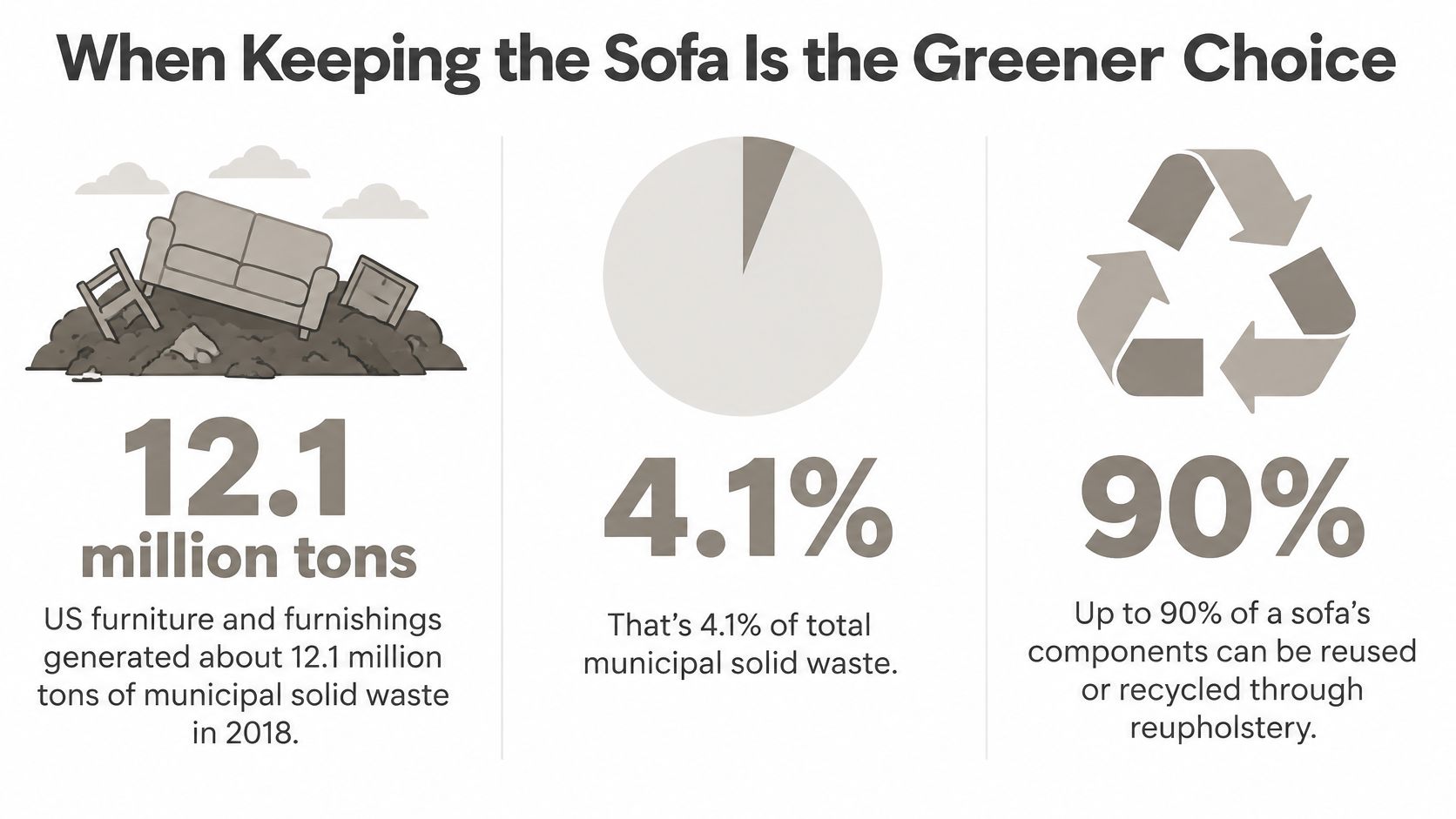
The scale is bigger than most households realise. The U.S. Environmental Protection Agency estimated that furniture and furnishings generated approximately 12.1 million tons of municipal solid waste in 2018, representing 4.1% of the total and more than five times the 1960 figure, with about 80.1% of it landfilled, according to the EPA's durable goods product data. Roughly 40,000 tons were recycled.
Keeping a usable piece in service avoids adding a bulky, hard-to-recycle item to that stream. A 2022 peer-reviewed study in the Journal of Industrial Ecology compared new furniture production with value-retention processes such as reuse, repair and refurbishment. In one chair case study, repair cut production waste by 76%, reduced embodied energy by 51%, and lowered process energy and process emissions by 91% each, as reported in the Journal of Industrial Ecology study. The study looked at wood-based chairs rather than sofas, but the logic carries across, because reupholstery preserves the same frame a replacement would have to recreate from raw material.
The lifecycle arithmetic explains why. Research on 25 furniture products found that pre-production accounts for an average of 76% of total environmental impact, with heavier pieces generally creating more, per this lifecycle assessment of furniture. The frame is the heaviest thing in the room, and it's the part reupholstery keeps.
The benefit narrows under specific conditions. Extensive structural rebuilding, a large volume of new foam, long-distance shipping of replacement textile and extra transport legs all add burden. A full rebuild of a failing frame can erase the advantage, which is why the condition test comes first and the environmental argument second.
The test: worn fabric on a sound frame is the strongest case for keeping a piece. A full rebuild weakens it. A frame that fails the joint check makes buying new the defensible choice, because a sofa that won't last isn't sustainable however many times it's recovered.
If sustainability is part of your reasoning, look at how makers handle it too. This look at Lee Industries and sustainable furniture shows what to ask a manufacturer about construction and materials.
Fabric Ratings and Fire Compliance to Check First
Two specifications decide whether the finished sofa performs and whether it's legal to sell in your market. Neither one appears on a mood board.
Match the abrasion number to the room
The Association for Contract Textiles identifies approximately 15,000 Wyzenbeek double rubs or 20,000 Martindale cycles as a benchmark for general-use upholstery, and approximately 30,000 double rubs or 40,000 Martindale cycles for high-traffic public spaces, per its performance guidelines for abrasion. The same guidance states that results above 100,000 double rubs may not provide meaningful additional value, and that abrasion resistance alone doesn't guarantee a longer service life.
That matters in a house with dogs, children and a sofa near west-facing windows. Fiber content, weave structure, finish and cleaning method all affect how a textile ages. A tight performance weave in a busy family room will usually outlast a looser, prettier cloth at twice the rub count. For a formal living room in Buckhead or a quieter sitting room in Roswell, a Belgian linen or a velvet is a reasonable choice precisely because the piece sees lighter traffic.
Fire compliance is a documentation question
Here's the part most buying guides skip. Replacing old foam, batting, decking and fabric can change a sofa's fire-safety position, and the rules differ by market.
In the United States, upholstered furniture manufactured, imported or reupholstered on or after June 25, 2021 must comply with the test method specified in California TB 117-2013 under federal regulation 16 C.F.R. part 1640, and testing covers the cover fabric, barrier materials, resilient filling and decking, according to the Consumer Product Safety Commission's business guidance. UK guidance similarly states that filling and cover materials used in reupholstery must meet applicable fire-resistance requirements.
Before any work is approved, settle three questions.
- Who owns compliance: Ask which party is responsible for component compliance on your job, and get the answer in writing.
- What's documented: Request documentation for the replacement foam and the cover fabric, not just a verbal assurance that both are "standard".
- Where the piece will live: Confirm whether the setting is residential, rental, commercial, hospitality or imported furniture, because documentation expectations change with each.
Documentation is cheap at the quoting stage and very expensive afterwards. Ask before the cover comes off, not after.
Custom Reupholstery Versus Made-to-Order and Mass-Produced
Three routes, judged on the same criteria, produce three different answers. The mistake is comparing a made-to-order quote against a mass-market price and concluding that custom work is overpriced.
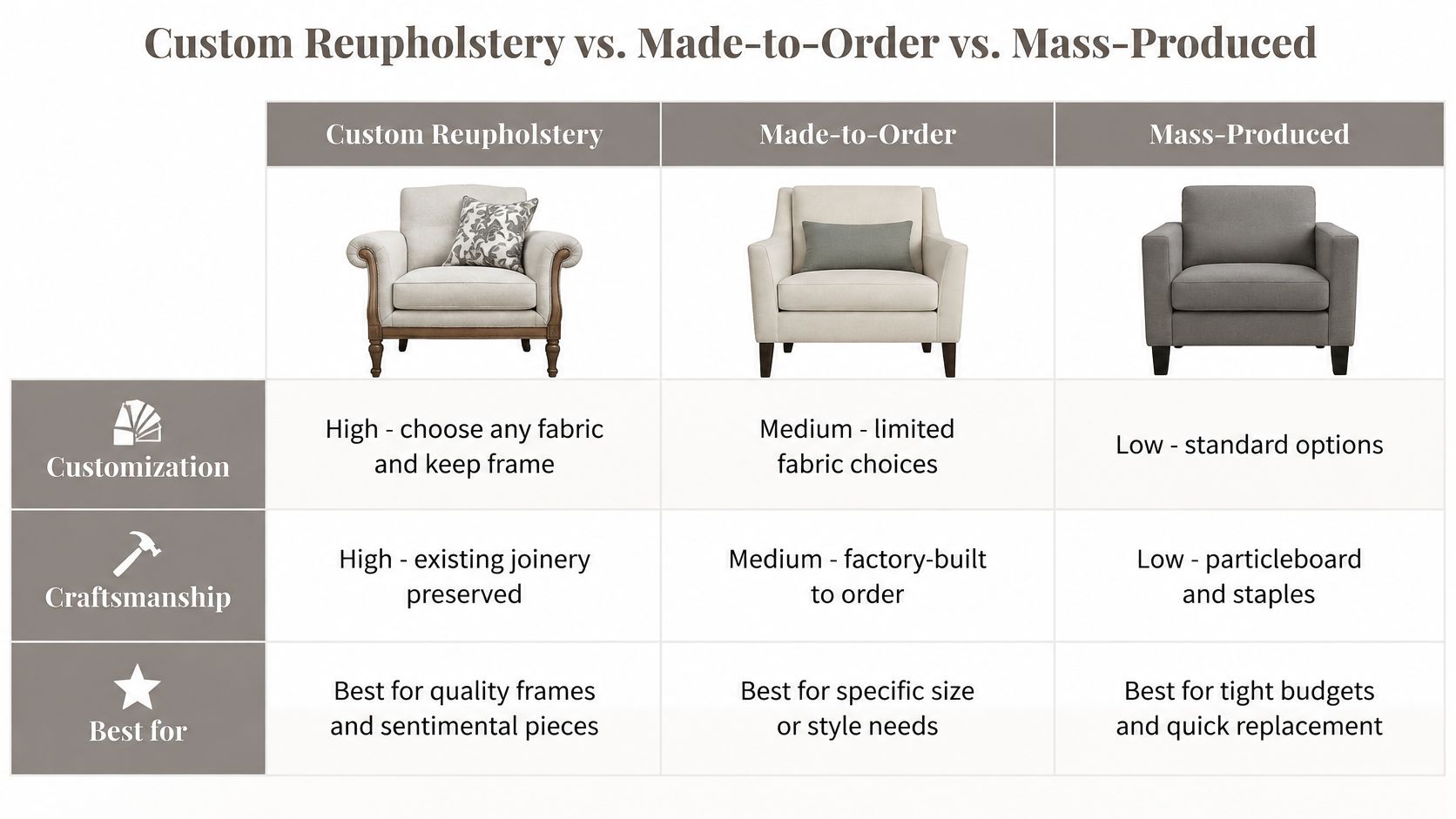
| Route | Customization | Craftsmanship | Best for |
|---|---|---|---|
| Custom reupholstery of your own frame | Fabric, cushion fill, stitching, buttons, tufting | Keeps existing joinery and proportions | Heirloom or favorite sofa with a sound frame |
| Made-to-order new sofa | Frame, fabric and details chosen before production | Depends on the maker, so check the frame and joinery | Unique silhouette or a new room |
| Mass-produced sofa | Limited fabric choice | Frame quality varies by line | Short-term or budget need |
Reupholstery wins on continuity. You keep proportions you already know work in the room, and you change everything you touch daily: the cover, the seat fill, the welting, the buttons, the crown of the cushions. A tight seat and a tufted back can become a cleaner, looser silhouette without touching the frame. Sentimental value and craftsmanship sit on the same side of the ledger here.
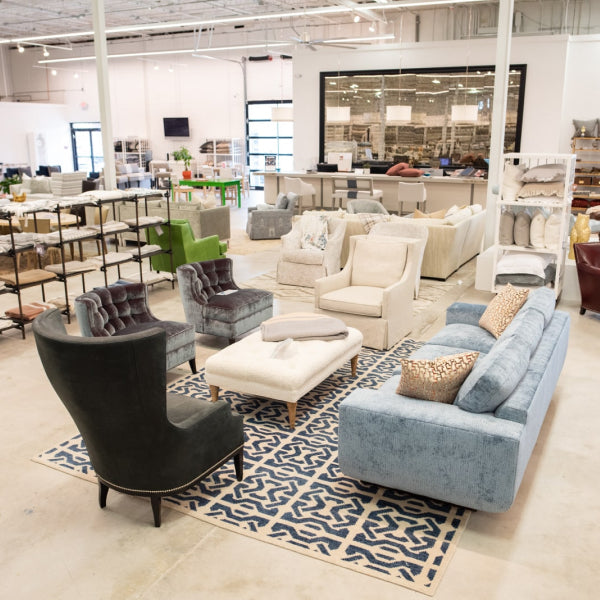
Made-to-order wins on fit and configuration. When the dimensions have to change, or a room needs a sectional that no existing piece can become, ordering new is the only route that solves the actual problem. Custom upholstered furniture made with American-made materials can be specified from the frame outward and customized to the piece, and the makers in this category are worth asking hard questions about joinery, suspension and foam density before you compare finishes. At our design center, custom furniture is developed with the in-house design team so the frame, fabric and detailing match the customer's own style, and the American-made upholstery lines we carry include Verellen, Wesley Hall, LEE Industries and Ambella.
Mass production wins on speed and entry price. It also gives up the most. Frame quality varies by line within the same brand, fabric choices are limited to what the line offers, and repair is often impractical because the frame was never designed to be opened. That's fine for a short-term need and poor value for a room you plan to keep for fifteen years.
Designer quality comes from the frame, the joinery, the suspension and the cushion build, not from the label sewn onto the deck. Ask any maker, existing or new, to show those four things before you discuss a single textile.
Your Next Move
Use the sofa's condition to set a repair-scope threshold: fabric only, fabric and cushions, or work that reaches the frame and suspension. If the frame needs extensive structural repair as well as new cushions and upholstery, compare that full scope with the cost of a replacement before deciding.
Get a written reupholstery quote and a replacement figure that includes delivery and removal. Compare each with the years of service the sofa is likely to provide, then check the replacement's fabric and foam documentation against the checklist above.
If the frame and dimensions still suit the room, choose fabric for its traffic and cleaning needs, not just its rub rating. If they do not, buy a replacement that meets the build standard you want.
To have the piece assessed before choosing, visit the Design Studio at Lewis and Sheron Textiles in Atlanta and speak with a Design Studio Associate. They can review its condition and discuss material and design options before production begins. Once the furniture is ready, you can pick it up or choose white-glove delivery.
Lewis and Sheron Textiles has served Atlanta since 1944, offering reupholstery for sofas, sectionals, accent chairs and other furniture. A Design Studio visit gives you a concrete first step: bring the piece into the conversation and discuss its condition, the work it needs and suitable materials before ordering a replacement.