


























Why build a wall to solve a problem that changes throughout the day? Open layouts look beautiful until you need a private office, a tucked-away dressing area, or a bedroom that feels separate from the rest of the house. Curtain dividers offer adjustable boundaries, without committing every activity to a permanently enclosed room.
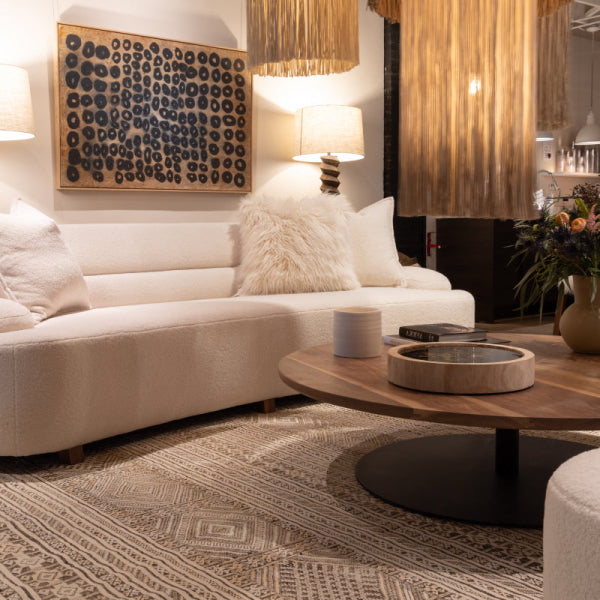
The distinction matters when you're investing in luxury sofas, custom chairs, and other substantial furnishings. A divider should complement those pieces, preserve useful circulation, and look finished from both sides. Fabric alone won't deliver that result. The track, lining, heading, and space reserved for the open panels matter just as much.
Start with the limitation: Curtains can screen views and soften reflected sound, but they aren't substitutes for sealed walls when confidential conversation or serious noise isolation is essential.
For an opening that needs a rigid closure instead, compare the clearance and hardware considerations in these barn door tips from Miller Waldrop. Fabric makes more sense when you want a boundary that can disappear into folds rather than remain a visible door panel.
The best curtain room divider ideas begin with a specific job. In a Buckhead living room, that might mean hiding a dining table after dinner. In an Alpharetta great room, it might mean keeping daylight while screening a desk. Choose the job first, then give the fabric the same attention you'd give any architectural finish.
1. Layered Ceiling-Track Linen Drapery Divider
Best for changing privacy without giving up daylight, layered linen drapery suits open rooms that serve different purposes throughout the day. Put an opaque linen panel and a coordinating sheer on independently operated tracks, so you can choose between an open room, a filtered boundary, and stronger visual separation.
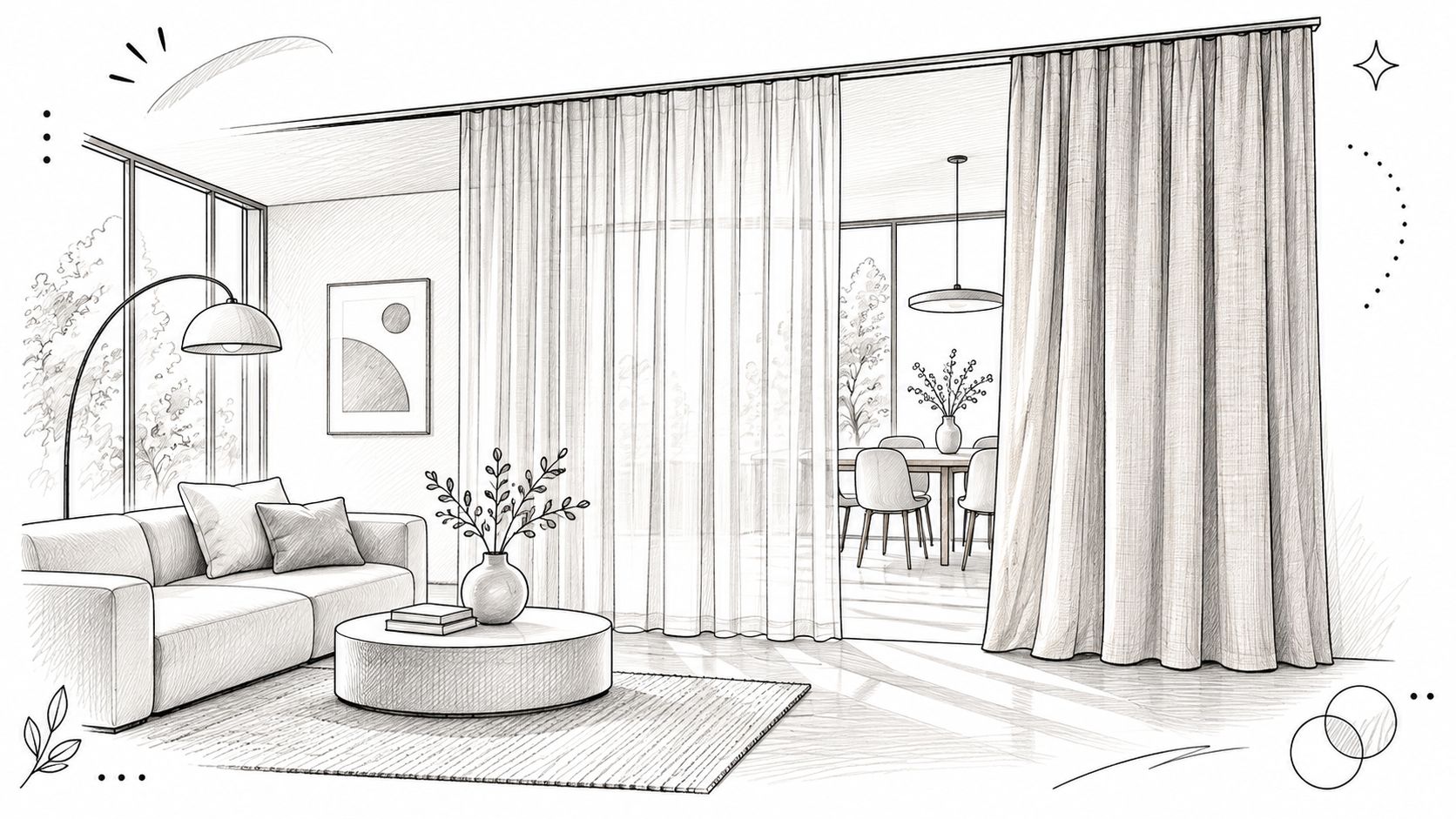
Say a Buckhead living room opens directly into the dining area. Warm ivory linen can provide a backdrop behind the sofa when closed, while a matching sheer screens the dining furniture more lightly during the day. In a Roswell family home, the same arrangement could conceal a workstation without making the great room feel permanently subdivided.
Specify the Track Before the Fabric
A ceiling track keeps the hardware visually quiet, but its attachment needs to suit the ceiling construction. Use this custom curtain track guide to understand the system before finalizing the panels.
- Plan the stacking space. Reserve somewhere for both layers to gather without covering a doorway or crowding a chair.
- Calculate finished fullness. Have the workroom calculate fabric from the heading, usable fabric width, seams, and desired folds, rather than adding an arbitrary allowance.
- Check the complete load. Include the face fabric, lining, headings, and hardware when confirming track capacity.
Keep the layers close in color if you want the divider to recede beside statement furniture pieces. Contrasting colors make the partition more prominent, which can compete with a patterned rug or richly upholstered sofa.
Floor length needs careful measurement, especially across uneven floors. For a polished finish, avoid curtains that hang too short, but don't let a frequently operated divider drag through the walking path.
2. Curved Track Divider for Sculpted Open Plans
A straight divider can make an otherwise comfortable room feel abruptly sliced in half. A curved track works better when the boundary needs to wrap around an activity, such as reading, dressing, or sitting, rather than follow an existing doorway.
Consider a Sandy Springs condominium with a primary-bedroom sitting area. A curved curtain behind a pair of custom chairs can make that corner feel enclosed while preserving the route between the bed and balcony. Drawn back, the fabric becomes a soft vertical accent rather than an obvious room partition.

This approach has architectural precedent. ArchDaily documents Mies van der Rohe and Lilly Reich's use of silk and velvet curtains in the 1927 Café Samt & Seide installation, where textiles defined areas without fixed walls. The useful principle is flexibility, not copying an exhibition interior.
Draw the Curve at Floor Level
Mark the proposed curtain line with painter's tape before ordering. Walk around it, pull out nearby dining chairs, and check whether the open panels would crowd the room.
Washed linen and supple silk-blend weaves are good candidates when the folds need to follow a curve. Test a generous sample by hanging it, because a stiff textile may project outward instead of settling into the intended shape.
A curved divider should make movement easier, not create an elegant obstacle.
In a custom Atlanta renovation, repeat the sweep of an archway or curved sofa rather than introducing an unrelated shape. Keep the fabric away from cooking surfaces, and don't wrap a kitchen island so tightly that the divider interferes with working clearance or ventilation.
3. Motorized Sheer Divider for Smart Luxury Homes
Motorization earns its place when operating the divider manually would be awkward. A tall room, a long track, or furniture that limits access can justify it. If the panel is easy to reach and rarely moves, a smooth manual system may be the more sensible investment.
In an Alpharetta residence, motorized sheers could separate a sunroom from a dining room while allowing daylight to reach the interior. In a Buckhead estate, they could mark the edge of a media area, but they won't darken the screen or keep movie sound out of the adjoining lounge.
Choose the fabric with those limits in mind. This guide to linen sheer curtains is a useful starting point for comparing the soft, light-filtering effect with the greater coverage of opaque drapery.
Make Operation Part of the Specification
- Match the motor to the assembly. Confirm the capacity for the finished fabric and any anticipated lining, not just the unsewn yardage.
- Resolve power early. Identify outlets, wiring routes, and motor access before closing walls or ceilings.
- Confirm control compatibility. Specify the actual remote, wall control, or smart-home integration rather than assuming every system accepts voice commands.
- Test the fabric's body. A sheer needs enough structure to hang cleanly, especially near supply vents.
Accessibility matters as much as convenience. NICETOWN's room-divider guidance highlights the importance of easy operation, clear exits, ventilation, and keeping alarms and controls unobstructed.
Don't place the only control behind the closed curtain or beyond someone's comfortable reach. Where supported by the selected hardware, a manual operating option is useful if power or connectivity becomes unavailable. The luxury is dependable daily use, not another app.
4. Velvet Blackout Divider for Bedrooms and Media Rooms
For a sleeping area or theater niche, lined velvet offers stronger visual enclosure and light control than an open-weave linen. Its depth also makes the divider a decorative feature, particularly in olive, aubergine, navy, or warm charcoal.

A Buckhead townhome could use velvet between a primary bedroom and dressing room, with the color repeated in a chair or rug. In a Sandy Springs home, the same treatment could enclose a theater niche. Similar planning applies to basement entertainment spaces, where light leakage and equipment placement deserve attention before the fabric is selected.
Separate Blackout From Soundproofing
Specify a lining designed for blackout performance. Velvet's appearance doesn't establish how much light the finished assembly will exclude, and gaps at the ceiling, sides, and meeting edges can still admit light.
Sound requires equally careful expectations. Small Space Logic's acoustic discussion reports absorption below NRC 0.20 for single fabrics and approximately NRC 0.60 for a tested triple-layer woven construction backed with nonwoven polyester; those figures describe sound absorption, not guaranteed speech privacy.
Acoustic reality: A curtain can make a hard-surface room less echoey without making the space behind it confidential.
Use structured pinch pleats to organize substantial velvet, and confirm the track can carry the finished weight. Consider lining or a coordinated reverse fabric when both sides remain visible.
The trade-off is bulk. Velvet needs meaningful stacking space, and a closed blackout divider may leave the inner zone dependent on artificial lighting. Plan lamps and controls so the room remains usable after the curtain closes.
5. Freestanding Upholstered Panel Screen with Drapery Insert
Not every divider should attach to the building. An upholstered screen works like movable furniture, making it a strong choice for a room you expect to rearrange or a space where ceiling installation isn't appropriate.
For a Roswell loft, consider an upholstered frame with a removable linen insert between the bed and sitting area. In a Buckhead apartment, a fabric-wrapped screen could conceal a study desk from the living room without committing to a permanent track.
The screen should relate to the furniture without looking like a matching suite. Repeat a color from a luxury sofa, or use a smaller-scale weave beside patterned custom chairs. Finish the reverse carefully, since a freestanding piece rarely has a hidden back.
Prioritize Stability Before Upholstery
Have an upholsterer assess the frame, hinges, feet, and intended folding position before covering it. A beautiful fabric won't correct a narrow base or a frame that twists when moved.
- Choose for handling. Put a durable weave on edges people will touch, rather than delicate embroidery or loose decorative yarns.
- Design for replacement. A removable insert lets you refresh the soft panel without rebuilding the entire screen.
- Protect circulation. Account for the feet and angled panels, not just the screen's apparent width.
For woven upholstery, Association for Contract Textiles guidance identifies 15,000 Wyzenbeek double rubs for low-traffic applications and 30,000 for high-traffic applications. Use that as a fabric-selection reference, not a stability rating or a promise of longevity.
This option offers partial visual screening rather than complete enclosure. It's best when you need to hide a desk, dressing corner, or view of a bed, not create a private room. Its furniture-like character also makes it especially compatible with collected designer furniture.
6. Performance Fabric Divider for Family and Entertaining Spaces
A performance divider should be selected for its documented care and handling characteristics, not merely because the sample carries a performance label. Sticky hands and frequent entertaining change the fabric decision.
In a Dunwoody-area family home, a divider between the kitchen and family room might be touched every day. In a Buckhead dining room, the larger concern may be occasional splashes and guests brushing against the panels. Those uses call for different levels of maintenance tolerance.
Crypton-treated weaves are candidates worth evaluating, but confirm the particular textile's drapery suitability, backing, cleaning instructions, and finished weight. A fabric that works beautifully on premium sectionals may be too stiff to form attractive curtain folds.
Choose the Maintenance Routine You'll Actually Follow
- Read the cleaning instructions. Establish whether the finished panel requires professional cleaning, spot treatment, or another specified method.
- Inspect the surface. Texture can disguise minor marks, but loose loops may be vulnerable to claws or jewelry.
- Check the lining too. The face fabric and lining need compatible care requirements.
- Keep the hem practical. Avoid puddling where pets, food, or daily traffic will soil the fabric.
Durability isn't a single laboratory result. Your Colors' explanation of upholstery testing cautions that abrasion ratings don't establish a fixed service life, since use, environment, and construction affect performance.
That distinction also helps when evaluating high-quality couches and other high-end furniture. For the divider, pay attention to reinforced leading edges, sound stitching, replaceable carriers, and a track people can operate without tugging the cloth.
Coordinate the curtain with a rug whose care suits the household. A hand-knotted rug and a washable rug offer different maintenance paths, so choose deliberately rather than treating either label as a guarantee against family wear.
7. Wall-Mounted Pinch-Pleat Divider on Iron or Bronze Rod
A decorative rod is the right choice when you want the divider's hardware to remain visible. Iron, bronze, and antiqued finishes can frame an opening like architectural trim, particularly in traditional and transitional interiors.
For a historic Atlanta home, consider lined pinch-pleat panels between the formal living room and library. An Ansley Park sitting-room doorway could use bronze finials that relate to nearby lighting without requiring every metal finish to match exactly.
Unlike a ceiling track, a wall-mounted rod emphasizes the opening itself. That's an advantage when the doorway has good proportions, but less helpful if you're trying to make an irregular ceiling or awkward opening disappear.
Give the Panels Somewhere to Go
Extend the rod far enough beyond the opening to accommodate the actual stacked fabric. The right extension depends on panel bulk, heading, and how much clear opening you need, not a universal measurement.
Compare curtain pleat styles before specifying the hardware. Pinch pleats give a neat rhythm, while the carrier or ring arrangement determines how smoothly those pleats travel.
- Locate structural support. Anchor brackets into suitable framing or an appropriate fastening system.
- Check bracket interference. Confirm that support brackets won't prevent the curtain from moving across the required span.
- Review both faces. Select lining and seams that look intentional from the adjoining room.
This option pairs naturally with heirloom-quality furniture, but the finish alone doesn't establish craftsmanship. Inspect the bracket strength, ring movement, pleat consistency, and stitching with the same care you'd apply to custom upholstered furniture.
A substantial rod can look reassuringly permanent. It can also become visually busy beside ornate cornices or heavily patterned walls. In that setting, simplify the finials and let the fabric provide the richness.
8. Gallery-Style Tiered Linen Drapery Divider
Choose tiered drapery when the divider should function as textile art as well as a boundary. Overlapping linens, sheers, and contrast bands can make the closed composition interesting without relying on a large printed pattern.
For a Roswell estate, a dining-room divider might combine warm flax linen with a translucent panel and a narrow dark border. In a Buckhead condominium, custom banding could frame a bedroom alcove and repeat the edge detail of an upholstered headboard.
This isn't the best approach for someone who wants the divider to disappear completely. Layering adds visual complexity, hardware, and fabric bulk, so the surrounding room needs enough restraint to support it.
Edit the Palette Before Adding Trim
Keep the fabrics within a related color family, then vary transparency and texture. If every layer has a different color, pattern, and trim, the result can look accidental rather than collected.
Lay samples beside the sofa upholstery, rug, and wood finishes. Then hang them vertically and overlap them, because a flat sample arrangement won't reveal how backlighting changes their appearance.
Let one fabric lead. Supporting layers should add depth, not compete for equal attention.
Specify whether the layers move independently or travel together. Independent tracks allow more arrangements, while a simpler combined treatment may be easier to operate and maintain.
If acoustic comfort matters, evaluate the construction rather than assuming extra layers provide isolation. Burton Acoustix's curtain-performance discussion distinguishes absorption from sound transmission and emphasizes the limitations of gaps around a curtain assembly.
Place decorative trims where they won't snag on adjacent panels or carriers. A restrained border that echoes a cushion or chair detail often contributes more to a refined interior than an elaborate treatment with no connection to the furniture.
How the eight curtain room divider ideas compare
Each divider solves a different room problem. Use this table to compare privacy, installation, and upkeep before matching an option to your layout.
| Item | Best For | Privacy Level | Installation | Upkeep |
|---|---|---|---|---|
| Layered Ceiling-Track Linen Drapery Divider | Flexible zoning with natural light | Adjustable, from sheer to private | Ceiling track; professional installation recommended | Regular vacuuming; periodic dry cleaning |
| Curved Track Divider for Sculpted Open Plans | Softly defining rounded spaces and nooks | Moderate; depends on fabric | Custom curved ceiling track; careful fitting | Routine fabric care |
| Motorized Sheer Divider for Smart Luxury Homes | Tall rooms and smart-home convenience | Low; sheers offer limited privacy | Ceiling-mounted motorized track; plan for power access | Occasional motor maintenance |
| Velvet Blackout Divider for Bedrooms and Media Rooms | Bedrooms, dressing areas, and media rooms | High; blocks light and softens sound | Strong hardware and a sturdy track | Dusting; professional cleaning |
| Freestanding Upholstered Panel Screen with Drapery Insert | Flexible, movable room separation | Moderate; less control than mounted drapery | Freestanding; no ceiling or wall installation | Reupholster as needed; check frame stability |
| Performance Fabric Divider for Family and Entertaining Spaces | Busy homes with children, pets, or entertaining | Adjustable; depends on lining and fabric | Ceiling-mounted or wall-mounted drapery hardware, chosen to suit the room layout | Follow fabric cleaning instructions |
| Wall-Mounted Pinch-Pleat Divider on Iron or Bronze Rod | Traditional rooms, doorways, and alcoves | Adjustable; depends on fabric | Wall-mounted rod with sturdy anchors | Professional cleaning and pleat care |
| Gallery-Style Tiered Linen Drapery Divider | Custom, textile-focused interiors | Adjustable; depends on fabric layers | Skilled sewing and careful layering | Routine fabric care; follow textile instructions |
Choosing the Right Divider for Your Space
Start with the problem you need the divider to solve: privacy, light, sound, or durability. If the room needs visual screening while retaining daylight, begin with layered linen or sheers. If darkness matters, prioritize blackout lining and edge coverage rather than relying on a dark face fabric.
Match the hardware to the layout next. A ceiling track suits a great room with a long uninterrupted boundary, a curved track can shape a sitting area, and a freestanding screen suits a room you may reconfigure. For confidential work calls or incompatible sleeping schedules, consider whether you need a properly enclosed room instead.
Evaluate the Divider Alongside the Furniture
Buyers searching for luxury furniture in Atlanta often begin with the best luxury sofa brands or the difference between custom and mass-produced furniture. Apply the same decision-making to drapery: look beyond the surface and examine construction, fit, operation, and repairability. Designer quality should be visible in the details you'll use, not just in a showroom photograph.
Furniture specifications deserve their own scrutiny. Woodstock Furniture & Mattress Outlet's foam-density guide identifies 1.8 pounds per cubic foot as a common home-furniture standard and 2.0 pounds per cubic foot or higher as high-density foam, while distinguishing density from firmness. A beautiful divider won't compensate for seating that doesn't meet your comfort and durability needs.
Whether you're furnishing in Buckhead, Alpharetta, Roswell, Sandy Springs, or elsewhere in Fulton County and North Atlanta, avoid buying each element in isolation. Bring together upholstery, drapery, rug, and finish samples before committing. That coordinated approach is more useful than choosing separate statement pieces and hoping they work together.
Confirm Fit Before Ordering
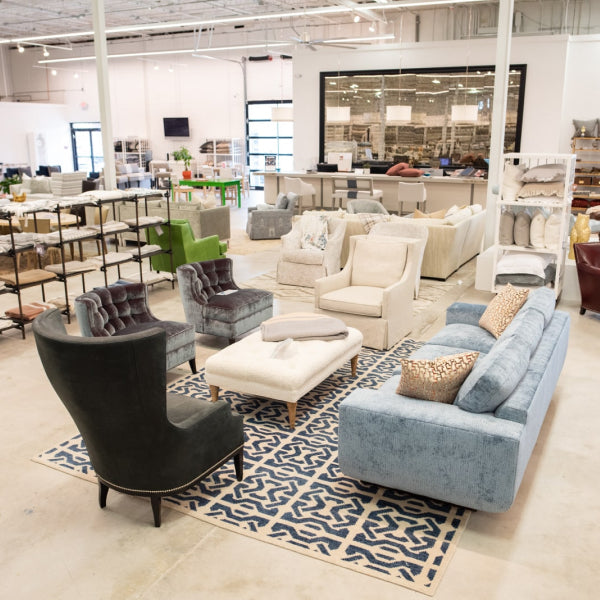
Bring fabric candidates and room photographs to our Design Center, where you can compare real samples, then review them in your home's light. Our in-house designers offer complimentary help when you shop; use that consultation to review fabric weight, pleat style, and the proposed hardware load requirements.
Our process begins with Design Studio Associates discussing your ideal drapes, and professionals can measure your home or office. Custom drapes are produced over four to six weeks, with home installation available as an optional full-service step.
Before approving the order, settle the open and closed positions, reverse-side appearance, cleaning method, and access to switches and vents. Those decisions turn an attractive fabric partition into a useful part of the home, and help protect the long-term value of the surrounding luxury home furnishings.
Lewis and Sheron Textiles offers home fabrics, custom drapery, custom upholstered furniture, and design support for a coordinated interior. Visit Lewis and Sheron Textiles with room photographs, measurements, and upholstery samples to explore a curtain divider that fits your layout and the way you live.