

















The most popular advice about linen sheer curtains is also the most misleading. You're told to pick a thicker sheer if you want privacy, or a lighter one if you want more daylight, as if one fabric can solve both. It can't. A sheer does one job well, diffusing daylight and softening a view. Privacy after dark, darkness for sleep, and heat control are separate jobs, and each one needs its own layer.
That distinction matters more in a considered home than the color does. In Buckhead or Alpharetta, where a living room may pair luxury sofas and heirloom-quality furniture with tall south-facing glass, the wrong single layer leaves glare on upholstery by day and a lit silhouette visible from the street at night. I would specify the system first, then the fabric. Once you know what each layer must do, weave, weight, and color become measurable choices instead of guesses.
Where Linen Sheers Work and What Each Layer Does
| Layer setup | Daytime privacy | Night privacy | Solar and glare control | Best rooms |
|---|---|---|---|---|
| Linen sheer alone | Partial, weave dependent | Low, visible from outside after dark | Low | Living rooms with distant neighbors |
| Linen sheer over privacy liner | Good | Moderate | Moderate | Living and dining rooms |
| Linen sheer over roller blackout | Good | High | High | Bedrooms and media rooms |
| Sill-length linen sheer alone | Partial | Low | Low | Kitchens, bathrooms and small windows |
Start with the simplest setup. A linen sheer alone works in a living room where neighbors are far off, planting screens the glass, or the room isn't used much after dark. By day it blurs shapes and takes the edge off brightness. At night, lamps reverse the effect and anyone outside can see movement and furniture outlines.
Stepping Up by Room
A sheer over a privacy liner suits living and dining rooms in Sandy Springs or Roswell where houses sit closer together. The liner adds daytime obscurity and moderate night privacy without turning the room dark. You keep the soft linen texture facing the room, while the liner does the quiet work behind it.
For bedrooms and media rooms, choose a sheer over a roller blackout. The sheer handles daylight hours. The blackout, lowered at night, gives real privacy, darkness, and the strongest glare control in the table. A sill-length sheer alone is the right limit for kitchens, bathrooms, and small windows where you only need to soften light and a long panel would catch moisture, heat, or a counter edge.
Practical rule: If a room is occupied after sunset and can be seen from outside, don't rely on an unlined sheer for privacy.
Run three checks before you commit. Note which hours the room is used after dark, whether a street or neighbor has a direct sightline, and how much glare hits a screen or television. Pick the row that covers all three, not the row that looks lightest in a photograph.
What Makes Linen a Sheer, from Fiber to Weave
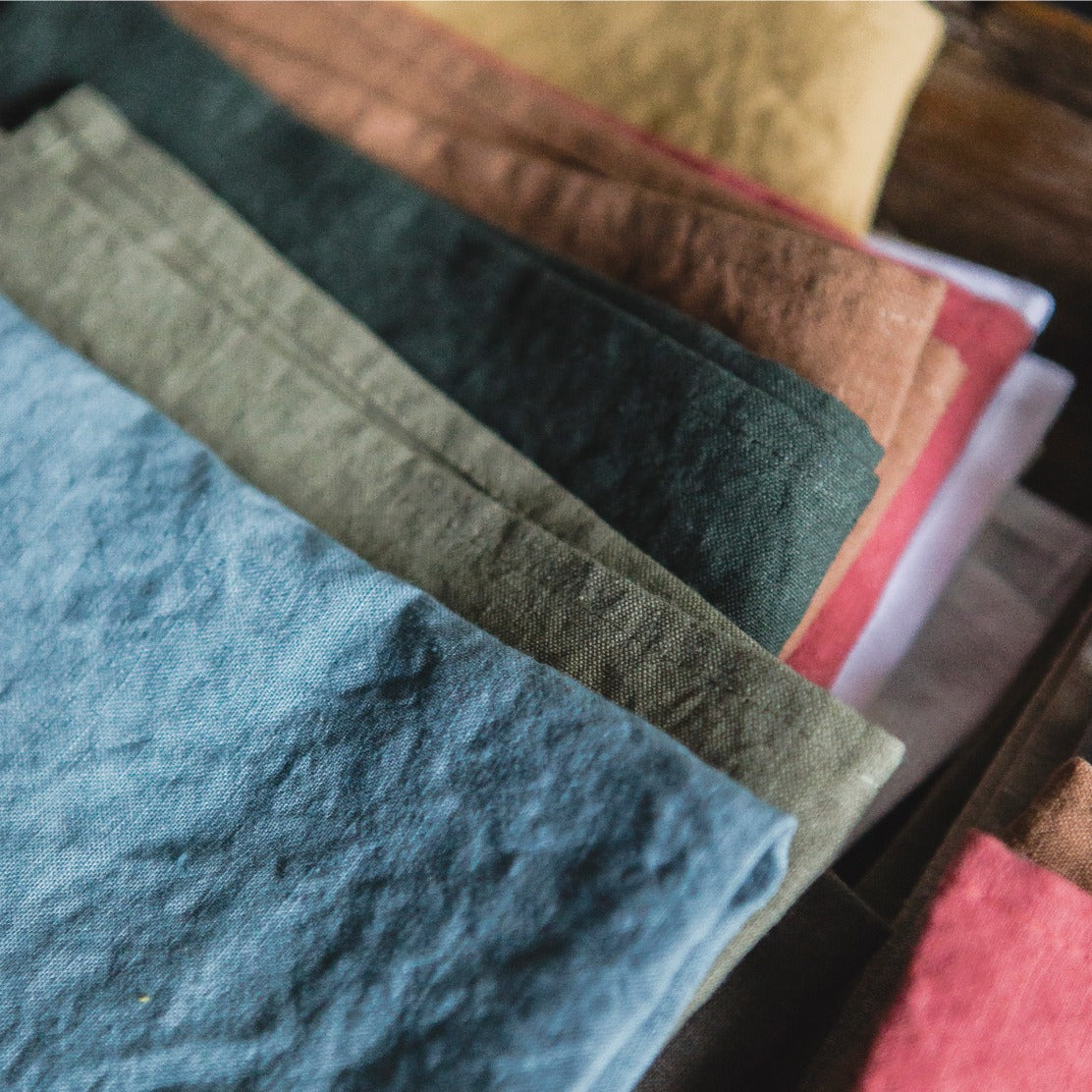
Linen is made only from flax fiber. That definition matters because many fabrics copy linen's slubbed appearance with synthetic or blended yarns that behave differently at a window. True flax yarn is naturally irregular. Held to the light, it scatters daylight the way frosted glass does, so brightness enters softly and shapes blur without disappearing.
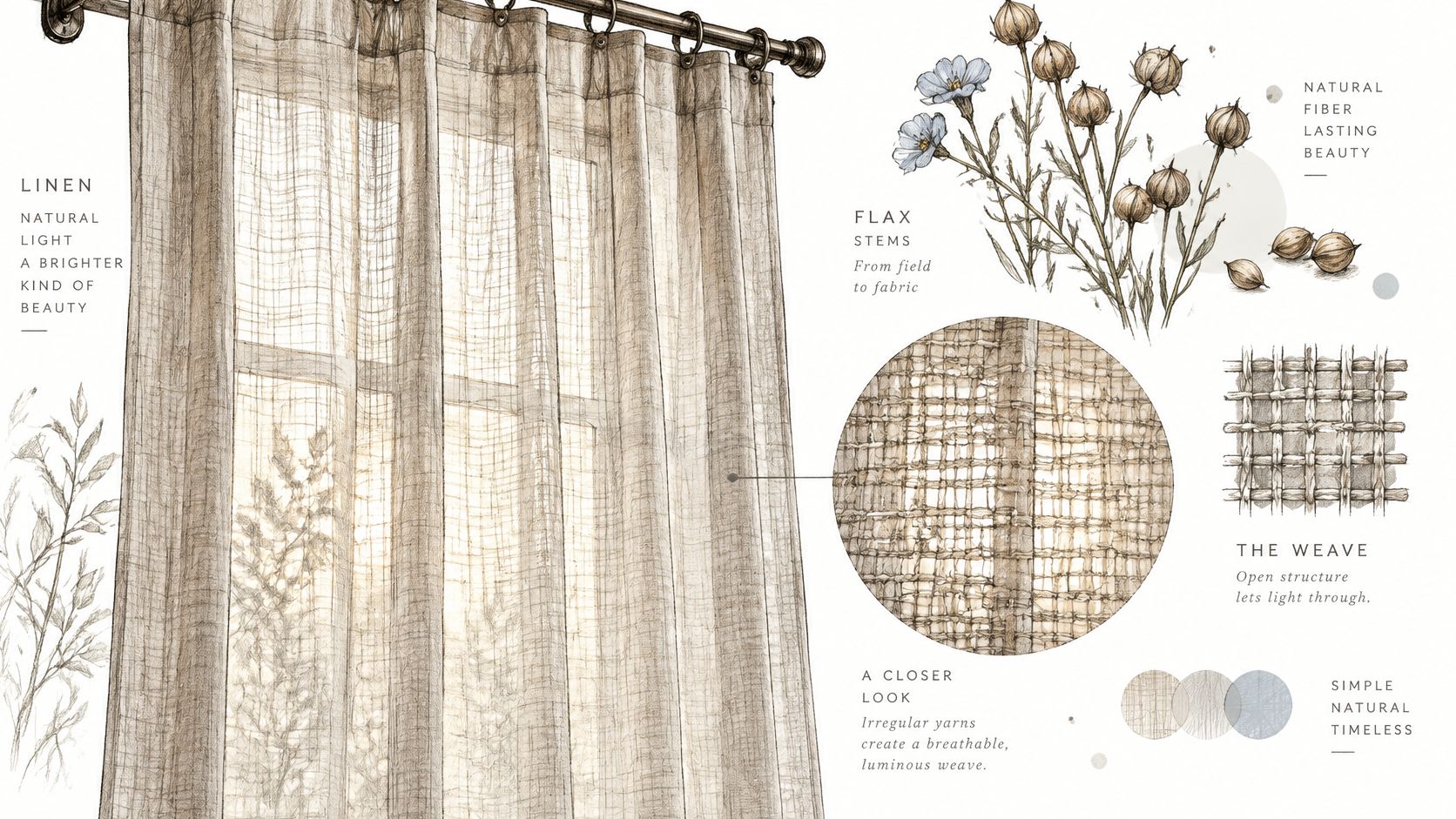
That irregular yarn, a breathable structure, and a translucent surface make a filter rather than a barrier. It's why linen suits a sheer in the first place. A flat, perfectly even imitation may look clean on a roll, but it tends to pass light with a harder, glossier quality and shows creases and dust differently.
Supply is concentrated, which explains much of the pricing and naming you'll encounter. In 2022, global production of raw or retted flax was reported at approximately 875,995 tonnes, with France accounting for about 75% of the total, according to a flax commodity overview. Premium sheers are therefore commonly traced to France, Belgium, and the Netherlands, where growing and processing are established.
A Quick Sample Check
Hold a generous piece against the actual window, not under showroom spots. Look for uneven yarn thickness, a matte surface, and diffused light rather than a shiny, uniform translucency. Then step outside if you can and look back in. If you can read furniture shapes clearly in daylight, a tighter weave or a second layer belongs in the specification, no matter how attractive the texture looks up close beside designer furniture.
Reading Sheer Fabric by Weave, Weight and Openness
The fiber label matters less than the construction behind it. Four inputs decide how linen sheer curtains perform in a room, yarn size, weave openness, finished weight, and color depth. Change any one and you change daylight, privacy, and drape at the same time.
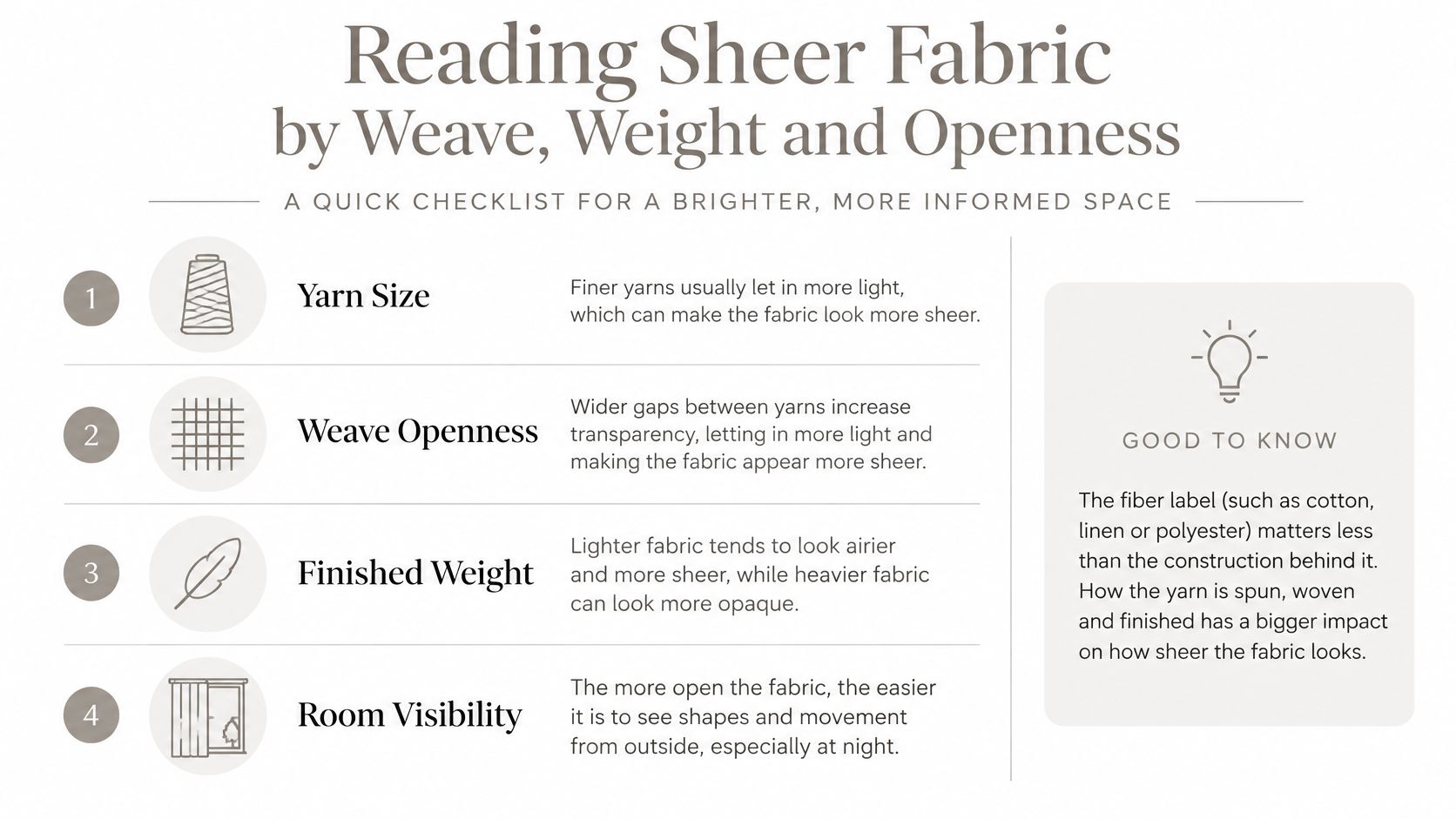
A loose, low-weight plain weave admits the most daylight, but silhouettes stay visible when indoor illumination exceeds outdoor illumination, a point set out in the CAMEO linen reference. That same openness lets more sun reach flooring, artwork, and custom upholstered furniture. A heavier, tighter weave lowers visibility and glare, but it also reduces the airy quality people buy a sheer for. There's no free gain here, only a trade you should make deliberately.
Color works similarly. A darker sheer cuts transmission and can improve daytime obscurity, yet it may dull a north-facing room and show lint more readily. Pale natural and white linens keep rooms bright beside premium sectionals and light upholstery, but they offer the least concealment after dark. Finished width then decides fullness. Too little width forces flat panels that reveal more of the room and hang without the soft folds that help scatter light.
| Specification | What it controls | What to request |
|---|---|---|
| Finished weight (grams per square meter) | Daylight diffusion and drape | Exact weight on the spec sheet, not an estimate |
| Weave openness | Visibility of silhouettes and solar transmission | Light-transmission or openness sample held to the window |
| Yarn size | Texture and how much light scatters | Yarn description from the mill or supplier |
| Fiber content | Hand, shrink risk and sun resistance | Percentage of linen and any blend fibers |
| Color depth | How much light passes through | Full-size sample viewed in the room, day and night |
| Finished width and pre-washing | Fullness and length stability | Finished width and whether the fabric is prewashed or preshrunk |
How to Test Before Ordering
- Request the numbers: Ask for finished width, weight in grams per square meter, weave description, and fiber percentages in writing.
- Use a large sample: Hold the actual fabric against the intended window with the proposed liner or shade behind it.
- Check both conditions: View it at midday and again after dark with room lamps on, from inside and outside.
A small color swatch can't predict any of this. It tells you dye, not openness at scale, not drape, and not nighttime visibility. I would not approve a full-height installation in an Atlanta living room from a swatch alone.
Layering Linen Sheers for Privacy, Glare and Heat
The best linen sheer installation is usually a two-layer treatment. That's not upselling. It's a recognition that privacy, darkness, glare, and energy control are separate requirements, and a single translucent fabric can't optimize all four. A thicker sheer is a compromise that often fails at both ends, too dark by day and still transparent at night.
The window itself explains why heat needs separate attention. The U.S. Department of Energy guidance on energy-efficient window coverings estimates that about 30% of a home's heating energy can be lost through windows, while approximately 76% of sunlight striking standard double-pane windows enters as heat during cooling seasons. Those figures describe the opening you're dressing, not the performance of an unlined sheer.
Don't borrow savings claims from other systems. Reported energy savings from curtains and other window-covering systems ranged from 41% to 62% in some studies and 24% to 38% in another, but those results apply to window-covering systems generally, not specifically to unlined linen sheers. A loosely woven sheer still allows substantial solar transmission. It moderates glare and perceived privacy, while fit, lining, openness, color, and whether the treatment is closed decide how much more it can do.
Privacy reverses at sunset. A sheer that looks opaque from inside at noon can become a lit screen from the street at 8 p.m.
The day and night reversal is the failure buyers notice first. During daylight, a tighter weave, heavier cloth, or darker color can reduce visibility while preserving brightness. After sunset, interior lights make an unlined sheer visibly transparent from outside, a pattern also noted in the Department of Energy cellular shades fact sheet, which found cellular coverings reduced heating energy by up to 20% and total heating-and-cooling energy by up to 15% compared with windows without shades. That comparison underlines the limit of one lightweight layer, especially in North Atlanta homes where bright sun and long warm seasons make solar control a daily issue.
Three Failures a Sheer Alone Causes
- Afternoon glare: West light washes out screens and puts harsh patches across artwork, rugs, and high-quality couches.
- Heat gain: South and west rooms in Fulton County warm quickly because the sheer diffuses light without stopping much solar energy.
- Night exposure: Bedrooms, bathrooms, and street-facing rooms lose dependable privacy once lamps are on.
Choosing the second layer is a lining decision before it's a style decision, and it helps to understand the role of drapery lining in custom drapes before you price panels. A privacy liner preserves a soft glow, a blackout liner or roller gives darkness, and heavier outer drapery adds insulation and a finished frame. For wide glass doors, where a sheer alone leaves large bands of glare, purpose-built sliding door shades for glare control are worth comparing as the functional layer behind or instead of a sheer.
Placement Rules That Make Layers Work
Hang the rod 4 to 6 inches above the frame so panels clear the glass and the room reads taller. Extend the rod so the sheer reaches 6 to 12 inches past each side, which reduces edge light leaks and lets panels stack off the glass. Plan fullness at about 2 to 2.5 times the window width. Less looks skimpy and reveals more, more can turn bulky on narrow windows.
Place the sheer nearest the glass, with heavier drapery or a shade as the room-side or concealed functional layer according to the hardware. Floor-length panels should just kiss the floor or hover slightly above it. Pooling suits formal drapery, but on a working sheer it collects dust and makes small length changes obvious after cleaning.
Say a Buckhead living room has tall windows, statement furniture pieces, and neighbors at a comfortable distance. Linen sheers nearest the glass under heavy linen drapery give diffused daylight for entertaining, then the outer panels close for night privacy and a more polished look. The sheer never has to pretend it's a blackout.
A bedroom needs the opposite emphasis. Put a roller blackout at the glass and a linen sheer in front of it, or pair the sheer with blackout-lined drapery. By day the roller disappears and the room stays bright. At night you get darkness and privacy that no weave density in a sheer can promise. That's the luxury outcome, each layer doing the job it's built for.
Caring for Linen Sheers Without Shrinkage or Distortion
Linen distorts from stress and heat more than from stretch. Reference data in a European linen overview reports approximately 1.8% elongation when dry and 2.2% when wet, with about 12% moisture regain. That low elasticity helps a panel hold a crisp drape, but it also means creasing is normal and moisture can change length or fullness.
Flax is stronger wet than dry, so careful laundering is reasonable when the care label allows it. Strength is not dimensional stability. Aggressive pulling, repeated high temperatures, and poorly supported wide panels concentrate force at headings and seams, where distortion shows first. Follow the maker's linen care instructions for your specific fabric before assuming a home wash is safe.
| Care task | Recommended approach | Risk if ignored |
|---|---|---|
| Washing | Gentle cycle in cool water, or hand wash, after checking the care label | Shrinkage, dye loss and distorted hems |
| Drying | Line-dry, or low heat, removed while slightly damp | Length change and heat creasing |
| Ironing | Iron on the reverse at medium heat while damp | Shine and scorching on sheer fabric |
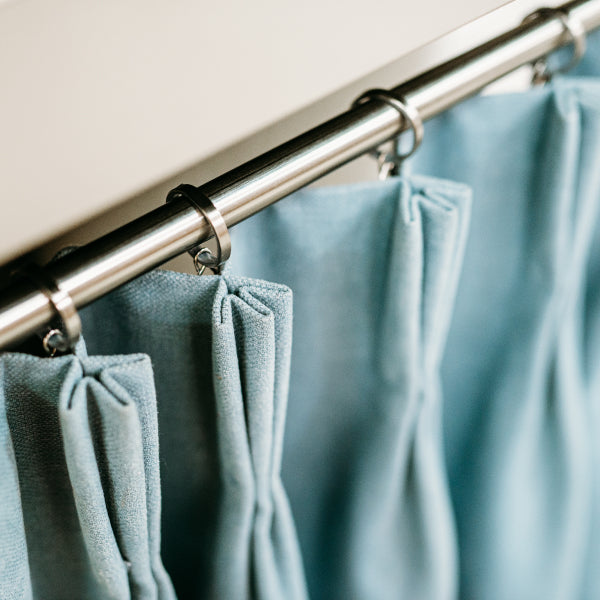
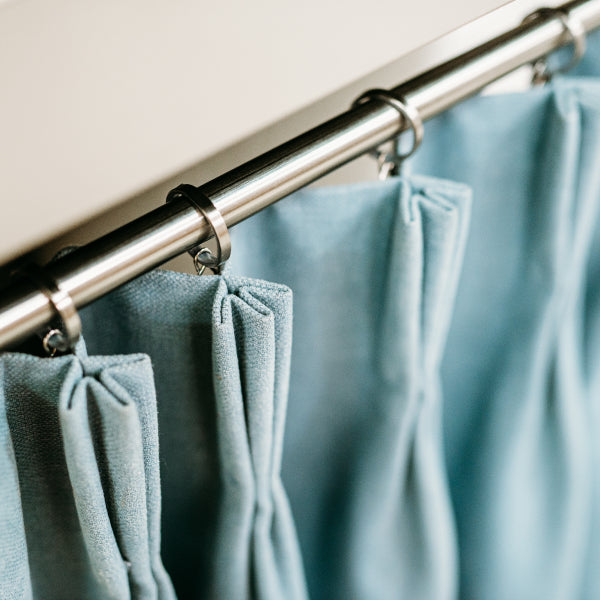
| Hanging | Rings or clips that spread weight across the heading | Stretched headings and sagging hooks |
| Sun exposure | Add a lining or a second layer on very exposed windows | Gradual fading and fiber weakening |
| Dry cleaning | Only when the label permits, with low-heat finishing | Heat and chemical stress on finished panels |
Hanging and First-Wash Checks
Use rings or clips spaced to distribute weight across a reinforced heading instead of loading a few individual hooks. Wide panels beside luxury home furnishings look calm only when the heading stays level. If one side drops, the hem reads crooked even when the fabric itself hasn't changed.
Floor-length panels need a test before final hemming. Wash a spare swatch or discreet corner using the intended method, record the length before and after, and re-measure once dry. Even a modest change alters pooling, hem clearance, and symmetry between a pair, so I would confirm the finished length after that first controlled wash rather than discovering it at installation.
Choose and Order Linen Sheers for Lasting Value
"Sustainable linen" isn't a precise buying claim. Ask for fiber composition, country and method of production, whether the fabric is prewashed or preshrunk, the care label, and documentation for any certification the seller claims. Those answers tell you more about service life than a general eco-friendly label, especially when panels will hang near high-end furniture that you expect to keep for decades.
Treat recycled linen as a trade-off, not a guarantee. Recycled content can use shorter fibers or textile waste and support circularity, but softness, strength, opacity, and stability may differ from virgin linen. Judge the actual sample for hand and openness, then decide whether the environmental benefit is worth any change in performance for that window.
Ready-Made or Custom
Ready-made panels suit standard sizes, spare rooms, and tighter budgets. The compromise is fixed width, length, heading, and fullness, which often means flat coverage or hems that miss the floor line you want. Custom panels fit the finished width, rod height, layer stack, and fullness to the actual opening, which matters in older Atlanta houses where windows in the same room aren't identical.
We offer custom panel drapery and custom drapes from classic linen to modern sheer fabrics, produced over 4 to 6 weeks, with pickup at the business location or white-glove delivery when they're complete. For custom furniture Atlanta projects that pair drapery with custom chairs or reupholstered heirlooms, that timing should be built into the room plan from the start.
Lasting value comes from fit, repairable construction, and a care routine you will actually follow, not from the fiber name alone.
Order in a sequence that prevents expensive reversals. First, get full-size samples and test them day and night. Next, measure finished window width and height from rod to floor using a consistent method for how to measure windows for curtains. Then choose the layer setup, confirm pre-washing and lining, and request a quote that itemizes fabric, lining, heading, and hardware.
Lifespan is set mostly by sun exposure and laundering stress. A lined sheer on a shaded window, washed gently and supported properly, will keep its drape and length far longer than an unlined panel baked on west glass and tumble-dried hot. Buy the construction you can maintain, and keep enough matching fabric information on file so a panel can be repaired, shortened, or reused in another room later.
Bring your window measurements, daylight photos, and the rooms that need night privacy to Lewis and Sheron Textiles, and we'll help you match linen sheer fabric, lining, and fullness to the way each room is used. From classic linen to modern sheer fabrics, our custom drapery is made to fit your Atlanta home rather than forcing your windows into a standard size.