
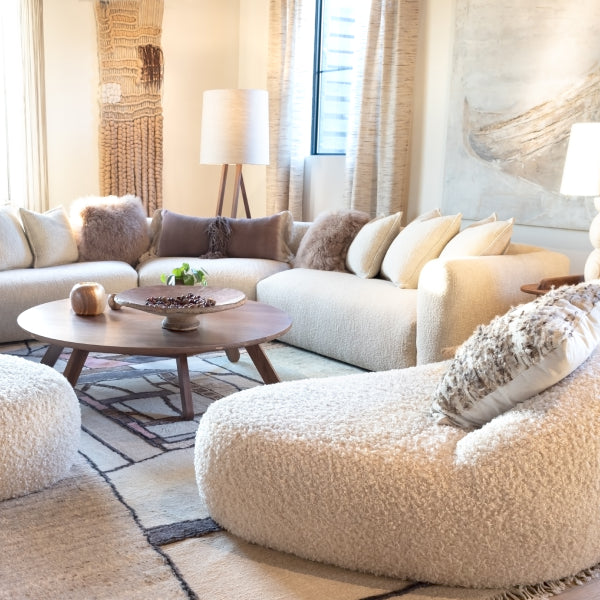
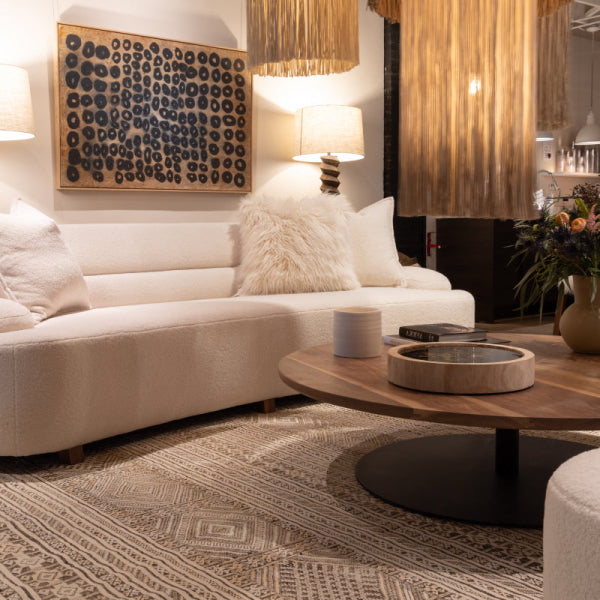








You're standing in a designer's showroom, running your hand across a cashmere bolt while considering fabric for a generous sectional. The color is right, the softness is irresistible, and you can already see it in your living room. Before you approve the yardage, though, there's a more important question: will this particular cloth suit the way you live?
Why Cashmere Yardage Deserves a Closer Look
A homeowner choosing luxury furniture in Atlanta might reasonably assume that the most exquisite fabric belongs on the most important piece. Yet a formal sitting-room sofa and a sectional used for homework, television, and weekend naps need different specifications. Softness is a starting point, not an upholstery approval.
Cashmere fabric by the yard deserves careful consideration because you're buying material that someone must turn into a finished furnishing. The fabric's relationship with seams, cushion shapes, window dimensions, and cleaning methods matters as much as its appearance on the bolt.
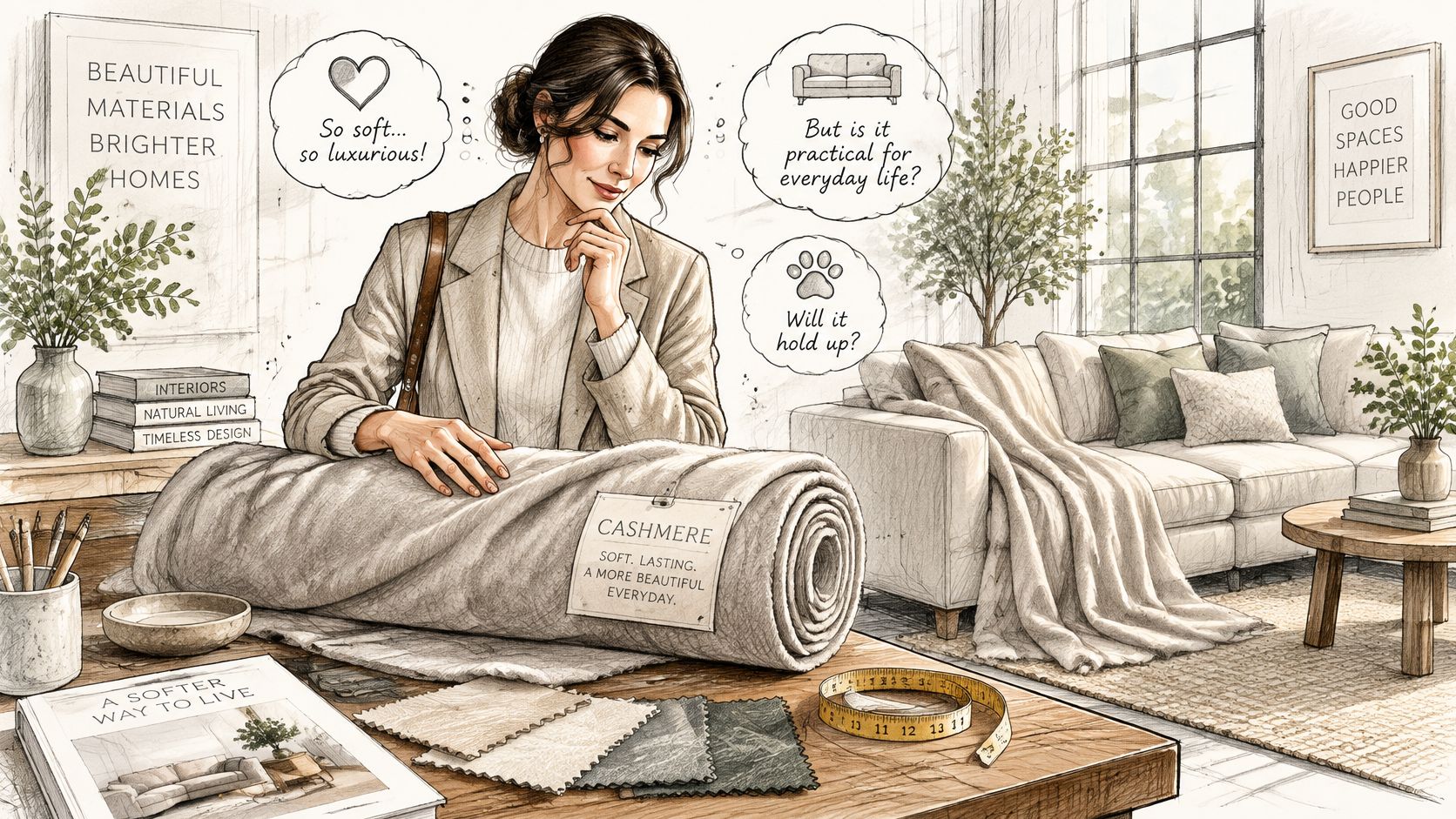
Start with the furnishing, not the fiber label
Consider a hypothetical Buckhead living room with a statement chair, fitted drapery, and a frequently used sofa. Rather than specifying the same cashmere everywhere, a designer should evaluate each application separately. The chair might justify a distinctive tactile surface, while the sofa needs documented seating performance.
That distinction doesn't diminish the material. It places luxury where you'll appreciate it without asking a decorative cloth to do an upholstery fabric's job.
Practical rule: Choose the role of the fabric before choosing the prestige of the fiber.
For homeowners comparing high-end furniture in Alpharetta or custom chairs in Roswell, the useful questions extend beyond color:
- Fiber: What exactly is in the cloth, and how is its quality documented?
- Construction: Was the fabric developed for seating, window treatments, apparel, or decorative use?
- Ownership: Can you support its cleaning requirements and obtain the sourcing information you need?
Think of these questions as one specification rather than separate shopping tasks. A beautiful interior depends on agreement between the material, the maker, and the household, not just on selecting the softest sample.
Understanding the Cashmere Fiber
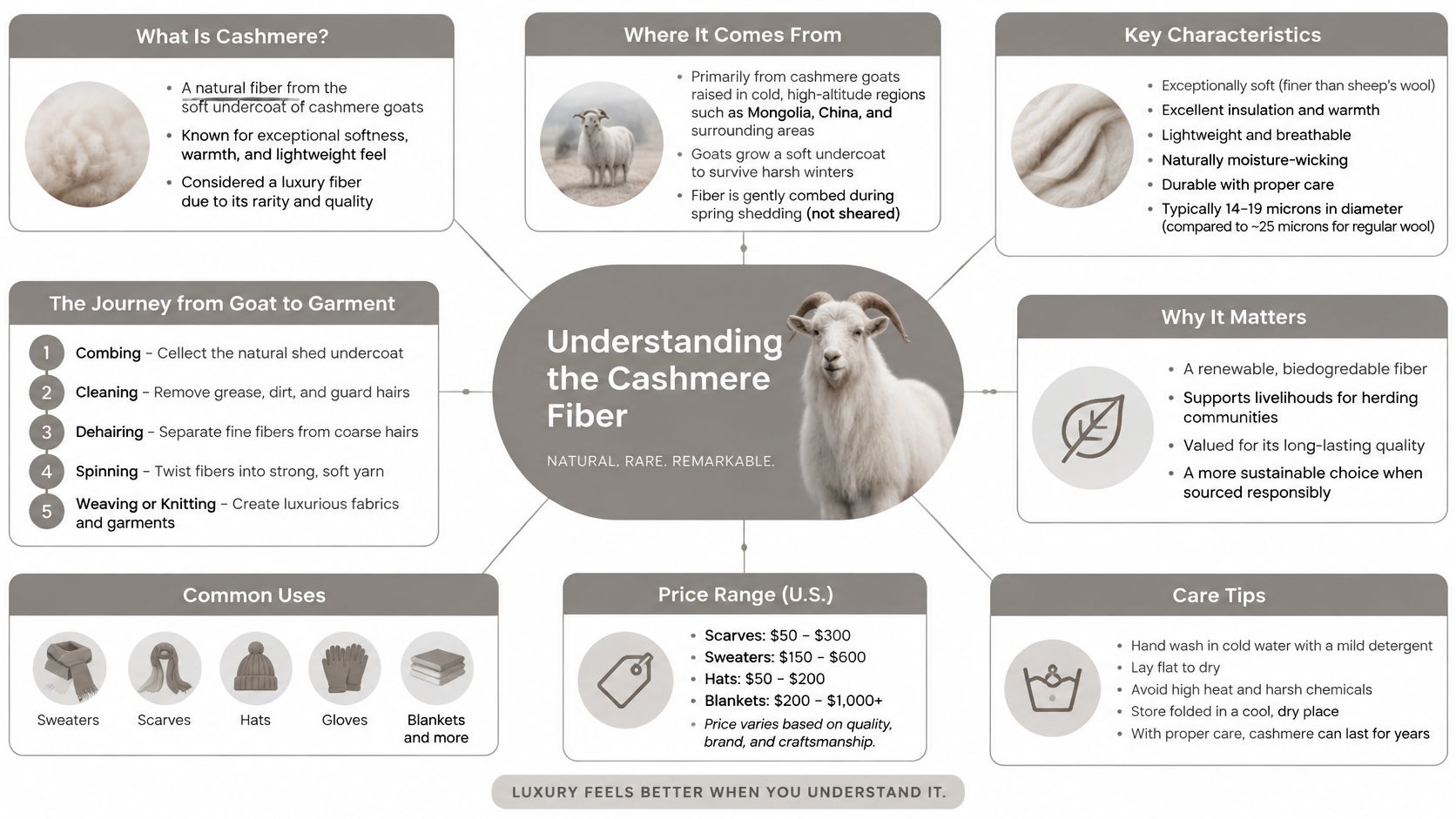
The fiber and the fabric aren't interchangeable terms. Cashmere fiber is the raw material; woven cashmere yardage is a constructed textile made from yarn, then finished for a particular appearance and purpose. Knowing the ingredient doesn't tell you everything about the finished cloth, much as knowing the wood species doesn't fully describe a custom chair.
Cashmere is a fine undercoat fiber, valued for its refined hand. For interiors, however, the useful question isn't just whether a sample feels soft. Ask how the supplier describes and verifies that softness.
Read fineness as a measurement
The Cashmere and Camel Hair Manufacturers Institute specifies a mean fiber diameter no greater than 19 microns, a coefficient of variation no greater than 24%, and no more than 3% by weight of fibers exceeding 30 microns, according to its technical definition of cashmere. Those measurements describe both the average fineness and the presence of coarser fibers.
Averages alone can conceal an uncomfortable detail. Coarse guard hairs can create a prickly sensation even when the overall average appears acceptable, so ask the mill about diameter distribution and coarse-hair content rather than accepting a marketing grade.
Understand why availability matters
Cashmere remains a scarce luxury input. It represented roughly 0.02% of worldwide fiber production in 2023, with China and Mongolia accounting for most global output, according to the cashmere life-cycle and social assessment. That concentrated agricultural supply helps explain why buyers shouldn't expect unlimited availability across every color, grade, and construction.
For a broader vocabulary before comparing samples, consult this guide to natural fabrics. Keep the categories separate: a fiber name identifies an ingredient, while a fabric specification describes what the mill made from it.
The same distinction is useful across a room. J.G. Carpet Cleaning LLC's resource on wool carpet cost and durability offers a separate reference when you're considering wool underfoot alongside cashmere furnishings. Evaluate each textile within its own application rather than transferring expectations from carpet to upholstery.
Comparing Grades, Blends, and Constructions
Place a supple cashmere cloth beside a more structured cashmere blend, and the first may win an immediate hand-feel comparison. That doesn't settle which belongs on your furniture. Composition describes ingredients; construction determines how those ingredients are organized.
A supplier's grade language can help begin a conversation, but it shouldn't replace measurable fiber information. Likewise, the cashmere percentage doesn't reveal the weave, yarn count, finished weight, backing, or treatment applied to the surface.
Cashmere Yardage Specifications to Compare
| Specification | What it reveals | Why it matters |
|---|---|---|
| Fiber data and grade | Documented fineness and the supplier's quality designation | Separates measurable information from descriptive language |
| Complete composition | Cashmere content and all other fibers | Lets you evaluate the whole blend rather than its headline ingredient |
| Weave and yarn count | How the yarns form the cloth | Helps distinguish a fluid textile from a structured construction |
| Finished weight | The fabric's mass | Provides context for body and handling without proving durability |
| Usable width | The available cutting area | Affects panel layouts, seams, and material requirements |
| Backing | Any support applied to the reverse | Must suit the proposed fabrication and furniture construction |
| Finishing | Treatments used to develop the surface and hand | Helps explain why visually similar samples behave differently |
| Intended application | The mill's recommended use | Establishes whether upholstery suitability is actually claimed |
A pure-cashmere textile may be worth considering when the central requirement is a particular hand or drape. A blend deserves consideration when the project calls for a different balance of structure and surface character. An upholstery construction should come with application-specific evidence, not merely an upholstery category on a retail page.
Compare samples as materials, not color chips
Ask for a sample large enough to fold over a cushion edge or hang as a small panel. A tiny swatch can establish color, but it can't give you the same understanding of body, folding behavior, or visual scale.
For a useful general companion while preparing questions, consult Miller Waldrop Furniture & Decor advice on choosing upholstery fabric. Use it alongside the mill's actual specification sheet, not instead of one.
- For a supple pure-cashmere option: Ask whether its fluidity supports the proposed shape and whether the maker accepts it.
- For a cashmere blend: Identify every component and request evidence for any performance claim.
- For a backed upholstery cloth: Have the workroom evaluate the finished construction, including how it will be sewn and fitted.
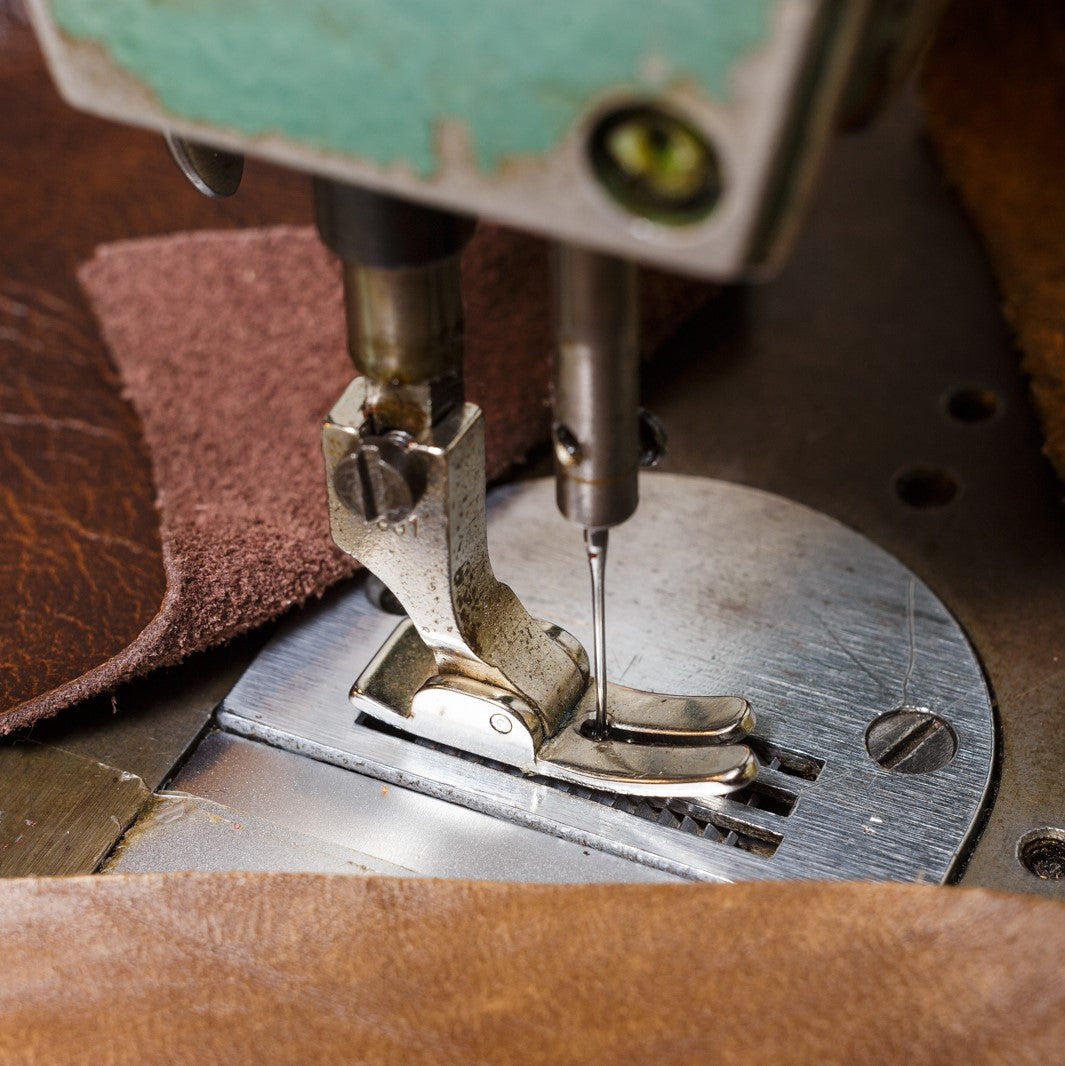
This is particularly important for custom upholstered furniture. Your upholsterer needs to approve the material before you purchase a large cut, because the attractive face of the cloth doesn't show everything that matters at the sewing table.
Choosing Cashmere for the Right Room
Start by describing the room. A formal lounge used for conversation presents a different decision from a family room where everyone gravitates to the same corner of the couch. Neither room is more deserving of luxury, but each requires a different specification.
Choose by contact, exposure, and maintenance, then consider the aesthetic effect. Don't assign a seating category just because a fabric looks substantial.
Separate decorative use from daily seating
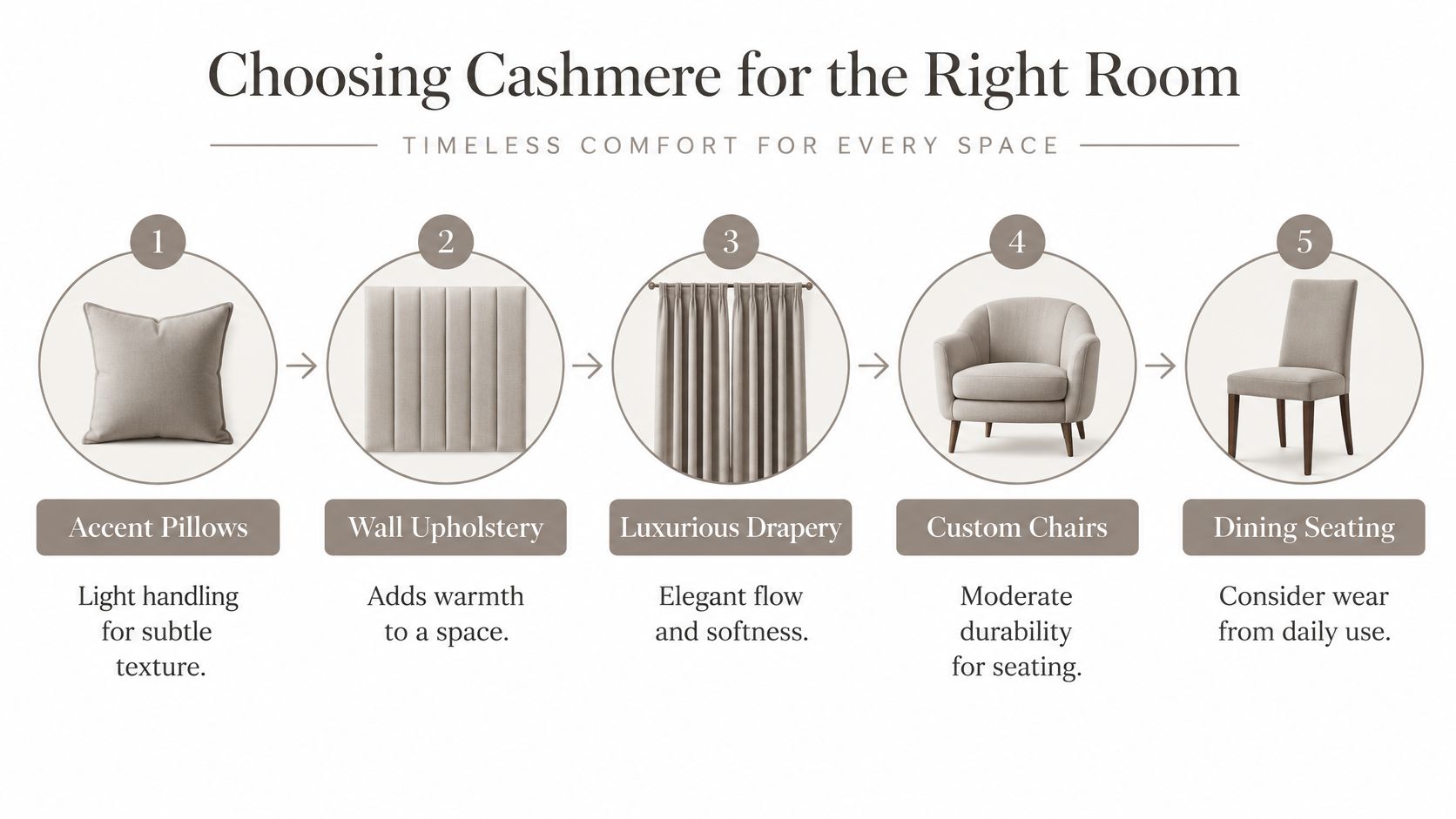
Lightly handled pillows, accent panels, wall upholstery, and luxurious drapery are reasonable applications to investigate. Heavily used sofas and dining chairs demand a more demanding approval process because construction, finishing, backing, and blend composition affect suitability, as outlined in the cashmere production and sourcing case study.
For a Sandy Springs bedroom, you might prioritize the look and handling of an occasional pillow. In a North Atlanta family room, a large sectional deserves a documented upholstery specification and a realistic maintenance plan. These are proposed decision scenarios, not interchangeable recommendations.
- Accent pillows and wall panels: Establish how often people will touch them and whether they can be serviced without disturbing surrounding finishes.
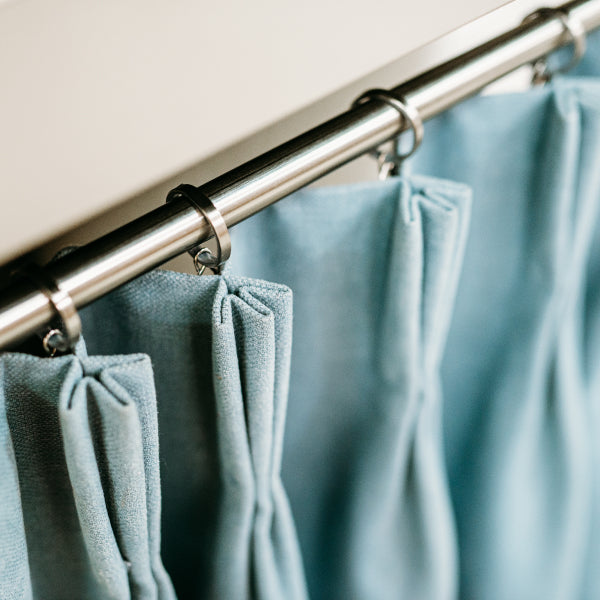
- Drapery: Ask the workroom to review the cloth against the window's scale, exposure, and proposed panel design.
- Custom chairs: Describe whether the chair is decorative, occasional seating, or someone's everyday reading place.
- Dining seating and premium sectionals: Treat repeated use as a reason to require stronger evidence, not as an opportunity to assume luxury pricing equals resilience.
Resolve the cleaning plan before the design
Removable fabric isn't automatically washable, and a removable cover doesn't eliminate the need for an approved cleaning route. Ask who will maintain the finished furnishing and whether the proposed method is practical in your household.
A decorative textile can be an excellent material in the right place without being suitable for every seat in the house.
For statement furniture pieces, exclusivity may come from restraint. A cashmere detail on an otherwise performance-led furnishing can be a more considered choice than covering every surface with the same cloth. Let the room's pattern of use guide where you concentrate the tactile experience.
Why Cashmere Fabric Prices Differ
A yardage quote is incomplete without the specification attached to it. Before comparing prices, confirm that the offers describe comparable material, usable dimensions, finishing, and service. Otherwise, the less expensive quote may only represent a different product.
Cashmere has a long commercial identity beyond finished sweaters. A historical account of the cashmere trade reported woven fabric approximately 57 inches wide at an average of $11–$12 per yard in early 1973, following the United States' 1971 removal of its prohibition on imports from China. Those are historical figures, not a current buying range.
Compare the complete quotation
Fiber selection is only part of the purchasing decision. Ask the seller to explain what you're paying for in the finished fabric and what support accompanies the order.
| Quote detail | Question to ask |
|---|---|
| Material specification | Are the fiber data, composition, construction, and finishing comparable? |
| Usable dimensions | Is this full-width yardage, and what width can the workroom actually cut? |
| Order format | Is the quotation for a cut length, a remnant, or a larger mill order? |
| Availability | Is the required quantity available together, or does the order depend on further sourcing? |
| Purchase support | Are sampling, sourcing assistance, or design consultation included? |
| Fabrication requirements | Has the maker confirmed the cutting layout and material allowance? |
For custom furniture in Atlanta, ask the workroom to calculate the fabric requirement before deciding which quote represents better value. Compare the cost of the approved project, not just the price printed beside a swatch.
Define value in terms of the finished result
A wider usable cloth may support a different layout from a narrower one. An available coordinated cut may be more useful than an attractive sample that can't be supplied in the required quantity. These are purchasing considerations, not reasons to assume that any particular premium is justified.
Buyers weighing custom versus mass-produced furniture should ask what customization includes. Does the maker approve customer-supplied material, review its specifications, and explain any limitations before production?
For luxury home furnishings in Fulton County and surrounding markets, quality over price means paying for documented suitability, skilled execution, and a result you want to keep. It doesn't mean treating the highest quote as automatic evidence of designer quality.
Testing Durability Before You Commit
Ask for the test report before approving cashmere for a sofa. A supplier's description of “durable” is less useful than a named method, a result, and confirmation that the tested construction matches the fabric you're buying.
Read abrasion results in context
For woven upholstery, the Association for Contract Textiles specifies 15,000 Wyzenbeek double rubs or 20,000 Martindale cycles for low-traffic/private spaces, and 30,000 double rubs or 40,000 Martindale cycles for high-traffic/public spaces, as summarized in this ACT abrasion benchmark reference. Keep the method attached to the result rather than comparing the figures as though they were the same unit.
A larger number isn't a complete quality judgment. ACT guidance cautions that laboratory methods can produce different results and may not correlate well with real use; Wyzenbeek results above 100,000 double rubs haven't been shown to indicate increased lifespan, according to this explanation of abrasion testing limitations.
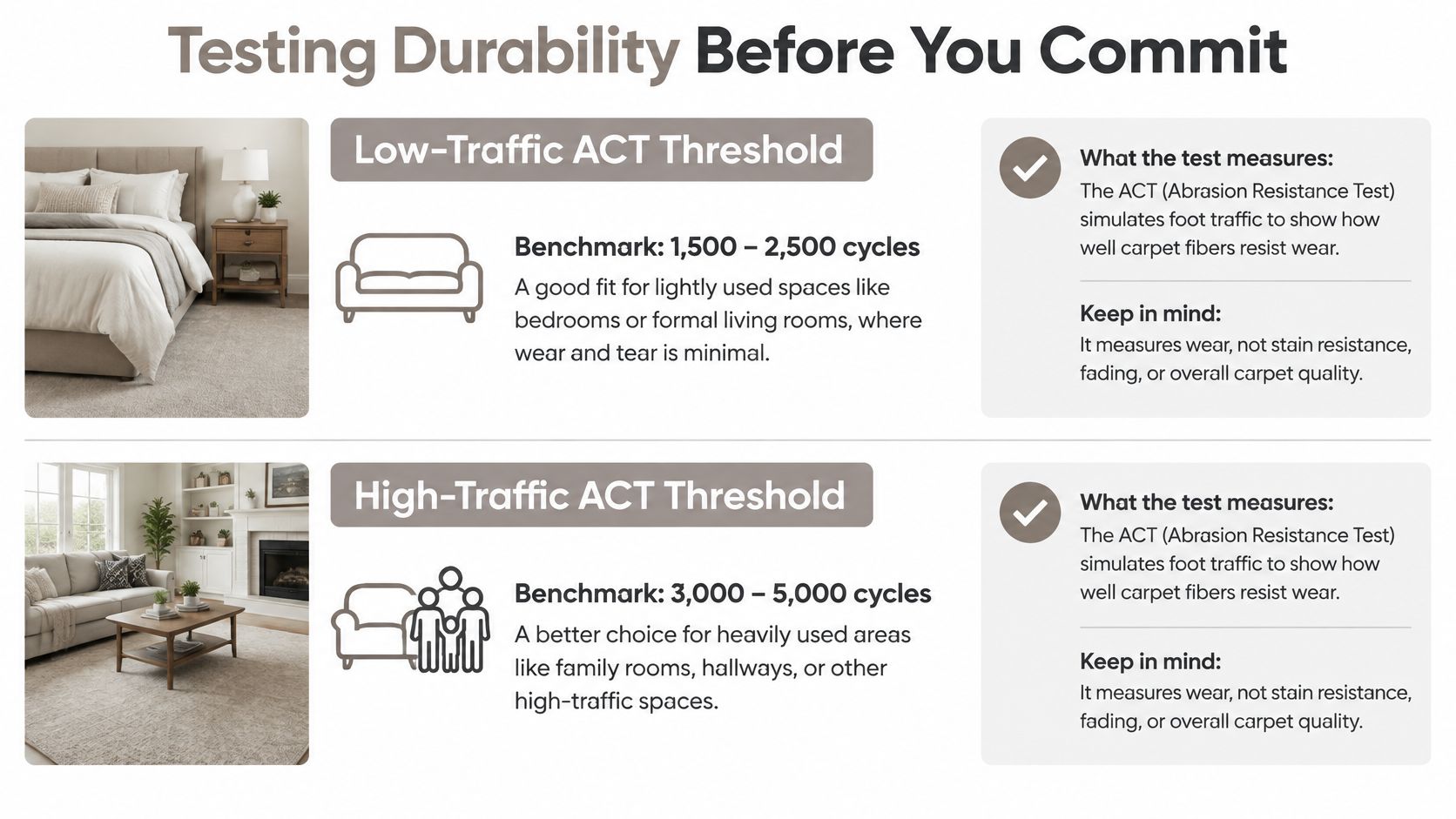
The benchmarks discussed here concern woven upholstery, not a universal rating for every textile application. For help reading the terminology on a specification sheet, use this fabric abrasion resistance guide.
Ask separate questions about separate risks
Abrasion doesn't establish stain resistance, lightfastness, seam safety, or cleanability. Those concerns need their own evidence and a discussion with the furniture maker.
- Pilling: Request the method and grade, not a broad promise that the surface will remain unchanged.
- Dimensional stability: Ask how the fabric was treated, measured, and conditioned.
- Seam behavior: Have the upholsterer review applicable seam-slippage or tensile information.
- Light and cleaning: Obtain the relevant results and written care route for the finished cloth.
The dimensional-stability framework uses ISO 3759 for specimen preparation and measurement, ISO 6330 for standardized domestic washing and drying procedures, and ISO 5077 for dimensional-change calculations; pilling methods fall under ISO 12945, as explained in this cashmere shrinkage testing guide. A pilling grade doesn't substitute for the other results.
Before cutting: Have a representative length tested under the intended cleaning protocol, with the workroom's approval.
Finally, assess the sample in the actual room. Look at it beside the rug, under daytime and evening lighting, and over the proposed furniture shape. This won't replace laboratory testing, but it helps prevent an expensive mismatch between a technically acceptable material and the interior you intended.
Sourcing and Caring for High-Quality Yardage
Responsible purchasing requires documents that describe the material you're ordering, not a reassuring phrase on a sample card. Ask the retailer to connect its claims to the particular fabric and order wherever possible.
ISO 22786:2025 establishes general requirements for cashmere-fiber production, preparation, traceability, ethical claims, and supporting information; recent industry reporting also describes more than 90% fulfillment of social and animal-welfare indicators under the Good Cashmere Standard, while noting continuing traceability and supply-chain challenges in Mongolia, alongside the cashmere production and traceability standard. These developments are reasons to ask better questions, not grounds for assuming that every retail cashmere fabric meets the same requirements.
Build a sourcing file for the project
Keep the specification, supplier correspondence, sample identification, and care instructions together. For an interior designer, that file helps preserve the reasoning behind a material choice when the client later needs maintenance or replacement assistance.
- Origin: Request the country and region of fiber origin, along with available processing information.
- Material status: Establish whether the cashmere is virgin, recycled, or a combination.
- Chain of custody: Ask what evidence connects the claimed source to the purchased material.
- Animal welfare: Request the named standard and the scope of any supporting verification.
- Processing: Seek dye-house information where available.
- Claim boundaries: Clarify whether a statement applies to raw fiber, yarn, or finished cloth.
A “cashmere blend” label doesn't prove responsible sourcing. Nor should a broad supplier policy be mistaken for documentation covering a particular fabric.
Plan for ownership, not just installation
Use the mill's instructions and the maker's requirements to establish care for the completed furnishing. Don't transfer a sweater-cleaning routine to an upholstered chair or lined drapery panel.
If you're comparing cashmere with other soft textiles for separate projects, On Pins & Needles Quilting Co.’s fleece yardage guide provides another material-specific reference. Keep those buying decisions distinct rather than treating all soft yardage as interchangeable.
Before placing an order, prepare measurements and discuss cutting requirements using this guide to buying fabric by the yard. Confirm that the representative sample and approved specification match what will be supplied, then retain an identified piece with the project records.
That modest administrative effort supports a much more considered purchase than choosing from memory and trying to reconstruct the details after installation.
Make the Investment Suit the Space
Pure cashmere isn't automatically the best specification for designer furniture. Purity answers a composition question, not every question about craftsmanship, suitability, or long-term ownership. A carefully engineered blend may be the wiser choice when you need a particular balance of tactile character and service performance.
For lightly handled accents and wall treatments, concentrate on the approved hand, color, fiber specification, and visual effect. For drapery, give the workroom enough information to assess the window, panel design, and installation. For sofas, sectionals, and dining chairs, insist on the application approval established through the checks above.
Buy the complete furnishing
When comparing the best luxury sofa brands, ask the same questions of every maker. Who approves the fabric, who resolves fabrication concerns, and what maintenance obligations will you accept?
The question of how long high-end furniture lasts can't be answered from a cashmere label. For an heirloom-quality furniture project, discuss the complete piece, including its construction, repair options, and future reupholstery, rather than relying on a prestigious covering.
If you're searching “designer furniture near me” or deciding where to buy premium furniture in Atlanta, bring a decision sheet rather than only inspiration photographs:
- Application approval: Has the maker accepted this exact cloth for this exact piece?
- Evidence: Are the specification and relevant performance records available?
- Project cost: Does the quotation reflect the approved layout and fabrication?
- Ownership: Are sourcing documentation, care, and future service arrangements clear?
Whether you're furnishing a Buckhead sitting room, an Alpharetta gathering space, or a Roswell retreat, exclusivity should feel personal rather than impractical. Choose cashmere fabric by the yard when its documented qualities support your design, and choose a different construction when the room asks more of it.
Lewis and Sheron Textiles offers an Atlanta Design Center with a broad fabric selection, custom furnishings, reupholstery, and made-to-order drapery services, supported by a heritage dating to 1944. Visit Lewis and Sheron Textiles with your room photographs, furniture dimensions, and fabric requirements to discuss cashmere yardage and suitable alternatives with the design team.