














Custom window treatments typically run about $400 to $1,800 per window for custom drapery, while custom shades commonly range from $300 to $2,500 or more per window. Fabric, hardware, lining, installation, and motorization are what move the invoice from a manageable renovation line item into a luxury project.
You're probably looking at a room with beautiful windows, unfinished walls, and a quote that feels disconnected from the fabric sample in your hand. That reaction is understandable. Custom treatments aren't priced like ready-made curtains because the work includes specification, fabrication, finishing, hardware, and installation, all customized to the opening.
For homeowners in Atlanta, Buckhead, Alpharetta, Roswell, Sandy Springs, Fulton County, and North Atlanta, the right question isn't just “What does custom window treatments cost?” It's “Which decisions deserve the premium, and where am I paying for decoration I won't use?”
What Custom Window Treatments Cost in 2026
A six-window project can put you between an $8,000 package and a $25,000 package before you have chosen a single fabric. Both figures can make sense. Standard workroom fabrics with manual rods stay closer to the first option, while imported textiles, elaborate construction, specialty hardware, and automation move the quote toward the second.
For planning, custom drapery commonly runs $400 to $1,800 per window. Custom shades often fall between $300 and $2,500 or more per window. Current pricing guidance places custom drapery across a wider range of $200 to $2,500 per window, with complex projects reaching about $300 to $4,000 per window as materials, labor, and construction requirements increase (custom drapery cost guidance).
A six-window installation may start near $3,000 and reach $40,000. Architectural access, unusual window shapes, and extensive automation can push the total higher. A U.S. installation survey reports an average project cost of $1,018, with installation commonly ranging from $167 to $1,872. Custom materials alone often begin around $800 per window and may range from $150 to $3,000 before labor (window treatment installation costs).
| Product Type | Budget Range Per Window | Typical Mid-Point |
|---|---|---|
| Custom drapery | $400 to $1,800 | $400 to $900 |
| Custom shades | $300 to $2,500+ | Varies by fabric and mechanism |
| Broad custom drapery range | $200 to $2,500 | $400 to $900 |
| Broad project-level range | $3,000 to $40,000 | Depends on opening count and specifications |
Budget by the decisions that change the invoice: fabric source, lining, hardware, installation complexity, and motorization. A wide living-room opening consumes more fabric and needs stronger hardware than a bedroom window. A blackout Roman shade requires different construction from a stationary decorative panel. A vaulted opening can add access equipment and installation labor.
Use the window's job to control spending. Pay for blackout performance in bedrooms, reliable hardware on wide openings, and automation where windows are difficult to reach. Avoid premium fabric or motorization on a decorative panel that will rarely move.
Window treatments also compete with other glass upgrades. A separate commercial tinting cost overview can help compare how tinting is priced, although tinting and custom fabric treatments address different privacy and design needs.
Read the quote as a set of choices, not one intimidating total. Each line should show what you gain, which upgrade earns its place, and where a simpler specification will perform just as well.
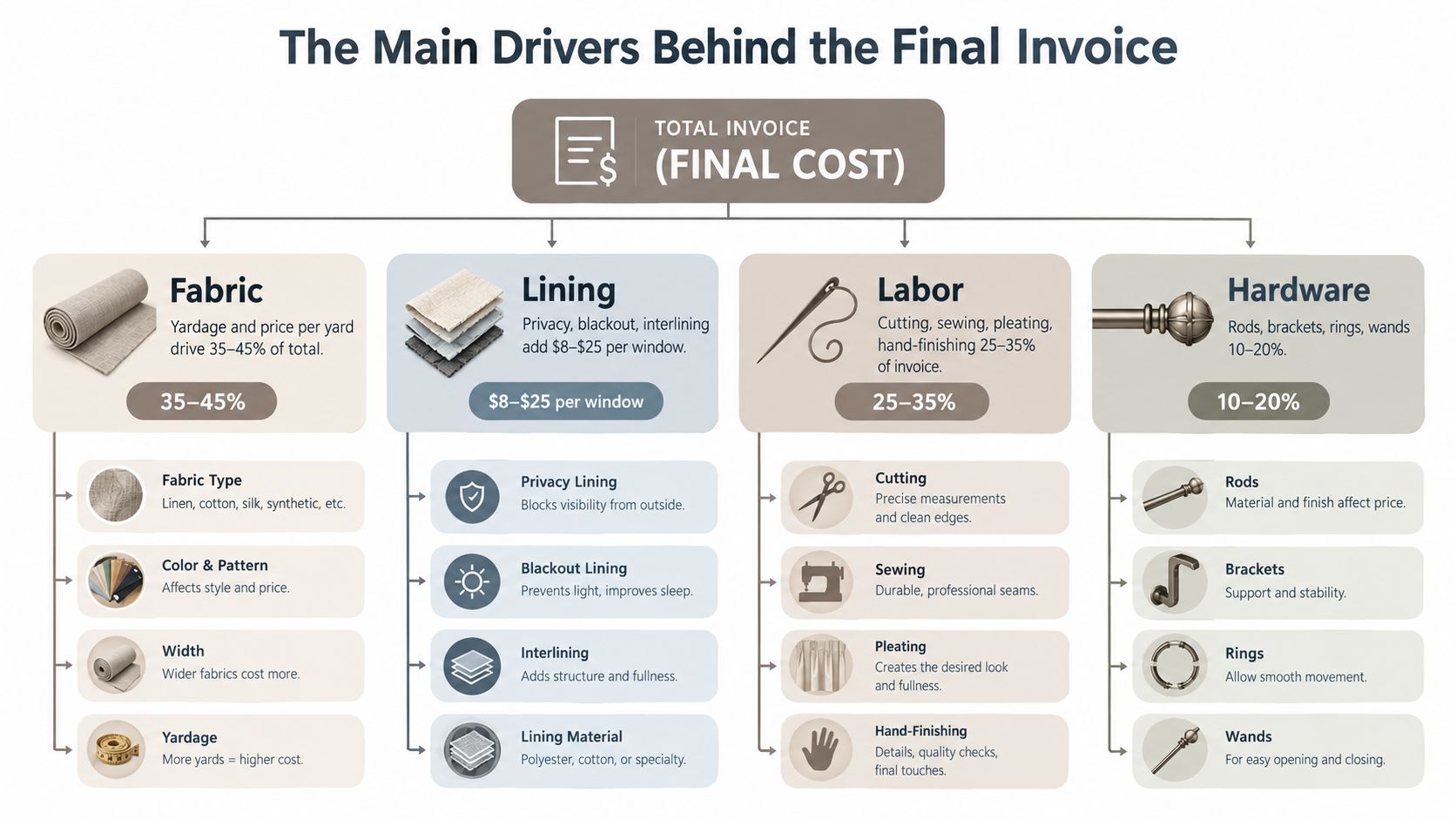
The Main Drivers Behind the Final Invoice
A quote makes sense when you read it the way a workroom builds it. The final figure comes from fabric consumption, construction time, hardware, and installation conditions. Each line points to a decision you can make.
Fabric sets the visual ceiling
Fabric is usually the first major variable. The quote reflects price per yard multiplied by required yardage, not the window's width alone. Fullness, pattern repeat, railroaded construction, pattern matching, and finished length determine how much material the workroom must order.
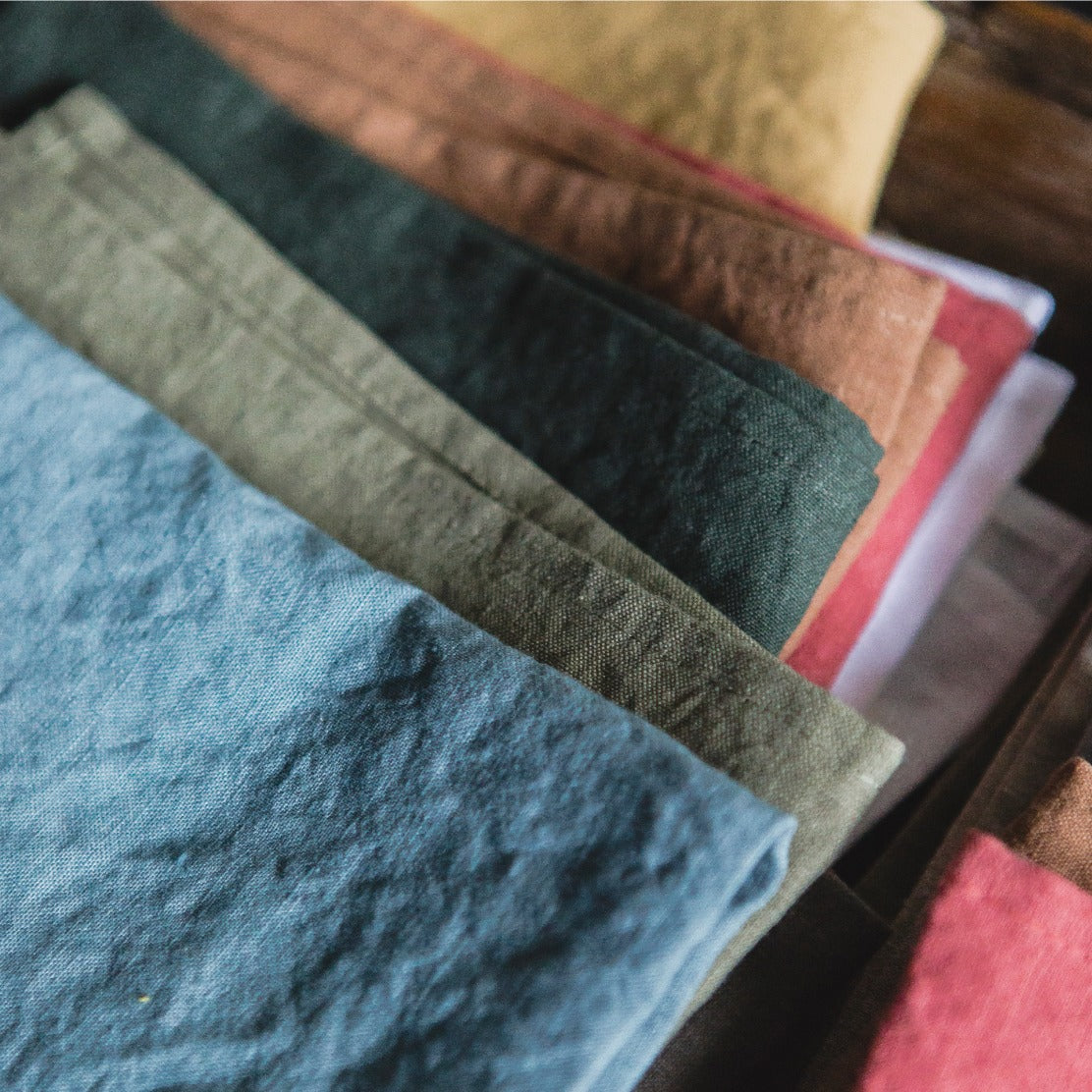
A fabric priced at $45 per yard can shift the project substantially compared with an $18-per-yard option. One panel may require several yards before lining and labor enter the calculation. Imported linen, silk, velvet, and large-scale jacquards also demand careful pattern placement and skilled handling, so their cost reflects more than fiber content.
Set the fabric budget after deciding how prominently the treatment will appear. Spend more on a focal room or a fabric that carries the design. Choose a simpler textile for a secondary room where proportion and installation do most of the visual work.
Lining changes performance
Standard lining gives the face fabric body and protection. Privacy lining increases opacity, blackout lining limits incoming light, and interlining adds insulation and fullness. Interlining is a meaningful per-panel upgrade, so specify it when warmth, drape, or fullness justifies the added work.
Bedrooms usually deserve blackout lining. Formal rooms that rarely need darkness usually do not. Match the lining to the window's job instead of applying the same specification throughout the house.
Labor is more than sewing
Labor covers pattern cutting, matching, sewing, pleating, pressing, hand-finishing, inspection, and installation. Hand-pleating can run at roughly twice the cost of machine work, because the workroom spends more time shaping and finishing each panel.
Expensive fabric and difficult windows leave less room for shortcuts. Reduce decorative complexity before reducing construction quality. A poorly finished panel can waste the value of a premium textile.
Hardware carries the weight
Rods, rings, finials, brackets, traversing tracks, wands, and motorized components all affect the invoice. A basic solid rod handles a straightforward installation. Custom metal finishes, oversized diameters, return brackets, bay-window hardware, and traversing systems cost more because they require extra material, precise specification, or added engineering.
Practical rule: Spend on hardware when it improves operation, scale, or longevity. Skip decorative finials that disappear behind a cornice or layered panel.
Window size and mounting conditions often create the surprise charges. Oversized openings need stronger support, while bay windows need coordinated returns. Brick, stone, unusually deep trim, ceiling mounting, and high access points can extend installation time.
Protect the required work first: accurate measuring, adequate support, safe installation, and construction suited to the fabric weight. Decorative hardware details, premium trim, and the highest fabric tier offer the clearest places to simplify.
Entry, Mid-Range, and Luxury Tiers Compared
The easiest way to locate your project is to compare complete specifications rather than isolated prices. A low fabric price paired with elaborate hand-finishing may not be cheaper than a moderate fabric with efficient construction.
| Tier | Fabric & Lining | Hardware & Labor | Per-Window Range | Best For |
|---|---|---|---|---|
| Entry | Stock-fabric drapery with standard lining | Machine pleats and solid rods | About $200 to $400 | Flex spaces, rental-style updates, secondary rooms |
| Mid-range | Designer-grade fabric with lined panels | Custom hardware and professional installation | About $400 to $900 | Most living rooms, bedrooms, and dining rooms |
| Luxury | Imported textiles, interlining, specialty lining | Hand-pleating, ornate hardware, and full motorization | About $900 to $1,800+ | Architectural focal points and fully tailored interiors |
The entry tier works when the treatment needs to cover the window cleanly without carrying the room visually. Stock fabrics, machine pleats, and solid rods can look composed when the proportions are right. This approach is ideal for a laundry room, guest room, or temporary-use space.
The mid-range tier is the workhorse. Designer-grade fabric gives you a better hand, stronger color, and more intentional texture. Lined panels hang with greater authority, custom hardware sits at the correct height and width, and professional installation prevents the crooked rod or undersized return that makes an expensive room feel unfinished.
Most residential rooms don't need the luxury tier. The mid-range specification handles about 70% of residential projects well.
The luxury tier earns its price when the window is a major architectural feature or the room demands a highly controlled finish. Imported textiles can bring an unmistakable surface quality. Interlining creates a fuller fall. Hand-pleating gives the top edge more definition, while motorized tracks make heavy or hard-to-reach panels practical.
Luxury also makes sense when the rest of the room already includes high-end furniture, luxury sofas, premium sectionals, custom upholstered furniture, or statement furniture pieces. A modest treatment can look under-specified beside heirloom-quality furniture, just as an extravagant drapery package can overwhelm a restrained room.
For designer furniture shoppers searching for luxury furniture in Atlanta, designer furniture near me, or custom furniture Atlanta, the same principle applies. Buy the specification that supports the room's use and scale, not the most expensive menu of options.
How Fabric, Lining, and Pleat Choices Move the Price
Take one panel measuring 54 inches by 96 inches. The window size tells you only part of the story. The final cost depends on fullness, pattern repeat, lining, and how the top is finished.
Fabric is the largest variable. A 54-inch-wide polyester print at approximately $18 per yard sits at the accessible end. A jacquard or linen blend at $55 to $120 per yard creates more visual depth and a more substantial hand. True silk or velvet at $150 to $300 per yard moves the panel into a different budget category before labor, lining, and hardware are added.
Fullness determines how much fabric the panel consumes. A simple treatment may use less material. A fuller statement panel uses more yardage to create deeper folds and a richer stack.
| Choice | Entry Option Approx. | Mid Option Approx. | Premium Option Approx. |
|---|---|---|---|
| Face fabric | $18 per yard | $55 to $120 per yard | $150 to $300 per yard |
| Lining | Standard lining | Blackout lining | Interlined construction |
| Top finish | Rod pocket or grommet | Pinch pleat | Goblet, cartridge, or tailored hand-finish |
| Single panel example | About $650 | Varies by fabric and construction | About $1,400 with premium upgrades |
Lining should follow the room. Cotton sateen is a sensible general-purpose choice. Blackout lining is appropriate for bedrooms, media rooms, and spaces where glare matters. Interlining adds another layer, more body, and more labor. It can add 40% to material cost alone, so use it where the fuller drape and insulating benefit will be visible.
Pleats sit on a sliding scale. Rod pockets and grommets are straightforward. Pinch pleats and goblet pleats require more hand-finishing. Cartridge, custom, and ripplefold styles fall between simple and highly hand-worked constructions depending on the workroom and hardware system.
A mid-weight linen panel might land around $650, while switching to silk, adding blackout lining, and using pinch pleats can move that same panel to roughly $1,400. If your budget is tight, choose two upgrades, not all three. I'd usually prioritize fabric quality and lining for a room used daily, then choose a simpler pleat.
For a broader perspective on selecting durable textiles for upholstered pieces, review this guide to best materials for long-lasting sofas. Drapery and upholstery have different performance demands, but both reward careful attention to fiber, weave, and use.
The role of lining deserves its own technical review, especially when you're comparing light control, body, and fabric protection. The drapery lining guide from Lewis and Sheron is useful before you approve a specification.
When Motorization Is Worth the Premium
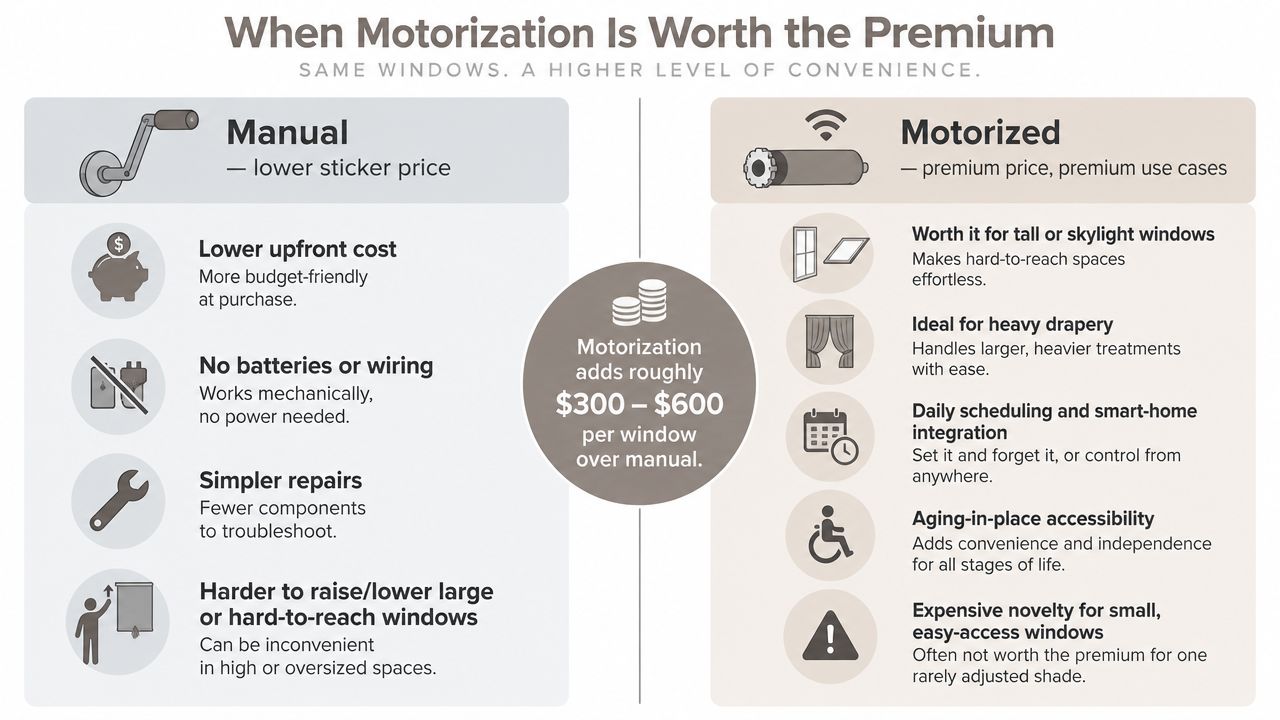
Motorization earns its place when manual operation is inconvenient, unsafe, or likely to be neglected. It's a poor purchase when the only benefit is being able to press a button on a window you can reach easily.
A hardwired motorized drapery track can add roughly $400 to $900 per opening, while battery-powered shade motors can add $150 to $350 per shade on top of the treatment itself (motorized treatment installation information). The total also depends on power access, electrician coordination, remote controls, hubs, and the treatment's weight.
Good use cases
Choose motorization for:
- Tall windows: You won't need a ladder or awkward reach to adjust the treatment.
- Vaulted ceilings and skylights: Manual operation is inconvenient at best and unsafe at worst.
- Behind-bed applications: Motorized controls prevent constant pulling across furniture.
- Heavy drapery: A proper track protects the fabric and makes daily operation quieter.
- Scheduled light control: Automated opening and closing can support a real routine based on sun exposure and occupancy.
- Accessibility: Motorization can support aging in place and reduce physical effort.
Energy efficiency can be part of the decision, but keep the reasoning practical. A schedule that closes treatments during intense sun or opens them for useful daylight has a clearer purpose than a vague promise of lower utility bills.
A single motorized shade in a rarely used guest room is usually an expensive novelty. The same technology across a whole-home package of ten or more openings can make more financial sense because system pricing and coordination may improve at project scale. A one-room retrofit often carries more overhead per opening.
Before approving the upgrade, ask about fabric noise, battery life, warranty length, service access, and replacement components. Motorization is a system, not merely a feature. If the room doesn't need scheduled operation or remote access, manual hardware is often the better buy.
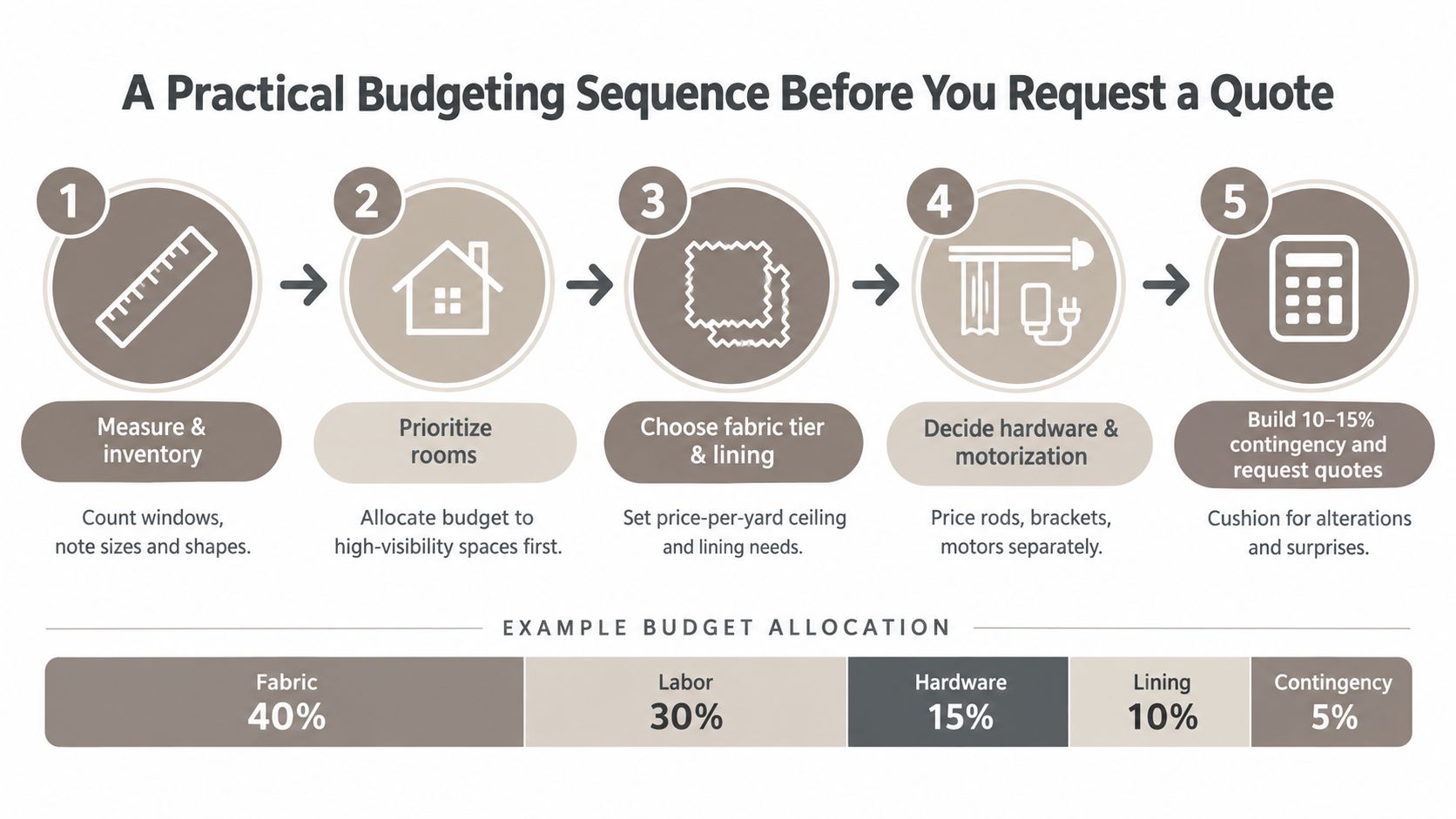
A Practical Budgeting Sequence Before You Request a Quote
A good budget starts before you visit a showroom. The aim is to give the designer a complete enough brief that the first quote reflects your priorities instead of a series of expensive assumptions.
Start with the openings
Inventory every window. Record rough width and height, note whether the opening is standard, oversized, arched, unusually deep, or difficult to reach, and photograph the trim, ceiling, floor, and nearby furniture.
Next, assign a priority. Focal windows in the living room, primary suite, and main entertaining spaces should receive the strongest specification. Secondary bedrooms can use a controlled mid-range approach. Laundry rooms and flex spaces can wait or use simpler treatments.
Set a tier room by room
Choose a per-window target from the entry, mid-range, or luxury tier. Don't assume the entire house needs identical fabric, lining, or hardware. Spend where guests see the treatment and where you operate it every day. Economize in bedrooms, laundry rooms, and low-visibility spaces when the function doesn't require premium construction.
Decide fullness and operation
Use 2.5 times fullness as a practical everyday default and reserve 3 times fullness for statement panels where the drapery needs a richer presence. Then decide whether each opening needs manual operation, a traversing system, a Roman shade, or motorization.
Before requesting a quote, use a detailed guide to measuring windows for curtains. Rough measurements are useful for planning, but a final quote should rely on professional verification.
Reconcile the total
Layer in hardware, installation, and any power work after you've chosen the fabric and construction. Keep a 10% to 15% contingency for alterations, specialty mounting, access, or decisions that change after samples arrive.
Your final worksheet should include:
- Window identification and rough dimensions.
- Room priority and selected tier.
- Fabric, lining, fullness, and pleat choice.
- Hardware, motorization, and installation.
- Contingency and a project total.
Bring that worksheet to a workroom or showroom. A designer can then challenge weak assumptions before they become change orders.
Planning a Custom Window Project With Lewis and Sheron Textiles
A showroom workflow turns a broad budget into a specification someone can fabricate. Lewis and Sheron Textiles begins with a free design consultation, where a designer can review window photographs, discuss measurements, and establish fabric direction before the order is written.
The process can then move into made-to-order drapery, Roman shades, or valances built to the opening. The important cost decisions happen together. Fabric yardage, lining, pleat style, hardware, and installation are considered as one composition instead of selected as disconnected upgrades.
Professional measuring can protect the budget when windows are oversized, unusually shaped, or part of a new-build installation. Hardware specification also matters. A rod that looks appropriate on a sample board may be undersized for a long span or incompatible with the panel weight. Lining upgrades, reupholstery of existing cornices, and installation coordination can change the final number, so they belong in the conversation early.
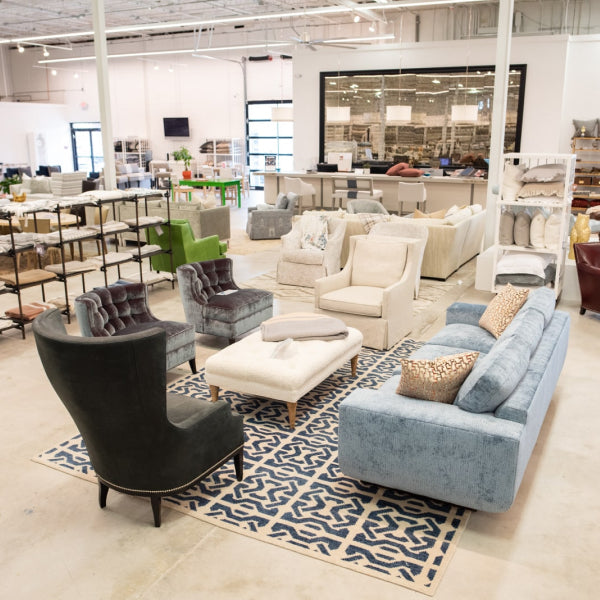
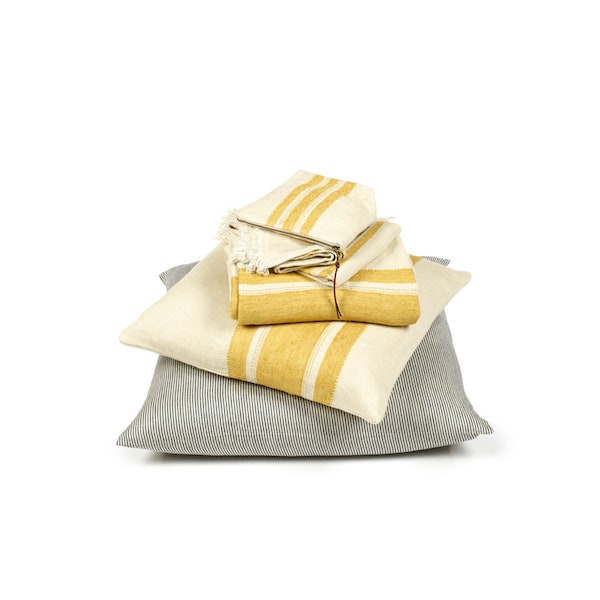
Lewis and Sheron Textiles serves Atlanta-area homeowners and designers through its Design Center, with in-stock fabrics and broader cut-yardage access from established mills. The showroom also supports made-to-order American-crafted upholstery, reupholstery, Belgian linens, rugs, trims, and accessories, which makes it practical for clients coordinating custom window treatments with designer furniture, luxury home furnishings, custom chairs, luxury sofas, and heirloom-quality furniture.
For clients outside Atlanta, nationwide shipping is available. The useful outcome of a consultation isn't a vague “starting at” figure. It's an itemized estimate that shows which portion belongs to fabric, labor, lining, hardware, installation, and motorization.
Bring window photos, rough dimensions, floor plans if available, and images of the furniture already in the room. Review the custom window coverings service with a designer, then ask for the quote to follow the same sequence used in your worksheet. That format makes it much easier to compare options without losing the design intent.
Lewis and Sheron Textiles offers made-to-order drapery, Roman shades, valances, fabric sourcing, professional measuring, and design consultation for homeowners and designers planning custom interiors. Visit Lewis and Sheron Textiles with your window photos and rough dimensions to discuss the right fabric, lining, hardware, and motorization choices for your Atlanta-area project.