






















You've chosen the fabric, settled on the color, and pictured the finished room. Then the custom drapery arrives in your Atlanta home, and the panels catch halfway across the window. The track sags near the center, the folds don't stack neatly, or the fabric brushes a handle every time you open the door.
That frustrating result usually isn't a problem with the drapery. It's a sign that the hardware wasn't treated as part of the design. A custom curtain track is the structural backbone behind the finished window treatment. It controls how panels move, where they stack, how clean the installation looks, and whether the system continues to perform after years of daily use.
The right choice depends on more than the window width. You'll need to consider the mounting surface, structural support, panel weight, projection, bay-window geometry, clearance, and whether motorization makes practical sense. The process becomes much easier when you make those decisions in order, with the drapery and the room's architecture considered together.
Why the Track Matters as Much as the Drapery
A homeowner in Buckhead may spend considerable time selecting a linen blend, lining, pleat style, and trim for a living room with tall windows. The fabric looks beautiful on the workroom table. Once installed, however, the panels drag at the center because the brackets were too widely spaced. The leading edges meet unevenly, and the stack-back covers more glass than expected.
That's the moment many people realize the track isn't a minor accessory. It determines whether the drapery feels effortless or behaves like a daily negotiation.
A properly specified system supports the fabric, keeps carriers aligned, and lets the panels travel without catching. A ceiling-mounted track can create the nearly invisible appearance many contemporary interiors call for, while a wall-mounted system may solve a projection or structural problem more elegantly. The best result isn't always the most concealed option. It's the option that fits the building and the way you use the room.
The hidden hardware shapes the visible room
The track affects several details that homeowners often attribute only to the fabric:
- Panel movement: Smooth carriers help the drapery open and close without pulling the pleats out of shape.
- Stack-back: The track length and draw configuration determine how much of the glass remains visible when the panels are open.
- Visual height: A ceiling-mounted track can reinforce a tall, uninterrupted line, especially with ripple-fold or other relaxed, continuous folds.
- Long-term support: Brackets, anchors, and structural blocking carry the combined demands of fabric, hardware, and operation.
Drapery lining also changes how a finished panel hangs, filters light, and holds its shape. Lewis and Sheron's guide to the role of drapery lining in custom drapes is useful when you're deciding how the fabric should perform, not just how it should look.
A manageable sequence
You don't need to solve every technical question at once. First choose the system type, then write a complete measurement specification, then confirm the mounting surface and installation method. After that, the fabric, lining, pleat style, and motorization decision can be coordinated with the track rather than forced onto it.
That approach works for a designer residence in Alpharetta, a renovation in Roswell, or a traditional home in Sandy Springs. Beautiful drapery needs dependable support, and dependable support begins with one decision at a time.
Choosing the Right Track System for Your Windows
Start with the room rather than the product name. A wide opening to a patio, a shallow bay window, and a formal pair of living-room windows may all require custom lengths, but they don't place the same demands on the hardware.
Four choices shape the project: where the track mounts, how the panels operate, whether the movement is manual or motorized, and which profile can carry the load while following the window's geometry.
Wall mount or ceiling mount
Wall-mounted tracks are useful when the ceiling can't accept fasteners, when the window has substantial molding, or when you need projection away from handles and frames. They also make it easier to work around a ceiling that slopes or contains concealed services.
Ceiling-mounted tracks create a cleaner architectural line and suit modern interiors, recessed pockets, and wave-style drapery. They also demand greater care. The ceiling must carry the system safely, the track must remain level, and the installer must confirm blocking or another suitable structural member before drilling.
Traverse track or decorative rod
A traverse track uses carriers inside a profile, allowing the panels to draw across the opening with a cord, baton, or motor. It's usually the more practical choice for wide spans, heavy fabric, sliding doors, and tight stack-back requirements.
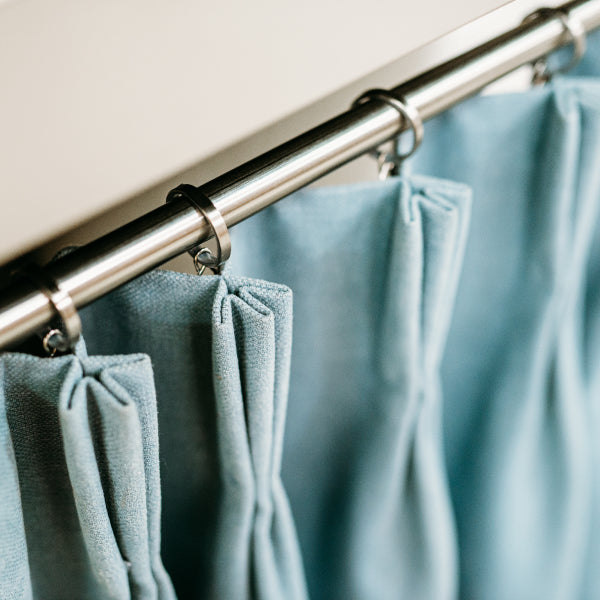
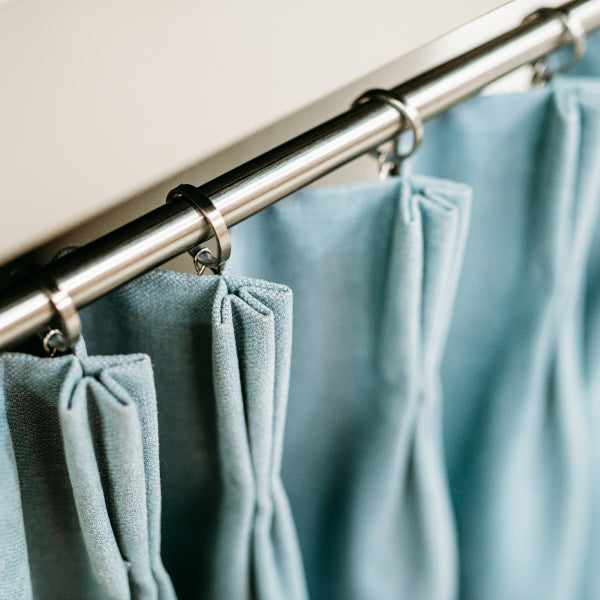
A decorative rod exposes the hardware and contributes to the room's style. It can be appropriate for lighter panels or a traditional scheme, but rings and brackets create a different movement pattern. If your priority is a continuous, controlled glide, a custom curtain track generally offers more predictable operation.
Manual or motorized
Manual operation remains a sound choice when the window is easy to reach and the panels are moderate in weight. A well-made manual traverse system can be quiet, durable, and visually restrained.
Motorization becomes more compelling for tall windows, large spans, frequently used rooms, accessibility needs, or a home already organized around smart controls. It also adds a motor and power requirement, so the electrical plan and load calculation belong in the early conversation.
Material and profile
Aluminum profiles work well for long, straight runs because they're light, stable, and available in configurations suited to professional drapery. Curved or heavier-gauge profiles are more appropriate when the track must follow a bay, handle substantial panels, or resist the forces created by repeated operation.
| Option | Best For | Drapery Weight | Look and Behavior |
|---|---|---|---|
| Wall-mounted track | Windows with molding, limited ceiling support, or clearance challenges | Light to heavy, depending on brackets and profile | Visible or partially concealed, practical projection |
| Ceiling-mounted track | Recessed pockets, modern rooms, and seamless architectural lines | Light to heavy, only with proper structural support | Minimal hardware, level alignment is critical |
| Manual traverse track | Reachable windows and regular daily use | Light to heavy, based on system specification | Controlled glide with straightforward operation |
| Motorized traverse track | Tall, wide, hard-to-reach, or accessibility-focused openings | Fabric, track, and motor must be assessed together | Button, remote, or smart-home operation |
| Straight aluminum profile | Long, uncomplicated runs | Light to moderate, with suitable support | Slim, clean, and adaptable |
| Curved or heavier-gauge profile | Bay windows, heavier panels, or demanding geometry | Moderate to heavy | Custom path with added structural attention |
A designer furniture project deserves the same level of coordination as the window treatment. Whether the room includes luxury sofas, premium sectionals, or statement furniture pieces, the track should support the composition rather than compete with it.
Measuring for a Custom Curtain Track
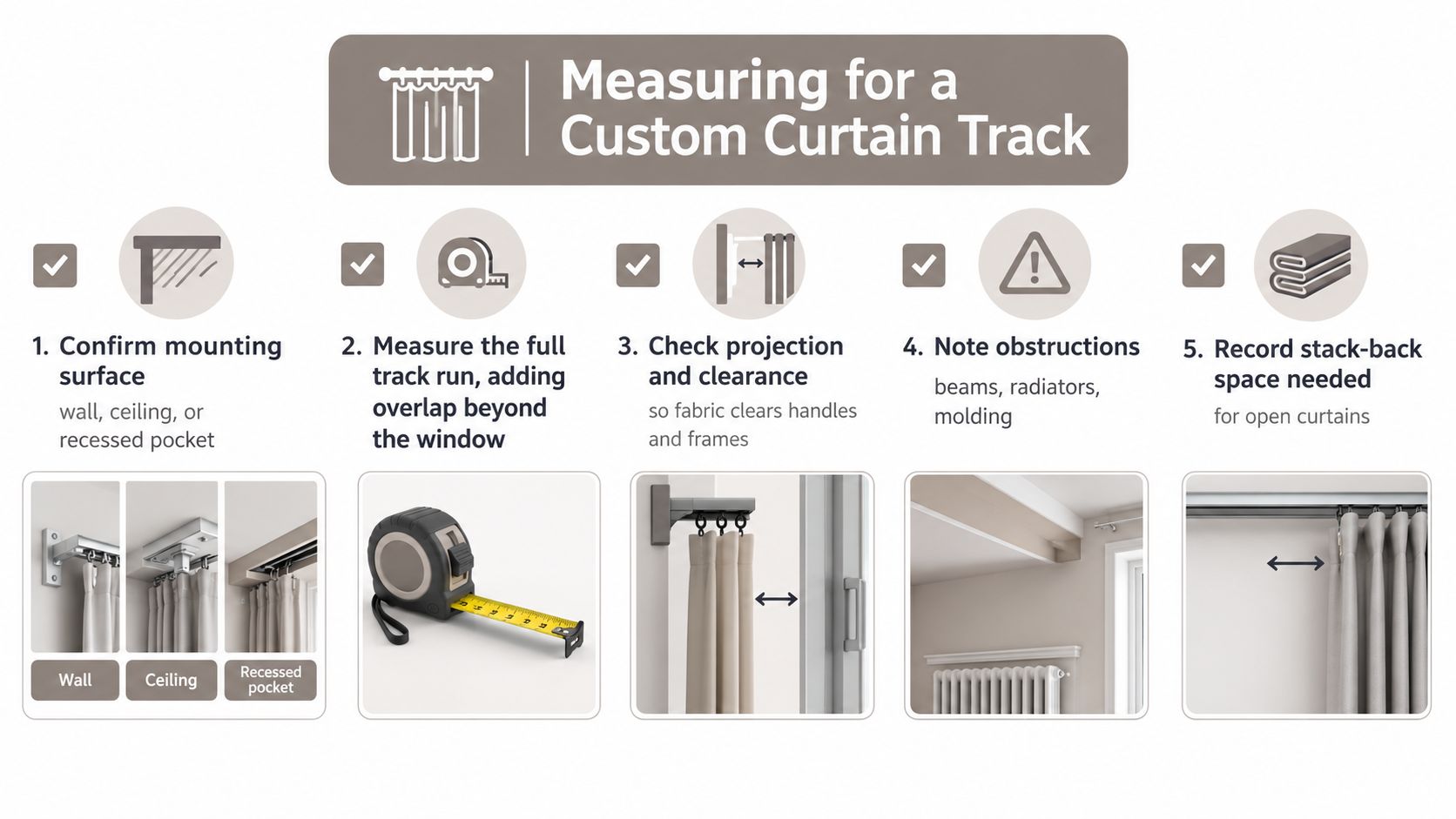
Measuring begins with the wall or ceiling, not the tape measure. Before recording a width, identify where the track can safely attach and whether the surface contains studs, blocking, or another load-bearing member.
For a wall mount, inspect the fixing line behind the finished surface. For a ceiling mount, look above the proposed track location and confirm that the structure can support the track, fabric, and any motor. If the ceiling cannot safely carry those loads, blocking needs to be provided before the finish work is closed.
Establish the full run
Measure the opening, then decide how far the track should extend beyond it so the panels can stack clear of the glass. Don't measure only the frame if the goal is an unobstructed view when the drapery is open. Record the desired draw, center opening or one-way opening, and the space available for the fabric stack.
For a recessed pocket, the practical specification is the slot-to-slot distance plus 6 inches. That added allowance helps the track and carriers fit the pocket configuration rather than only matching the visible opening.
A bay window may require a curved profile, segmented sections, or carefully coordinated joins. Sketch the bay from above and mark each angle before requesting a quote. A straight track ordered to the widest point won't follow the architecture.
Check projection and clearance
Projection is the distance from the mounting surface to the front of the track and fabric. Confirm that the finished panels clear window handles, door hardware, radiators, deep casing, and nearby furniture. Heavy lining and full-bodied upholstery can make a seemingly generous clearance feel tight once the treatment is installed.
For a dual-track arrangement, allow at least 5.25 inches of separation for ceiling-mounted tracks, as specified in professional motorized drapery installation guidance from Crestron. The exact spacing still depends on the profiles, brackets, fabric fullness, and lining.
If you're coordinating a broader renovation, the guidance on measuring for custom windows and doors can help you think about openings as built conditions rather than isolated trim measurements.
Write down:
- Mounting surface and fixing locations
- Full track run and opening direction
- Stack-back space on each side
- Projection and clearance obstacles
- Bay angles or splice locations
- Single or dual track configuration
- Manual or motorized operation
- Fabric weight, lining, and pleat style
For additional guidance on the window itself, Lewis and Sheron explains how to measure windows for curtains. A complete specification gives a workroom or supplier something useful to quote. One isolated width does not.
Installing Your Track the Professional Way
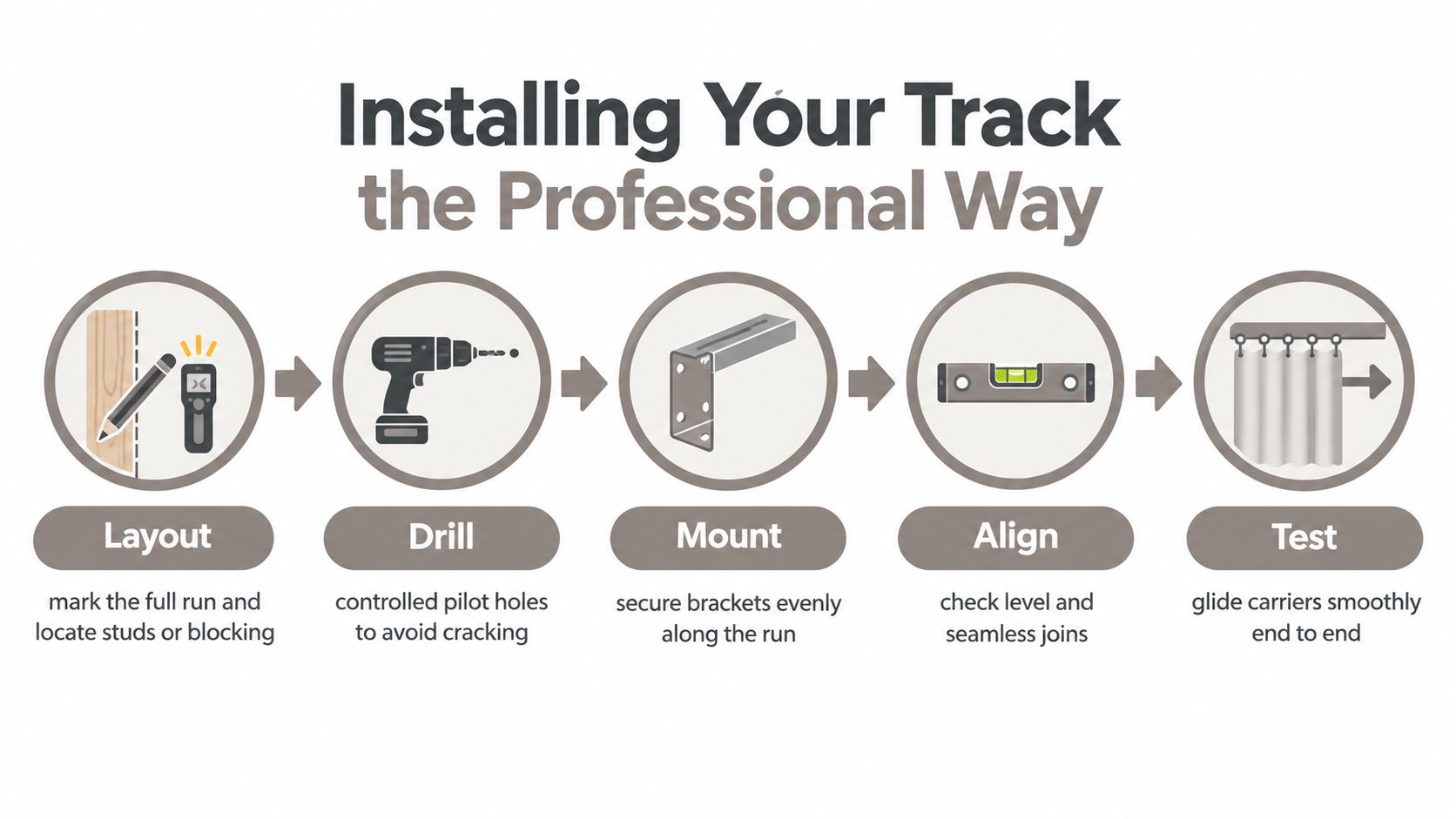
Professional installation starts on the floor or drawing board, not with the first screw. Lay out the full track run, including returns, joins, motor position, and opening direction. Mark the bracket line and locate studs or blocking before you transfer any hole locations to the wall or ceiling.
Controlled pilot holes help prevent cracking and make it easier to correct a small layout error before the final fasteners go in. Install the first and last brackets, then the center bracket, and continue with the remaining supports. End brackets should sit within about 4.3 to 5 inches of each track end, with the intervening brackets evenly spaced. Heavier panels may need additional brackets, especially across a long run.
Alignment determines movement
A premium track can still bind if it isn't level. Installation manuals specify that the track must be level for proper operation, with wall-mount brackets aligned on one horizontal line and fixed into studs or other load-bearing members.
If there's no structural member at a fixing point, don't substitute an ordinary wall plug because it happens to fit the screw. The anchor must be rated for the combined weight of the fabric, track, and motor, if a motor is part of the system. The mounting surface and the hardware rating need to agree.
Practical rule: The track should be level, the brackets should be aligned, and the fixing method should match the actual load.
Long or motorized tracks deserve a two-person workflow. One person can support the profile while the other aligns the brackets, checks the joins, and protects the track from twisting. Spliced sections are particularly vulnerable during handling, so keep them supported across their length rather than lifting from one end.
Test before the fabric arrives
Before hanging the drapery, move every carrier from end to end. Check the joins, returns, center meeting point, and any transition through a curve. A dry-run reveals a misaligned bracket or tight splice while the correction is still simple.
The correct sequence is visible in the installation workflow below.
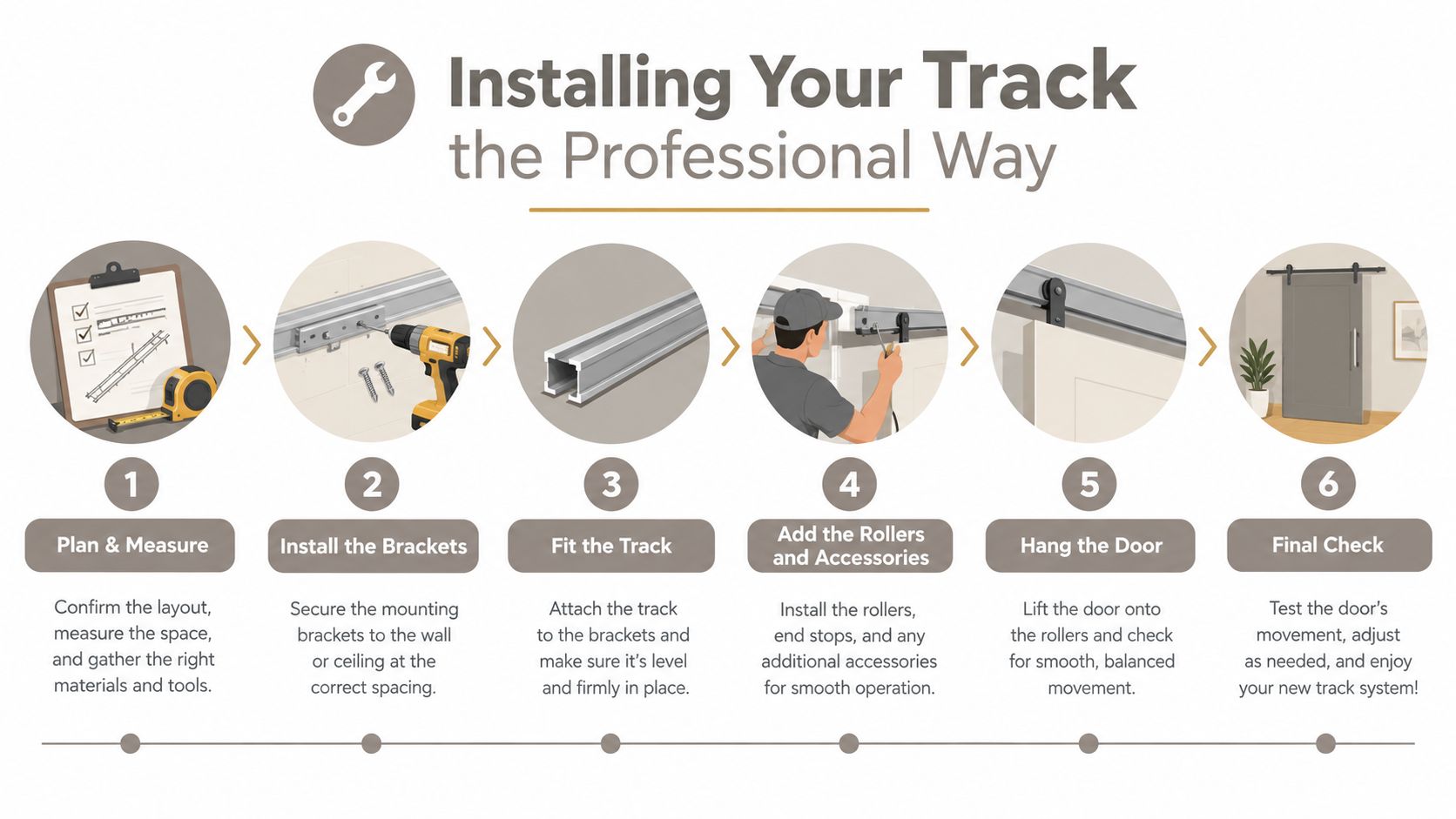
Only after the carriers glide freely should you attach the fabric. This protects the drapery from unnecessary pulling and lets the installer distinguish a hardware problem from a fabric-attachment problem.
Common Pitfalls and How to Avoid Them
The most expensive-looking failures often begin with inexpensive omissions. A few minutes spent checking the building, the projection, and the carrier path can prevent a finished window treatment from needing to be taken apart.
The most common root cause is misalignment. A track that isn't level or a splice that doesn't meet cleanly can create binding, uneven movement, and premature wear.
Mistake one, measuring only the opening
A homeowner measures the glass, orders that width, and discovers that the open panels still cover the view. The fix is to measure the full track run, including the stack-back area and any return. This matters especially for sliding doors and broad expanses of glass.
Mistake two, underestimating projection
Fabric catches on a handle, molding, radiator, or deep window casing. Before ordering, measure from the mounting surface to the nearest obstruction, then add the depth of the track, carriers, lining, and finished panel. A clean-looking ceiling installation still fails if the fabric cannot clear the room's hardware.
Mistake three, drilling without finding support
A bracket feels secure at first, then the track sags or an anchor pulls loose. Locate studs or blocking before you mark the run. Where structural support isn't available, specify an anchor rated for the complete installed load rather than choosing fasteners by convenience.
Mistake four, skipping the carrier test
The panels are hung before anyone checks the track. The first pull exposes a tight join or carrier that catches at one point. Run the carriers end to end before the fabric goes up, then correct the track while access remains easy.
Mistake five, mishandling a splice
Spliced tracks need careful support during installation. Never pick up a spliced track upside down, because the splice can bend. Keep the channel aligned, support the joined sections, and avoid twisting the profile while moving it into position.

When a Motorized Track Is Worth It
Motorization used to be framed primarily as a luxury feature. That description is now too narrow. Market coverage places the smart and motorized curtain track market at about USD 3.85 billion in 2025, with a projection of USD 7.15 billion by 2034, and identifies demand for ceiling-mounted and IoT-enabled systems in the same forecast from Accio's market overview.
The numbers don't decide a project, but they do clarify the direction of the category. Motorized tracks are being considered for convenience, accessibility, architectural simplicity, and integration with the way people already operate their homes.
When the motor earns its place
Motorization makes practical sense when the windows are tall, the span is broad, or the panels are difficult to reach. It's also helpful in a bedroom, media room, or living area where the drapery is adjusted every day. A smart-home connection can make the system feel integrated rather than added on.
Accessibility is another strong reason. A motor can reduce the need to reach, pull, or manage heavy panels manually. For a ceiling-mounted wave system, it can also preserve the uninterrupted appearance of the architecture while making operation simple.
When manual is enough
A manual traverse track may be the better choice for a reachable window, a moderate panel weight, and a room where the drapery is adjusted occasionally. It has fewer components, no power-access question, and can deliver excellent movement when the track is properly supported and aligned.
The compatibility questions deserve attention before you choose:
- Load: The motor adds weight to the system, so the structure and anchors must support the fabric, track, and motor together.
- Power: Confirm where power will come from and whether the cord, outlet, or wiring affects the proposed mounting line.
- Access: Decide how the system should behave if power or controls are unavailable.
- Span and fabric: Ask whether the chosen motor and profile suit the track length, curve, lining, and finished panel weight.
A simple decision framework works well. Choose motorization when reach, frequency, accessibility, or smart-home integration creates a clear daily benefit. Choose manual operation when the window is accessible and the system can deliver the movement you need without adding electrical complexity. In either case, specify the structure before selecting the convenience feature.
Working With Lewis and Sheron on Your Custom Drapery Project
A track is only half of the window treatment. The drapery it carries must be cut, lined, weighted, and constructed for the opening, the operating method, and the room's intended use.
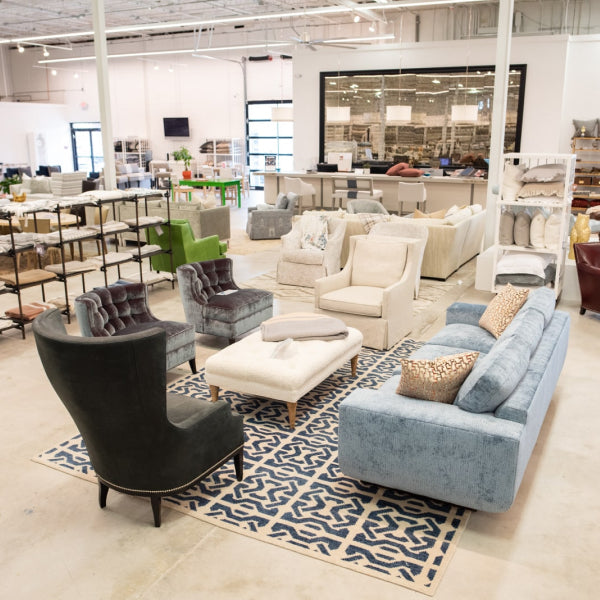
For Atlanta-area homeowners and designers, Lewis and Sheron coordinates track specification, fabric selection, and custom construction through one project. Its in-house designers are offered complimentary when shopping, and the showroom carries over a thousand in-stock bolts, along with cut-yardage from mills including Kravet, Fabricut, and Libeco Home. The business has served the community through four generations since 1944, with service for both designers and homeowners and nationwide shipping available.
That support is useful when a project includes a bay window, a recessed pocket, a heavy lining, or a choice between manual and motorized movement. You can bring:
- Your written measurements and mounting notes
- Photos of the window, ceiling, trim, and nearby furniture
- The fabric, lining, and pleat style you're considering
- Questions about clearance, stack-back, structural support, and controls
Lewis and Sheron's custom drapery service brings those decisions together so the track and the finished panels are treated as one coordinated installation.
Lewis and Sheron Textiles offers custom drapery, premium fabrics, designer furniture, and in-house design support for Atlanta-area homes and professional projects. Bring your measurements and window photos to Lewis and Sheron Textiles, and ask the team to help you specify a custom curtain track that fits the architecture, the fabric, and the way you live.