












Your favorite sofa still fits the Buckhead living room perfectly, but the upholstery no longer does. You're comparing warm brown hides, wondering whether to restore the frame or invest in something new, and the workroom has given you a fabric-yard estimate. Then you discover that buying upholstery leather by the yard isn't quite like buying fabric.
The important questions are how much of each hide can become furniture panels and which finish will tolerate your room. For homeowners choosing luxury furniture in Atlanta, those decisions deserve as much attention as silhouette, cushion comfort, and color.
Leather Finishes That Suit Luxury Seating
A beautiful hide has to suit the life around it. In that Buckhead living room, a formal sofa used for conversation has different demands from the family sectional where children, denim, and afternoon sunshine meet.
The finish, not the price per yard, decides whether that hide can live there. Start with the room's hardest condition, then choose the appearance you love within a suitable performance category.
The furniture-leather standard EN 13336:2022 covers aniline, semi-aniline, nubuck or suede, and coated or pigmented leather, while excluding fur, hair-on, and wool-on leather. Those categories describe useful differences, but they aren't a guarantee that every hide within a category performs alike.
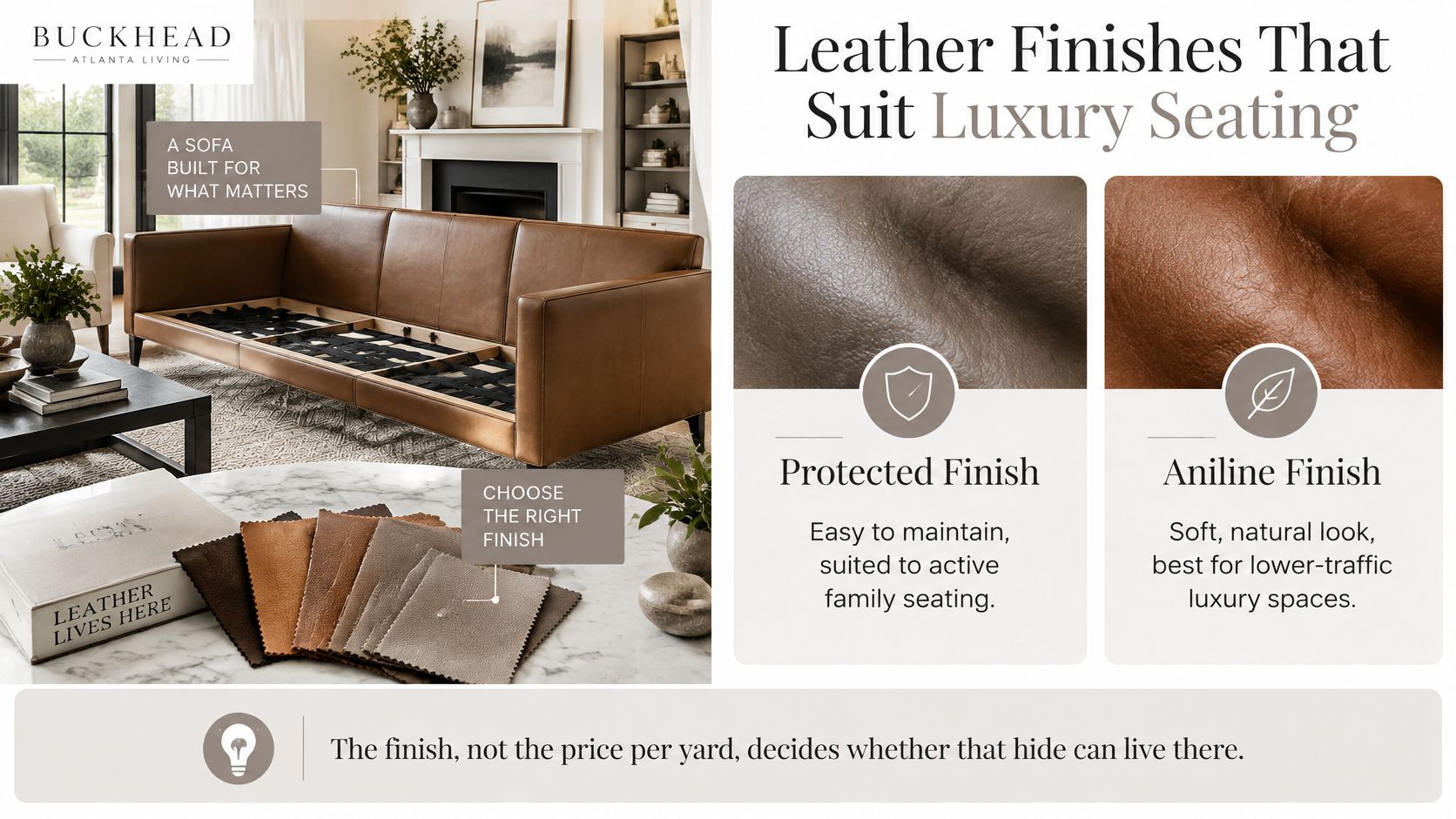
Upholstery leather finishes for furniture
| Finish | Hand and look | Stains and sunlight | Best use | Ask for |
|---|---|---|---|---|
| Aniline | Softest hand, open grain, color can shift hide to hide | Absorbs spills and fades in direct sun; develops patina | Formal living rooms and low-traffic adult seating | Lightfastness and a spill plan you will actually follow |
| Semi-aniline | Natural grain with a light protective film | Better spill resistance than aniline; still marks and can fade | Everyday luxury sofas and lounge chairs | Wet and dry rub plus finish adhesion |
| Pigmented or coated | More uniform color and a slightly firmer hand | Strongest resistance among these choices to stains, denim transfer, pets, and sun, subject to the product's testing | Family rooms, sunny rooms, dining chairs | Finish adhesion, flex resistance, and colorfastness |
| Nubuck or suede | Velvety nap that shades with direction | Shows oils and water; nap can crush on seats | Accent chairs and low-spill spots, rather than seat centers | Nap direction and whether the workroom will accept it on seating |
Aniline rewards someone who enjoys natural variation and accepts visible use. It's less comfortable as a decision for someone who expects every cushion to remain identical. Semi-aniline is often the sensible starting point for an everyday luxury sofa because it preserves grain character without leaving the surface quite so exposed.
Protected leather deserves consideration for an active Alpharetta family room, but protection isn't scratch-proofing. Nubuck can make custom chairs feel wonderfully tactile, provided you welcome directional shading rather than treating it as a defect.
Match the claim to the room
FIRA's guidance on specifying leather for furniture identifies tear strength, flexing endurance, finish adhesion, wet and dry rub colorfastness, and lightfastness as relevant performance properties. Use those properties to turn a lifestyle concern into a purchasing question.
- Sun across the cushions: Request lightfastness results rather than assuming a darker color won't fade.
- Denim and damp contact: Check wet and dry rub colorfastness. For wine, request separate spill-cleaning guidance because a rub test isn't a stain test.
- Repeated sitting: Look for flex resistance appropriate to seating.
- Frequently handled arms: Verify finish adhesion as well as surface wear.
Tyner Furniture's leather sofa advice for Michigan homes offers another useful consumer perspective when comparing leather seating. Apply any advice to your own exposure and maintenance habits rather than choosing by region alone.
A high abrasion number doesn't establish stain resistance, softness, or repairability. Choose your table row before doing the yardage math.
Square Feet to Order from Fabric Yards
Don't buy leather as if it were a rectangular fabric bolt. Start with the workroom's fabric estimate, convert it to a leather planning budget, and have the actual hides checked against the patterns.
Fabric yards converted to leather square feet
The following are worked planning examples, not standard yardage requirements for every piece. The conversion follows the hide square-footage estimator's allowance of approximately 18 square feet of leather per equivalent fabric yard, compared with the geometric 13.5 square feet in a linear yard of 54-inch-wide fabric.
| Piece | Fabric yards | Leather to budget (sq ft) | Small extra reserve |
|---|---|---|---|
| Accent or dining chair | 3 | 54 | Illustrative allowance of 5–8 sq ft |
| Loveseat or small sofa | 6 | 108 | Illustrative allowance of 10–20 sq ft |
| Standard sofa | 8 | 144 | Illustrative allowance of 15–20 sq ft |
| Deep sofa | 10 | 180 | Illustrative allowance of 18–25 sq ft |
| Sectional run | 12 | 216 | One extra same-lot hide, subject to layout |
| Large sectional | 15 | 270 | One extra same-lot hide, subject to layout |
The reserve column illustrates how you might budget for matching and a future repair panel. It isn't a published cutting allowance or an instruction to purchase those exact quantities without the upholsterer's approval.
A hide has curved edges, narrow areas, and places the cutter won't want on a visible seat. A generous total area can still fail to provide a broad, clean panel. Think of fitting a large baking tray into a cupboard: total storage volume doesn't tell you whether the opening is wide enough.
Allow for waste without counting it twice
The leather conversion already provides more area than the fabric rectangle. Don't automatically add another blanket waste percentage to the converted figure, then add another reserve because the material is leather.
Instead, separate the order into planning area and project-specific reserve. The cutter should decide whether the reserve needs to cover adjacent-panel matching, defects, unusually broad cushions, or a repair piece.
Ordering rule: A square-foot total is a budget. A pattern layout on the actual hides is permission to cut.
For premium sectionals, reserve material from the same lot while it's available. A later purchase in the same named color may not sit comfortably beside the original cushions.
Concealed deck areas may accept sections that aren't suitable for exposed seating. That flexibility helps, but it doesn't mean every offcut is useful: a narrow strip can't replace an uninterrupted cushion face.
Compare quotations on the same basis
Ask each supplier whether the quotation is per nominal yard or per measured square foot. If a nominal yard represents the planning allowance used in the table, divide the quoted yard price by that allowance to establish a price per budgeted square foot.
Keep that comparison separate from the final cutting yield. A lower area price isn't necessarily better value if the hides can't accommodate the visible panels.
Write the planning area and reserve separately on the order. Before cutting, require confirmation of each hide's measured area and the layout that those hides will support.
How to Measure and Order the Hide
A catalog yardage estimate is a starting point, not a leather cutting plan. Give the upholsterer enough information to identify a shortage before the material is committed.
Our guide to measuring fabric for upholstery can help you organize the furniture measurements. Leather also requires a map of where those measured shapes will fit.
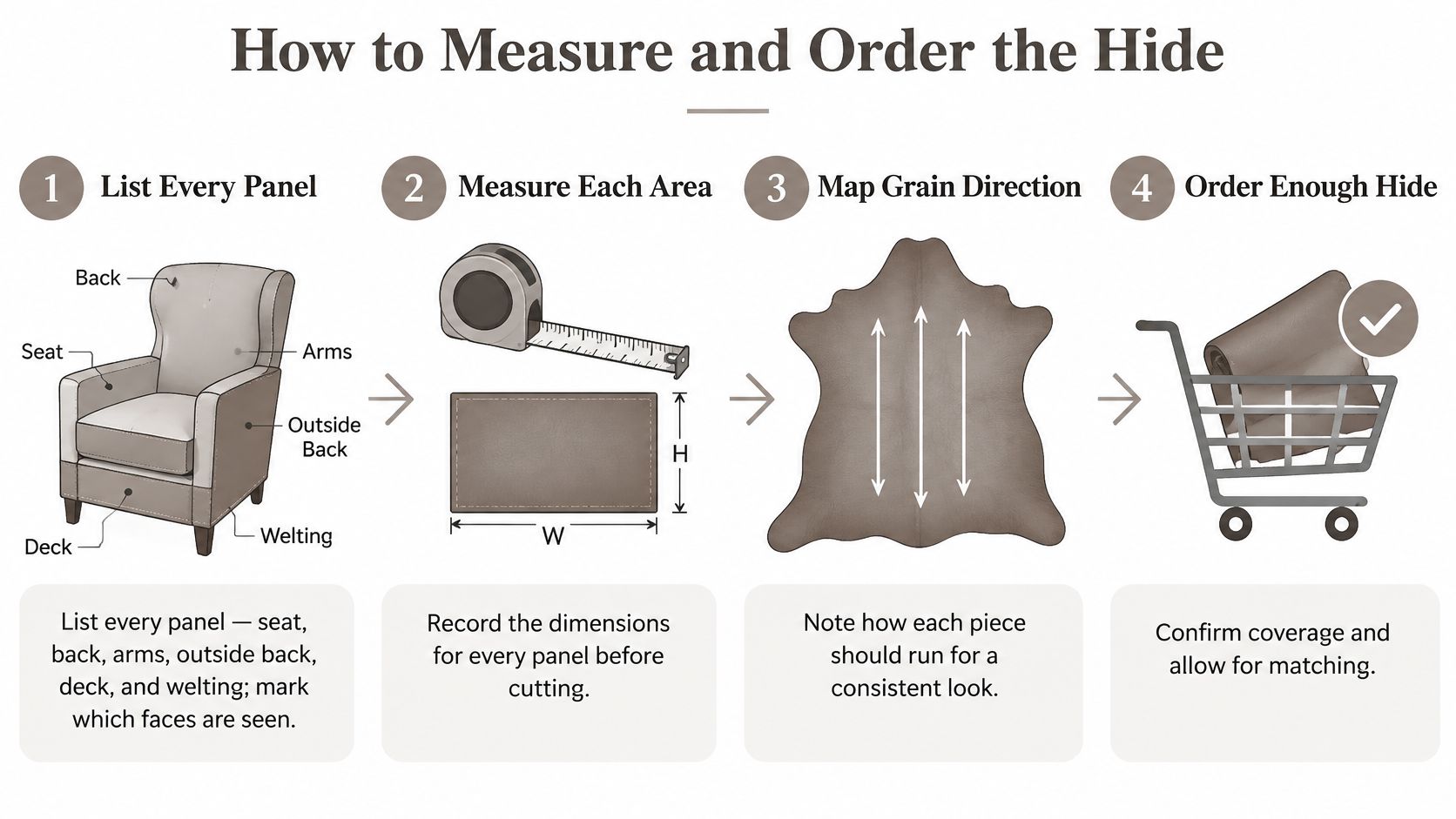
Build the cutting record
-
List every panel. Include seats, backs, arms, outside back, deck, and welting. Mark visible and concealed faces so the cutter doesn't use prime material where nobody will see it.
-
Measure each panel at its widest and tallest points, including the workroom's specified seam and turning allowances. For a hypothetical pattern, that might mean adding half an inch to an inch per edge, but the shop must set the allowance for the actual construction. This prevents ordering from finished dimensions alone.
-
Record the area budget and reserve separately. Use the conversion basis already established, then attach a drawing or paper pattern layout. Don't assume that a long cushion will fit merely because the total square footage looks generous.
-
Pull a full production hide or a substantial representative cutting. A tiny sample can help select color, but it won't show the distribution of scars, shading, stretch, or thickness. This step prevents approving an entire sofa from a perfect little corner.
Approve performance and production
-
Request the technical sheet. Include thickness, tear strength, tensile strength and elongation, flex resistance, grain strength, finish adhesion, bagging resistance, abrasion method, wet and dry rub performance, water spotting, and lightfastness. The Association for Contract Textiles abrasion guidelines distinguish test procedures, so don't directly convert Wyzenbeek double rubs into Martindale results. Confirm that the reported method is appropriate to the material being offered.
-
Test the intended cleaner on a spare cutting, using the proposed application method. Let it dry and inspect for color transfer, a changed sheen, stiffness, or a visible ring. Don't perform a deliberate spill test on a saleable hide without permission.
-
Approve a master hide for color and character. Record the dye lot, acceptable natural markings, and the agreed appearance under your room lighting. For complex custom upholstered furniture, approve a full-size mock-up before committing the remaining material.
-
Require the supplier to state the measured square feet per hide and the workroom to confirm directional coverage. Stop the order if the lot can't cover the visible panels in the approved orientation. That prevents a last-minute patch or an unmatched replacement hide.
Keep these approvals together rather than scattering them through messages. A dated panel map, material reference, and written approval give the cutter a usable production record, not a collection of preferences to interpret.
Grain Direction Seams and Panel Matching
Treat a hide like a map, not a bolt you can rotate freely. Different areas have different cutting value, and the most expensive mistake is assigning the right color to the wrong part of the furniture.
The broad butt area is the first place to investigate for seats and exposed backs. Neck areas can feel firmer or show wrinkles, while belly areas tend to stretch more. Let the cutter assess the actual hide rather than assuming every section behaves exactly like a diagram.
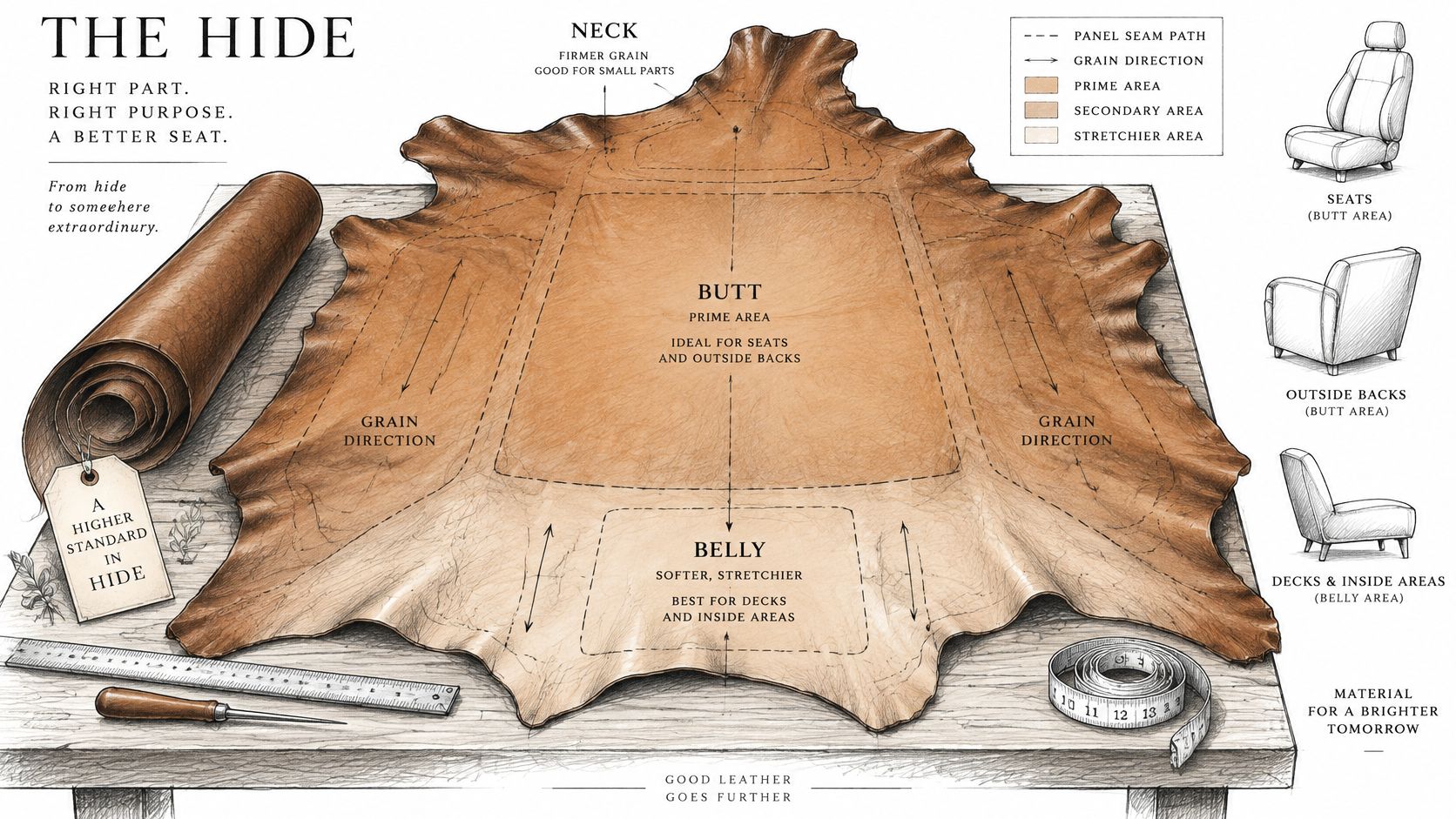
Put the best area where the eye rests
Place the cushion patterns before allocating scraps to small components. The center of a seat, the front of an arm, and the outside back of a floating sofa need clean, stable material.
- Seat faces: Reserve broad areas without distracting scars or localized stretch.
- Paired arms and backs: Keep the surface orientation consistent so neighboring panels read as a set.
- Concealed decks and interior faces: Consider softer edge sections only where the construction can accommodate their give.
- Natural marks: Approve their location deliberately. A brand hidden beneath a cushion is different from a brand on the leading arm.
Check the layout in raking light before cutting. A panel that looks compatible under overhead lighting may appear noticeably different when sunlight crosses the grain.
Matching means coordinating color, texture, and direction, not merely using hides with the same color name.
If hides differ slightly, use the master hide for the most prominent group of panels. Put a compatible secondary hide where the eye won't compare it directly with that group, such as an outside back or a distant sectional return. Don't scatter the difference across alternating cushions.
Let the frame determine the seams
Leather seams attract attention against a relatively smooth surface. Place joins at existing style lines, such as a boxed cushion edge, a welt, or a deliberate upholstered division, rather than inserting a patch through an uninterrupted back.
Our explanation of bias and grain in fabric helps distinguish woven-fabric layout from leather cutting. Leather has no woven bias, so the cutter should plan long welt strips around the hide's actual stretch and available length rather than copying a fabric layout.
Allocate welting after nesting the principal faces, but don't assume scraps will supply enough continuous material. Where necessary, a skilled leather workroom can skive seam or welt edges to reduce bulk, setting the depth against the actual thickness and construction.
Don't steam or heavily wet finished leather to force it around an unsuitable curve. Adjust the pattern, seam placement, or material choice instead. That restraint is part of what makes designer furniture look refined rather than merely covered.
What to Hand the Upholsterer
Leather won't rescue a loose frame or flattened cushion core. Before investing in a new hide, separate the value of the furniture's structure from your attachment to its appearance.
That distinction matters whether you're restoring an heirloom in Roswell or comparing custom versus mass-produced furniture in Sandy Springs. A recognizable silhouette isn't enough. High-quality couches need sound support underneath the upholstery.
Ask the construction questions first
- What is the frame? Have the joints, rails, and arms inspected. Sound hardwood with well-executed joints and reinforcement presents a different restoration case from an assembly already moving at its connections.
- What holds the seat? Identify the suspension and its condition. Re-covering shouldn't conceal failed support that will remain uncomfortable.
- What is inside the cushion? Request foam density and the full cushion construction, including wraps and inserts. Density isn't the same as firmness.
- Where must the leather give? A tight seat needs a different cutting decision from a softly filled loose back. The upholsterer should match panel stability to the design.
A DreamSofa construction discussion published by lohud uses 2.5-pound high-density foam as a shape-retention benchmark and describes frames built to its standard as engineered for 15 to 20 years or more, backed by a lifetime frame warranty. That's a manufacturer-specific benchmark, not a universal promise for furniture carrying similar upholstery.
For a new piece, ask exactly what the warranty covers. For an existing piece, have the structure assessed on its own condition rather than borrowing the expected lifespan of another manufacturer's frame.
Assemble a workroom packet
Hand over the approved master-hide reference, panel map, directional arrows, defect-placement approvals, and cleaner-test result. Include the final decisions about stitching, buttons, tufting, nailhead placement, and welting.
For premium sectionals, identify how the furniture separates for delivery or a future move. Decorative details and sectional connections affect where the workroom can place seams and how it can handle the upholstered components.
Before cutting: Authorize the shop to stop if the approved layout doesn't fit. Don't authorize improvisation on the most visible panels.
Ask the cutter to mark defects on the reverse or with a marking product confirmed safe for that finish. Ordinary chalk or tape shouldn't be assumed harmless on an absorbent surface.
To find the best luxury sofa brands or “designer furniture near me,” use these construction questions to judge the answer. Designer quality is visible in coherent proportions and careful detailing, but it also depends on what you can't see.
If the frame fails inspection, restoring it may be the wrong investment. Keep a frame because it's worth rebuilding, not because you've already chosen the leather.
Care That Keeps the Hide for Decades
Long-term value comes from choosing furniture you can maintain, not from expecting leather to be maintenance-free. That applies equally to statement furniture pieces and the family sofa used every evening.
Giorgi Bros' leather furniture guidance places full-grain leather at roughly 25 to 50 or more years and top-grain leather at approximately 15 to 25 years with proper care. Treat those ranges as guidance, not a warranty for every hide, finish, cushion, or frame.
Preserve the finish you selected
Use a soft upholstery brush attachment to remove crumbs from seams and cushion gaps. Grit left where people sit can abrade the surface, especially when it collects along welting.
Blot spills with a clean, absorbent cloth instead of rubbing them across a larger area. Keep strong direct sunlight off the piece with placement or window treatments, and address a concentrated sun stripe before it becomes a permanent color difference.
- Use the approved cleaner: Keep the tested product and its instructions with the furniture record.
- Avoid improvised treatments: Household wipes, saddle soap, and heavy oils aren't interchangeable with furniture-leather care products.
- Condition selectively: Follow the leather supplier's guidance for that finish rather than adopting a shoe-care routine. Some protected finishes don't need conditioning.
- Share the wear: Rotate reversible cushions where the construction allows, and keep pets' nails away from exposed arms.
Vinson Fine Furniture's guidance on cleaning top-grain leather furniture safely is a useful companion when establishing a care routine. Our guide to caring for high-end upholstery also helps you coordinate maintenance across mixed-material rooms.
Know when care becomes repair
A light mark on aniline may become part of the patina. A cracked pigment film or persistent color loss needs a professional assessment, not an untested home dye kit.
For homeowners across Fulton County and North Atlanta comparing luxury home furnishings, heirloom-quality furniture is a combined investment in material, construction, and upkeep. Exclusivity means more when the piece suits your room and can remain useful there.
At Lewis and Sheron Textiles, our Atlanta reupholstery process starts with a visit to the Design Studio to speak with Design Studio Associates about the piece. Bring clear photographs, dimensions, and any existing upholstery information so the frame, material choice, and detailing can be discussed before production.
Lewis and Sheron Textiles offers upholstery repair and reupholstery in Atlanta for custom furniture, accent chairs, armchairs, stools, headboards, dining chairs, love seats, ottomans, kids' recliners, rocking chairs, sofas, and sectionals. Visit Lewis and Sheron Textiles to speak with our Design Studio Associates about your piece and plan the material, usable area, and construction decisions before anyone cuts.