



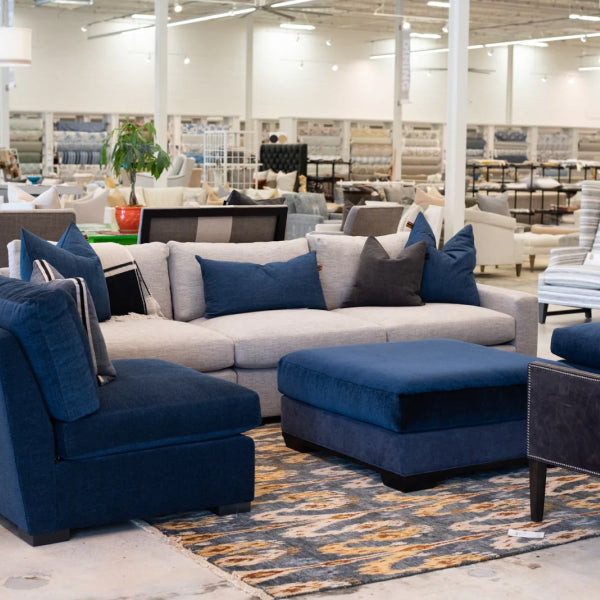

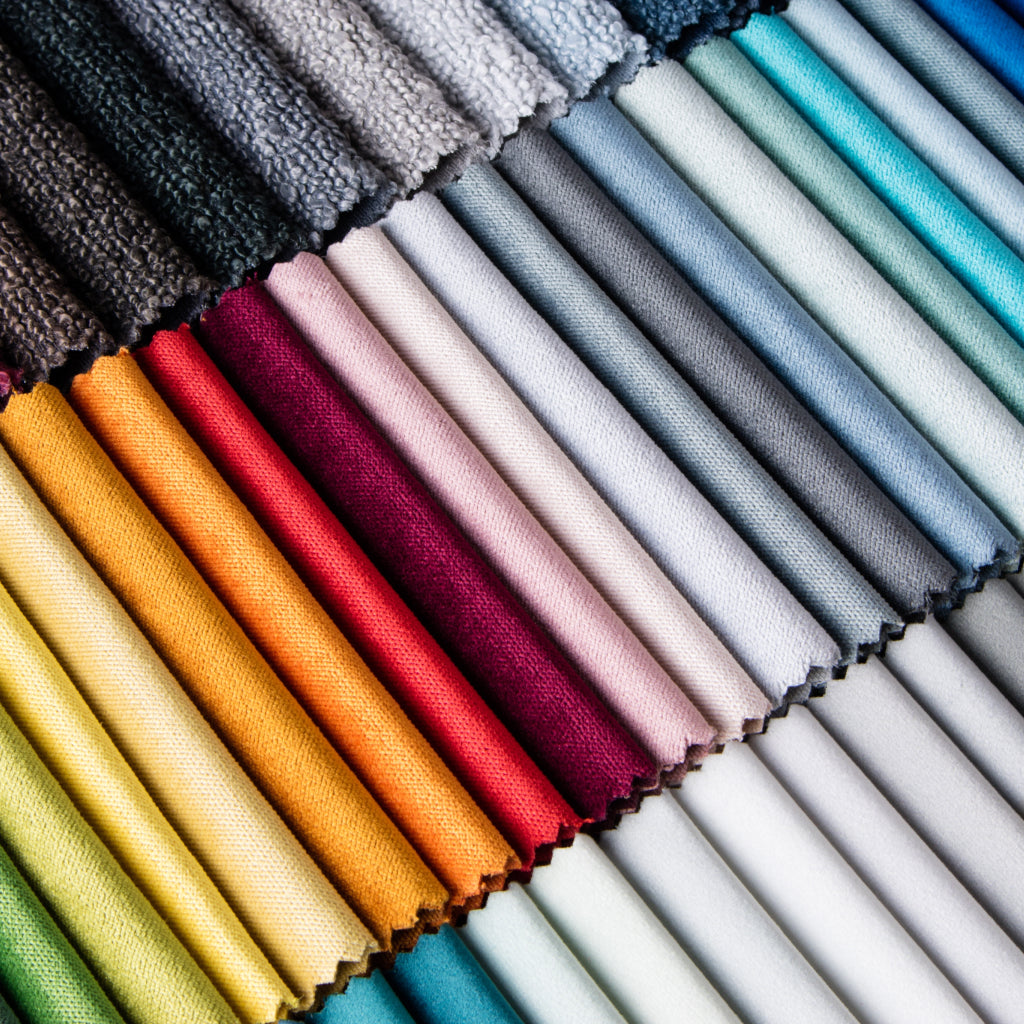

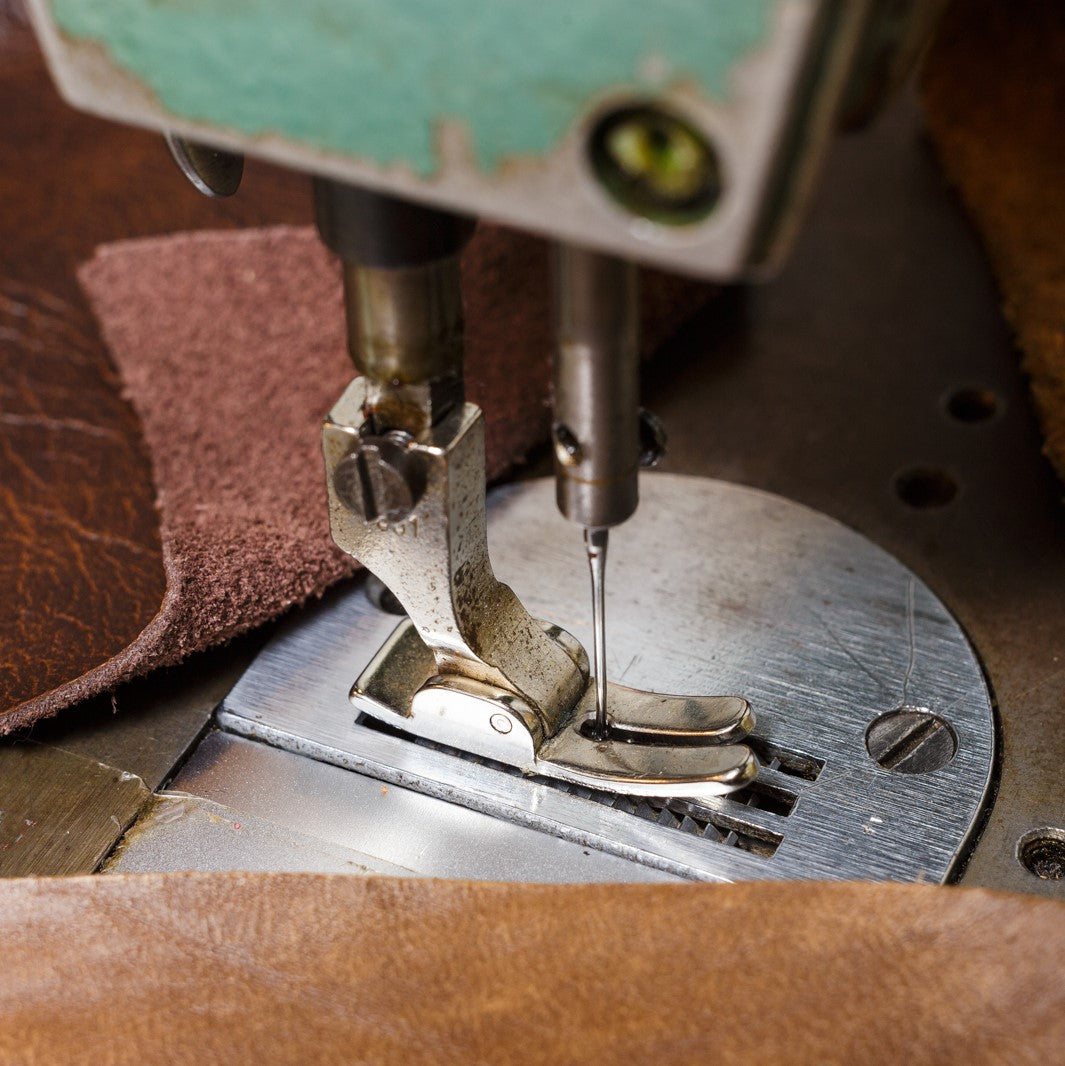
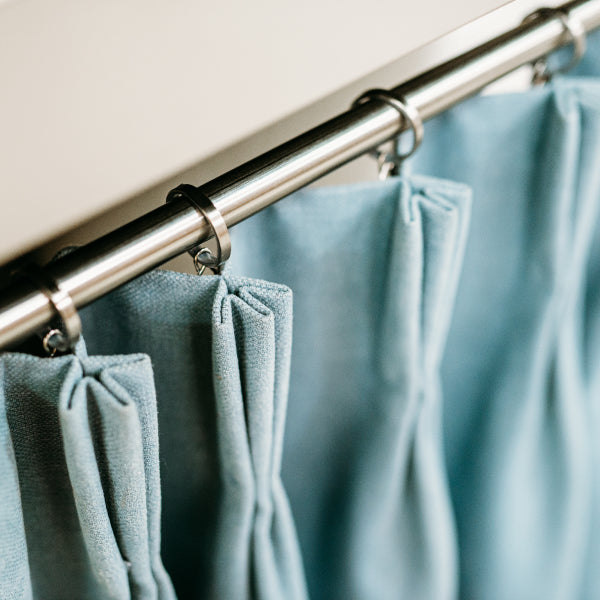


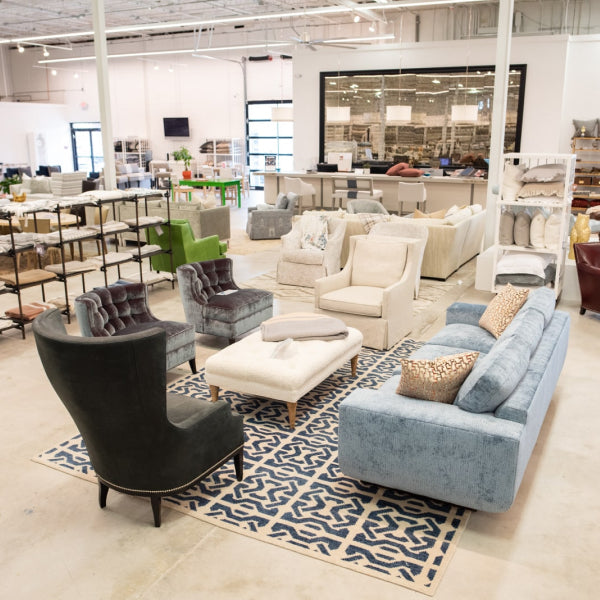

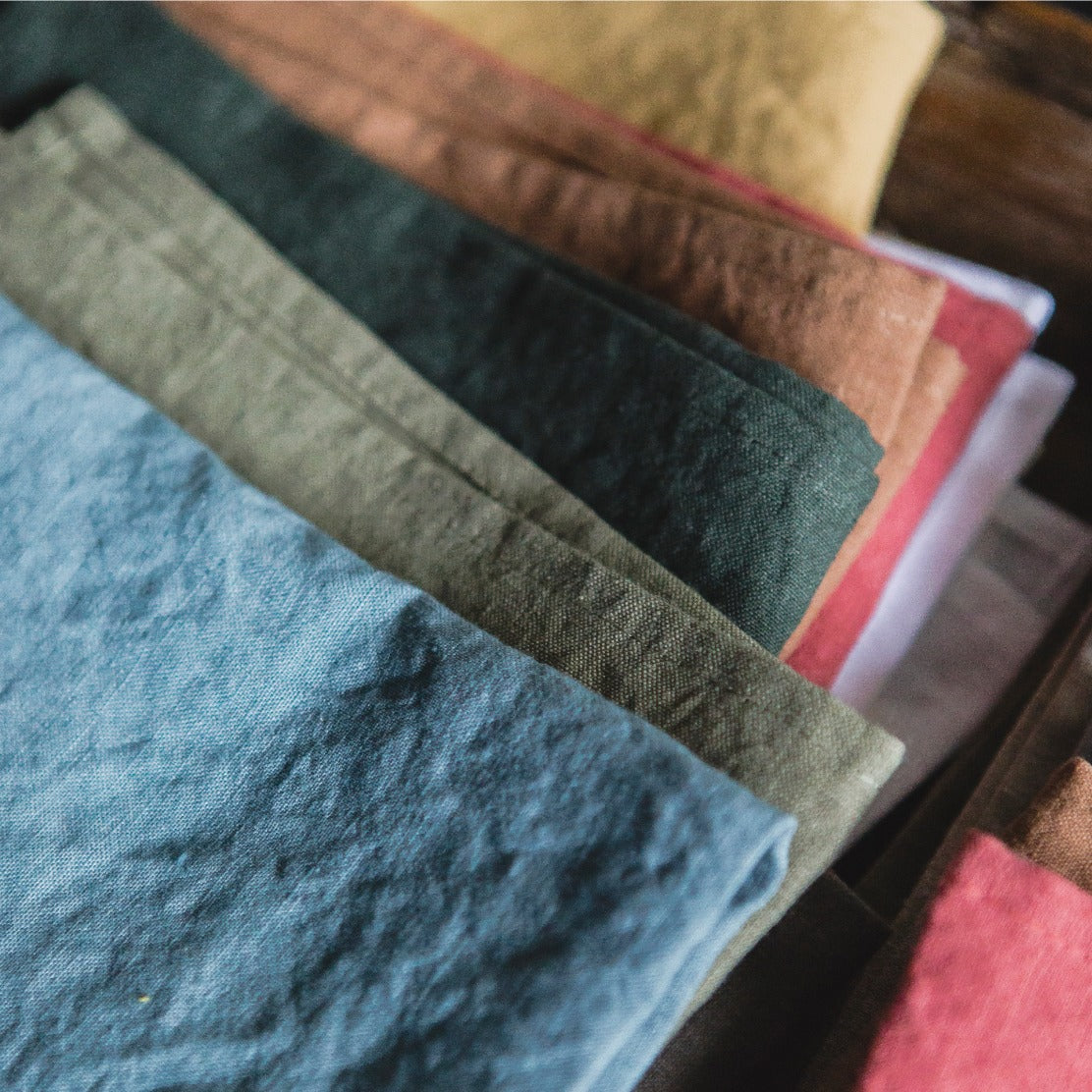

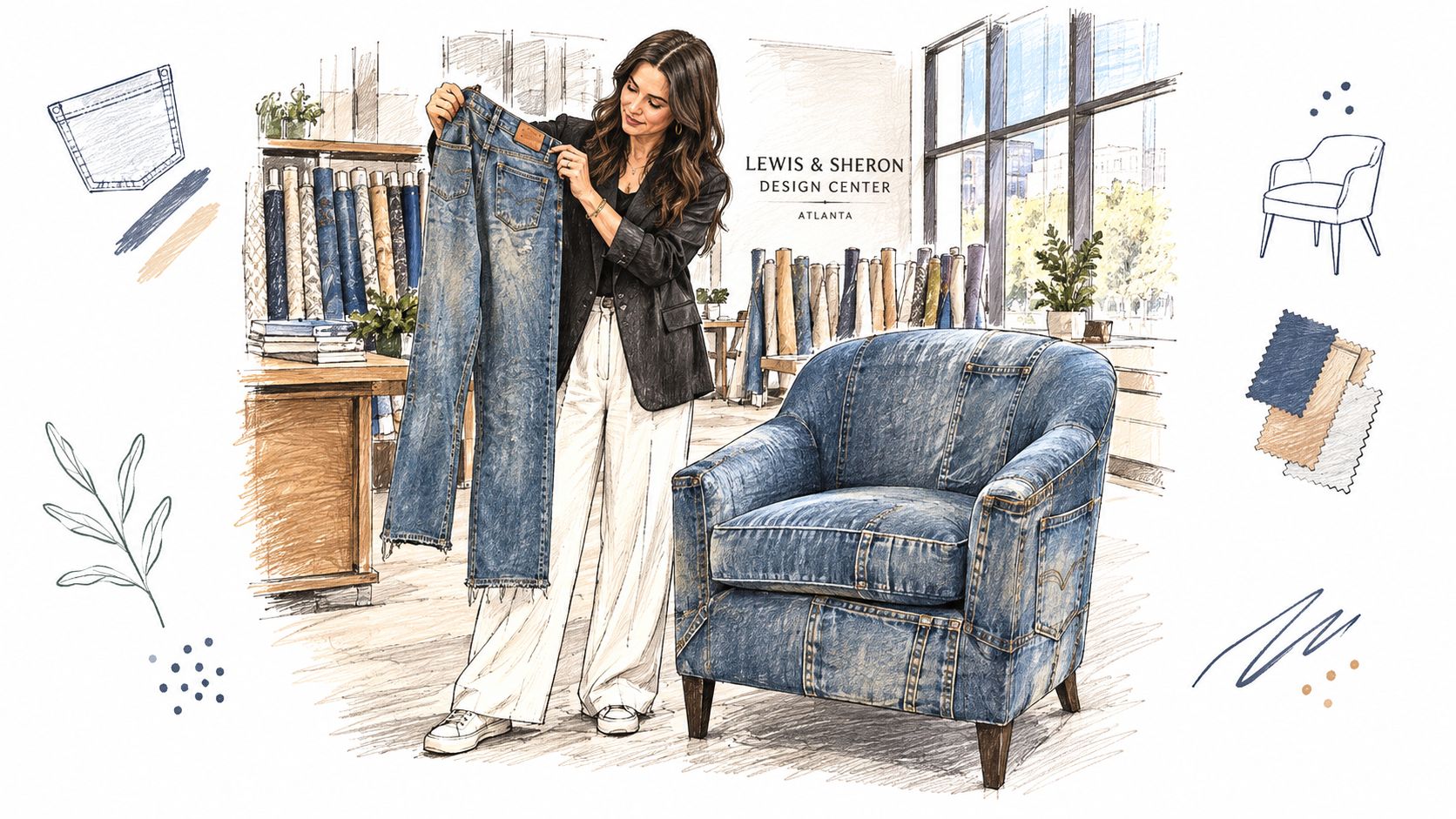
You're standing in the Lewis and Sheron Design Center in Atlanta with two denim samples in hand. One feels heavy and reassuring. The other feels lighter, softer, and somehow more alive. The question is not which one looks more expensive. It's which one will still look intentional after years of family use, cleaning, sunlight, and the daily friction of an upholstered frame.
That distinction matters when you're choosing fabric for a luxury sofa, premium sectional, custom chair, or statement furniture piece. High quality denim fabric isn't defined by color or weight alone. It's a construction with measurable strength, abrasion resistance, color retention, dimensional stability, and recovery. Treat it like an interior textile, not a pair of jeans cut into upholstery.
Why a Designer Walks In Holding a Pair of Jeans
A residential designer once came into the Atlanta showroom carrying a worn pair of jeans and a denim-covered accent chair rescued from a client's grandmother's home. The jeans felt substantial, but the fabric at the knee was close to failure. The chair's denim looked lighter and less rugged, yet its cover remained intact across the arms, seat, and back.
That contrast is exactly why trained eyes can still misjudge denim. A substantial hand can come from weight, finishing, or sizing. It doesn't tell you how the yarns will respond to repeated rubbing, how the color will behave under a damp cloth, or whether the fabric will hold its dimensions after cleaning.
The question behind the sample
The designer wasn't asking whether the chair could be made attractive again. That part was easy. The question was whether the replacement denim could support another generation of use without turning the chair into a fragile decorative object.
For a pair of trousers, fading may be desirable. For an upholstered seat, color transfer onto clothing or neighboring textiles is a problem. A little softness can make denim pleasant to wear, but excessive softness may signal a fabric that lacks the structural support required at a seat front or welt.
A designer's rule: Never approve denim for furniture because it feels expensive in your hand. Approve it because the mill can explain how it performs.
The same discipline applies whether you're furnishing a Buckhead townhouse, a Roswell family room, or a North Atlanta project with custom upholstered furniture. The fabric must suit the frame, the traffic, the cleaning expectations, and the way the room will be used.
What High Quality Denim Actually Means
High quality denim is a performance profile, not a visual category. For furniture, judge the cloth by how it behaves in both warp and weft directions, how it handles repeated contact, and how it changes during cleaning and daily use. A rich indigo face or soft hand can support a design concept, but neither proves that the fabric belongs on a sofa, ottoman, accent panel, or heirloom chair.
Start with the test vocabulary
Tensile strength measures the force required to break the fabric. Denim is often stronger along the warp, so request separate warp and weft results rather than accepting one combined figure. Tear strength measures how a cut or defect travels through the cloth. That result matters at seams, corners, welts, and attachment points, where a small weakness can become a visible failure.
Abrasion resistance matters most on sofa seat fronts, ottomans, cushion edges, and other high-contact areas. Martindale testing uses repeated rubbing, while Wyzenbeek reports double rubs. Common North American upholstery guidance identifies approximately 15,000 Wyzenbeek double rubs for general residential use and 30,000 or more for heavy-use or commercial environments, with comparisons mapping those levels to roughly 20,000 and 40,000 Martindale cycles. Review the upholstery abrasion benchmarks for furniture textiles, then ask which test method the mill used before comparing ratings.
Colorfastness to rubbing, also called crocking, shows whether indigo transfers during dry or wet contact. Colorfastness to washing and dimensional stability show how the cloth responds to laundering or professional cleaning. Denim quality research evaluates abrasion, tear strength, rubbing colorfastness, washing colorfastness, and dimensional stability through methods including ISO 13937-1, ISO 12947-2, and ISO 3759.
Use the report, not the sales language
For stretch denim, request stretch and recovery results. ASTM D3107 measures stretch properties in fabrics made with stretch yarns, while ASTM D5034 measures breaking strength and elongation. A fabric may feel comfortable on the sample table yet recover poorly after repeated compression. That weakness can leave a fitted cushion looking loose.
| Test | Property measured | Residential upholstery target | Why it matters |
|---|---|---|---|
| Tensile strength | Breaking force in warp and weft | Request separate conditioned results for both directions | Shows whether the cloth can withstand tension at seams and attachment points |
| Tear strength | Resistance to tear propagation | Compare documented results among candidate fabrics | Helps assess vulnerability around welts, corners, and cuts |
| Abrasion | Surface wear under repeated rubbing | Approximately 15,000 Wyzenbeek double rubs for general residential use, or 30,000 or more for heavy use, with the applicable Wyzenbeek and Martindale comparison | Predicts service behavior at high-contact areas |
| Colorfastness | Transfer during wet and dry rubbing, plus washing response | Request wet and dry crocking results and laundering data | Protects clothing, adjacent fabrics, and the intended indigo character |
| Dimensional stability | Shrinkage or growth after cleaning | Require residual dimensional-change data | Prevents loose covers, distorted seams, and ill-fitting replacement panels |
| Stretch and recovery | Extension and return after tension | Request results for every elastane blend | Indicates whether cushions will keep their tailored shape |
A mill that will not provide these results has not provided enough evidence to approve yardage. Ask for the test method, conditioning details, direction tested, and whether the results apply to the exact colorway and finish you plan to order.
Fiber, Weight, Weave, and Selvedge Explained
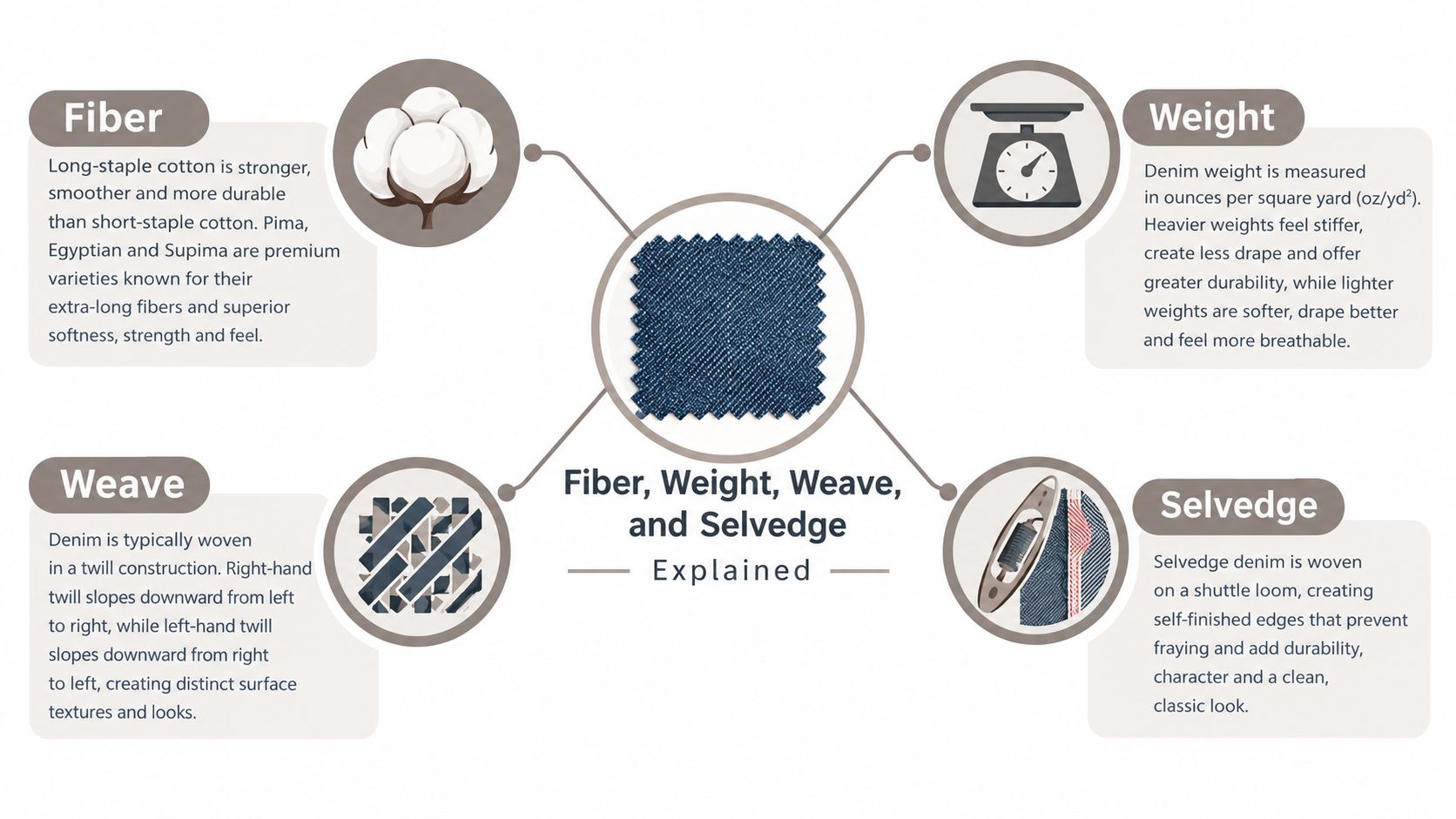
Read a denim specification sheet in four passes. First identify the fiber. Then assess weight, weave, and edge construction. Each variable influences the hand, appearance, workability, and service life, but none deserves to stand in for the others.
Fiber determines the starting character
Cotton remains the familiar foundation, but cotton quality varies. Long-staple cotton generally supports smoother, more consistent yarns than short-staple cotton. Pima, Egyptian, and Supima labels can be useful, but ask the mill to identify the actual fiber content and yarn construction rather than accepting a prestige name as proof of performance.
Recycled cotton can support a lower-waste construction, yet shorter fibers may require careful spinning and reinforcement to achieve the needed tensile performance. Tencel and other cellulosic fibers can change softness, moisture behavior, and drape. Elastane adds comfort and flexibility, but it also changes recovery and can reduce abrasion performance as its proportion rises, a trade-off documented in research on stretch content and denim durability.
Weight affects workability
Fabric weight is commonly discussed in ounces per square yard, while mills may also report GSM. Published denim studies classify approximately 200 to 300 g/m² as light denim and 300 to 600 g/m² as heavy denim, with increasing weight generally associated with greater warp tensile strength, compressibility, and stretch recovery, but lower air permeability and increased stiffness. Those relationships are summarized in denim construction research on weight and weave.
For furniture, weight must be evaluated with density, yarn count, and finish. A cloth that is technically heavy may fight a curved chair frame, while a lighter but tightly constructed denim may tailor more cleanly.
Weave controls the surface
The familiar 3/1 right-hand twill creates the diagonal face associated with denim and distributes wear effectively. Broken twill and basket structures can produce different surface directions, drape, and visual texture. Ask whether the mill is specifying ends and picks per inch, not only the weave name.
Selvedge is a construction detail
A selvedge edge indicates a self-finished woven edge, commonly produced on a shuttle loom. It can add character and provide a clean edge for selected design details, but selvedge alone doesn't guarantee superior quality. The yarn, dyeing, density, finishing, and test results still decide whether the cloth belongs on a sofa.
For a project where denim is paired with checks or a patterned design, explore plaid denim fabric to see how denim can function as part of a broader furnishing vocabulary. Use the edge for a deliberate design reason, not merely because it sounds artisanal.
Apparel Denim Versus Upholstery-Grade Denim
A pair of jeans and a sofa can share indigo color and twill structure, but they don't face the same stresses. Apparel denim is engineered for movement, laundering, softness, and a particular fashion effect. Upholstery denim must tolerate repeated rubbing, tension at seams, cushion compression, and the demands of a fixed interior environment.
Compare the intended job
Apparel denim may be soft, washed, lightly elastic, and designed to develop fading. That can be right for jeans, jackets, small decorative cushions, or a removable accessory. It's a poor reason to cover a luxury sofa.
Upholstery-grade denim should arrive with performance documentation. Look for abrasion results, seam slippage information, pilling results, colorfastness to rubbing, and any applicable flammability documentation required for the project. Some upholstery constructions use a stabilizing backing, coating, or companion layer to control stretch and improve handling. That support can make the difference between a clean fitted panel and a cover that shifts at every stress point.
| Specification | Apparel denim | Upholstery-grade denim |
|---|---|---|
| Primary purpose | Movement, comfort, laundering, and wash effects | Repeated contact, tension, compression, and clean tailoring |
| Abrasion documentation | Often absent or not central to the sale | Should include a stated Martindale or Wyzenbeek result |
| Seam behavior | Designed around garment seams and body movement | Must be evaluated at welts, corners, joins, and attachment points |
| Color behavior | Fading may be part of the aesthetic | Wet and dry crocking must suit furniture use |
| Stretch | Useful for fit and comfort | Requires recovery evidence before use on primary seating |
| Best applications | Jeans, jackets, and selected light accessories | Sofas, sectionals, ottomans, headboards, and high-contact chairs |
Before you select a fabric for a custom chair or sectional, use this guide to choosing upholstery fabric to match the textile to traffic, maintenance, and room function. For an existing piece, review how to reupholster furniture before ordering fabric. The workroom needs to know whether the cloth will be railroaded, patterned, backed, or joined at a visible seam.
My decision rule is simple. If the denim has only apparel information, keep it on apparel or low-contact accents. If it's going on a luxury sofa, require upholstery testing before committing to yardage.
The Heavier Is Not Always Better Trap
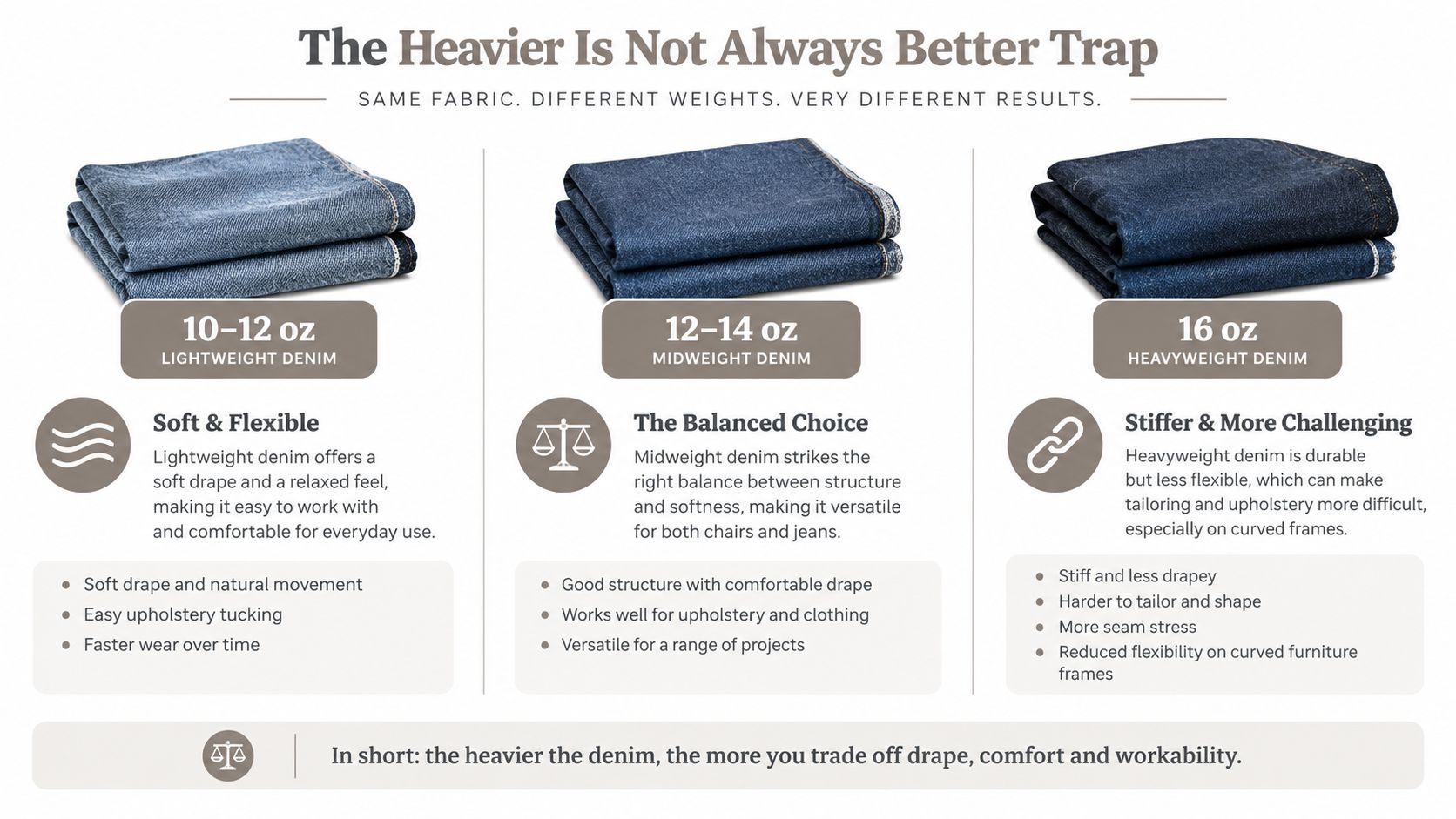
The heaviest denim on the sample table is often the first one a buyer reaches for. That instinct is understandable and frequently wrong.
A heavier cloth can improve body and resistance to certain stresses, but weight also brings stiffness, difficult tailoring, and reduced flexibility over curved furniture frames. A dense, well-finished midweight denim may perform better than a heavier fabric made with weaker yarns, looser construction, or unsuitable finishing.
Weight creates trade-offs
Very heavy denim can resist tufting and make crisp transitions harder to achieve. It can also add unnecessary load to a furniture system that depends on properly balanced webbing, springs, foam, and cover tension. Upholstery is a three-dimensional application. A fabric that looks impressive flat on a cutting table may behave poorly when pulled around a radius.
Light denim creates the opposite problem. It may drape beautifully but stretch across a seat, reveal the cushion beneath, or lose its intended shape under repeated compression. That's why fabric weight should be considered alongside yarn count, ends and picks per inch, weave structure, abrasion data, and recovery.
Blends deserve closer scrutiny
Elastane can improve comfort in apparel, but increasing spandex content may reduce abrasion performance. Recycled cotton can reduce dependence on virgin fiber, but the shorter fiber length must be managed through spinning and reinforcement. A 2025 peer-reviewed study found that post-industrial waste and up to 20% post-consumer waste could be used in tested denim without compromising fabric quality, and that fiber type showed no effect on abrasion or pilling resistance in those samples. The findings appear in the study of recycled content and denim performance.
That result doesn't give every recycled denim a free pass. Ask for the actual test report for the actual construction. Sustainability and durability belong in the same conversation, especially because blends containing elastane can make recycling more difficult.
My specification rule: Weight is one input. It isn't a quality grade.
A Specifier's Checklist for Buying High Quality Denim
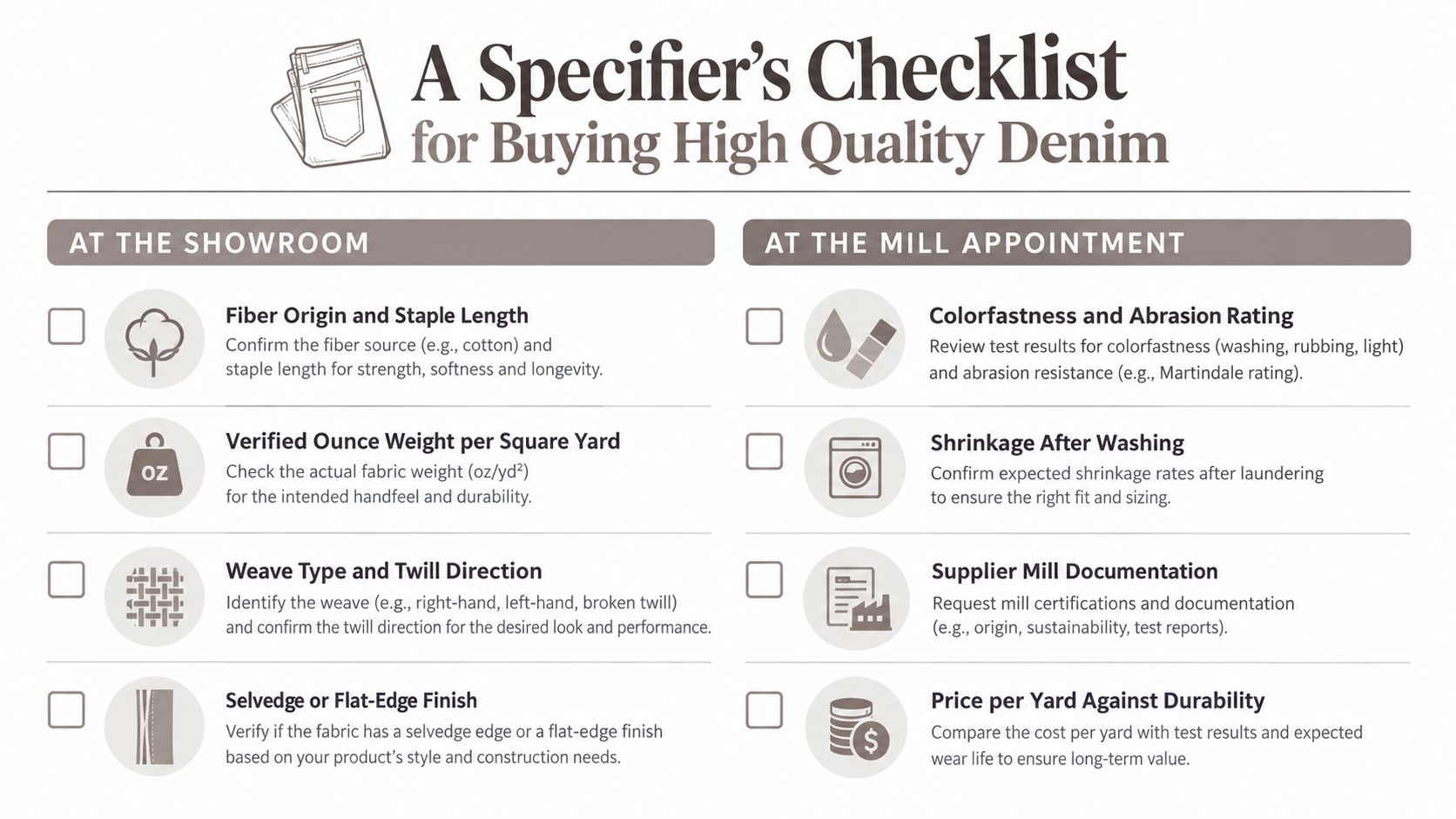
Bring this checklist to a mill appointment, workroom consultation, or showroom visit. If a supplier can't answer the first questions clearly, don't move to bulk yardage.
Qualify the construction first
Ask for the complete fiber disclosure, including cotton type where available, elastane content, and recycled fiber content. Confirm the weight in ounces per square yard or GSM, the weave construction, twill direction, selvedge or flat-edge finish, and country of origin.
Then ask how the fabric was dyed and finished. Rope dyeing, slasher dyeing, and pigment processes produce different surface character and color behavior. Confirm the pre-shrinking or sanforization process, minimum order requirements, lead time, and warranty terms in writing.
Demand evidence before approval
Request current test results for abrasion, tensile strength, tear strength, pilling, seam slippage, colorfastness to light, and wet and dry crocking. If the fabric will be used in a U.S. residential project, ask which flammability documentation applies to the finished upholstery assembly.
- Fiber: Verify fiber origin, staple description, and every blended component.
- Weight: Confirm the conditioned fabric weight, not an informal hand estimate.
- Weave: Record the twill structure, direction, density, and edge finish.
- Performance: Match the documented abrasion result to the room's traffic and use.
- Cleaning: Ask for shrinkage after laundering or the recommended professional-cleaning method.
- Sample: Obtain a memo and a full cutting large enough to assess hand, drape, color, and backing.
- Workroom fit: Let the upholsterer test stitching, turning, welt formation, and seam behavior.
For a deeper explanation of how abrasion affects upholstery selection, review fabric abrasion resistance for furniture applications. Then place the sample on the actual frame, under the room's lighting. Indigo can read dramatically different beside warm wood, Belgian linen, polished metal, or a hand-knotted rug.
Missing test data is a red flag. So is vague fiber disclosure or reluctance to provide a cutting. A supplier who expects a designer to approve expensive yardage from a tiny swatch is asking for an avoidable mistake.
Caring for Premium Denim Across Decades
Premium denim rewards controlled use and disciplined cleaning. Start by reducing concentrated abrasion. Rotate or reposition loose cushions when the design allows it, and don't let one seat, edge, or headboard section absorb every contact point.
Vacuum with a soft brush attachment and low suction. Remove dust before it works into the twill surface, especially on seat decks, piping, and the creases where cushions meet. For spot work, use distilled water and a pH-balanced cellulose cleaner compatible with the fabric's care instructions. Avoid optical brighteners, which can alter the way indigo reads.
Know when to call the workroom
A small mark is a cleaning question. Fraying thread, widening seam gaps, exposed welt cord, or a thinning line across a warp direction is a construction question. Don't scrub aggressively when the yarns are already weakening.
Use the fabric code and manufacturer's instructions before any wet treatment. Denim may be stable, sanforized, washed, coated, or backed, and those variables change the safe cleaning method. The care guidance for high-end upholstery is a useful reference before you attempt a deeper intervention.
Protect the story, not just the surface. A repair made early can preserve an heirloom chair. A late repair may require replacing an entire panel or cover.
Store loose denim panels, slipcovers, and seasonal cushions away from direct ultraviolet exposure. Keep them clean, dry, and supported rather than folded tightly for long periods. When the fabric begins to show structural fatigue instead of ordinary patina, call a professional workroom and evaluate reupholstery before the frame or cushion system suffers collateral damage.
Choosing Denim That Lasts in an Atlanta Interior
The right denim for an Atlanta home balances three realities: moisture in the regional environment, strong southern light, and genuine family use. Dimensional stability matters in a humid room. Colorfastness matters near bright windows. Abrasion and recovery matter on the sofa where people sit.
For a primary seating piece, choose a stable woven construction with documented tensile, tear, abrasion, crocking, and dimensional results. Reserve fashion-forward stretch denim for accents unless the mill can prove recovery and service suitability. Match the fabric's weight and weave to the frame rather than selecting the heaviest bolt in the room.
Ask for a substantial memo, then test the cloth on the actual frame. For a large custom project, a five-yard sample can reveal hand, seam orientation, railroaded cutting possibilities, nap or color direction, and the way the denim responds to corners and curves. The workroom should be part of that conversation before yardage is purchased.
For luxury furniture in Buckhead, Alpharetta, Roswell, Sandy Springs, Fulton County, and surrounding affluent markets, the best purchase is rarely the fastest purchase. Bring swatches, floor plans, and your maintenance expectations to the Lewis and Sheron Design Center for a specification review with a textile specialist.
Lewis and Sheron Textiles offers in-stock and cut-yardage home fabrics, including heavy-duty bull denim for custom upholstery, along with made-to-order furnishings and reupholstery support. Visit Lewis and Sheron Textiles with your frame dimensions and fabric questions so the final selection supports both the room's design and the piece's intended life.