





















You've chosen the sofa, settled on the wall color, and found a curtain fabric that looks right beside both. Then afternoon arrives: sunlight washes across the television, the room feels uncomfortable, and the beautiful panels don't solve either problem. Ordering custom curtains for living room windows starts with understanding the glass, not approving the swatch.
Decide What Each Window Needs From Its Curtains
The west-facing living-room window throws afternoon glare onto the television, while a shaded window beside the reading chair stays cool and comfortable. Giving both windows identical curtain construction may keep the room visually consistent, but it won't address their different conditions.
Curtains are a common window covering. Their effect on glare, heat, and drafts depends on construction, fit, and how easily the panels operate. A custom order lets you specify each window for the job it needs to do.
Give each window a priority
Start by identifying the main task for each treatment: privacy, light control, or thermal buffering. One curtain can help with more than one, but naming the top priority makes it easier to decide what to order.
Check each window in the room:
- Orientation: Which direction does it face, and when does direct sun reach it?
- Sightlines: Can neighbors or passersby see inside, particularly when lamps are on?
- Glare: At what time does sunlight interfere with television viewing or reading?
- Winter comfort: Does the glass feel cold from the seating area?
- Operation: Can everyone at home reach and move the curtains comfortably?
A north-facing bay beside a reading chair may need drapery that softens the light and adds comfort. For a west-facing window, consider a lined panel with exterior shading if afternoon glare is the main problem. Adding heavier curtain fabric alone may not solve it.
Matching panels can still have different specifications. Keep the same face fabric or color palette across the room, then adjust the lining, operating system, or underlying shade for each exposure. Check that any shade and curtain can be used as intended without obstructing one another.
Working rule: Record the main job for each window before choosing its construction. Use that priority to guide the lining, fullness, and hardware.
Choosing Fabric and Lining for Each Window
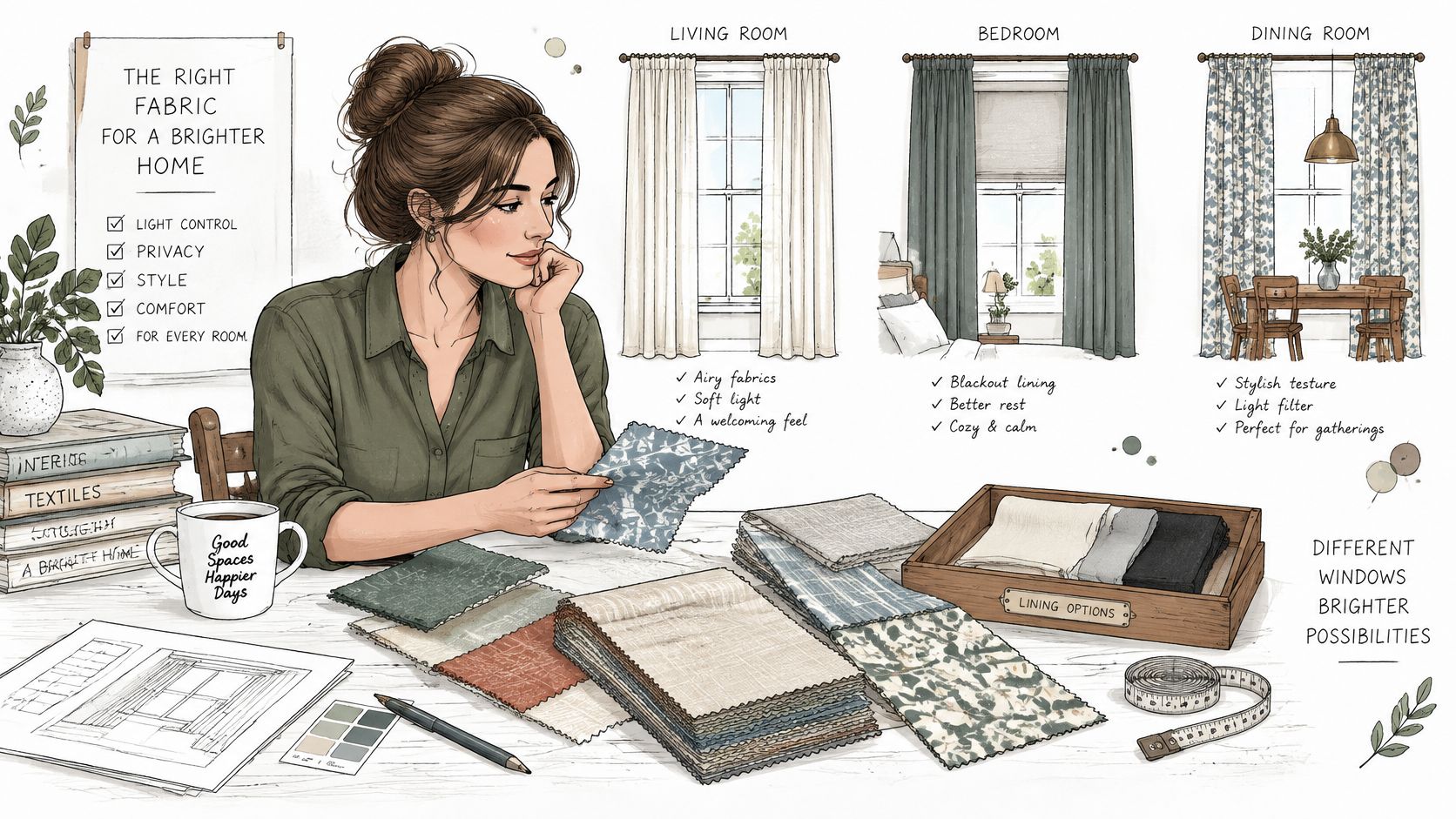
A west-facing living room may need curtains that cut late-afternoon glare, while a shaded window may need only a soft filter for daylight. Choose fabric and lining for the window's job, then check how the material looks in the room.
For a daylight-first space, consider sheers or light linen. Medium-weight cotton and linen blends offer a practical middle ground; heavier woven fabrics create a more structured treatment. View the fabric hanging vertically, since folds and drape can look different from a square sample.
Compare the complete construction
Lining changes the finished curtain, affecting opacity, weight, and drape. Use the comparison to start the conversation, then confirm the selected product's properties with the maker.
Lining options compared by performance
| Lining | Light control | Insulation and noise | Best fit |
|---|---|---|---|
| Unlined | Light filtering to sheer | Minimal | Airy rooms and daylight-first spaces |
| Cotton sateen lining | Moderate blocking | Protective backing for face fabric; not a moisture barrier | Everyday living rooms with direct sun |
| Interlined (batting layer) | Strong blocking, depending on construction | Added thermal buffering and sound absorption | Cold walls and formal rooms |
| Blackout lining | Near-total blocking through the fabric | Moderate, construction-dependent | Media rooms and glare control |
Use this guide to drapery lining to compare options with your workroom. Blackout lining does not guarantee complete darkness; light can still enter around the curtain's edges.
For south-facing glass in an Atlanta living room, cotton sateen may be worth discussing as a protective backing. Ask how the chosen lining handles sun exposure and moisture-related staining. It will not solve condensation or make damp glass safe for the fabric.
Sample against the room
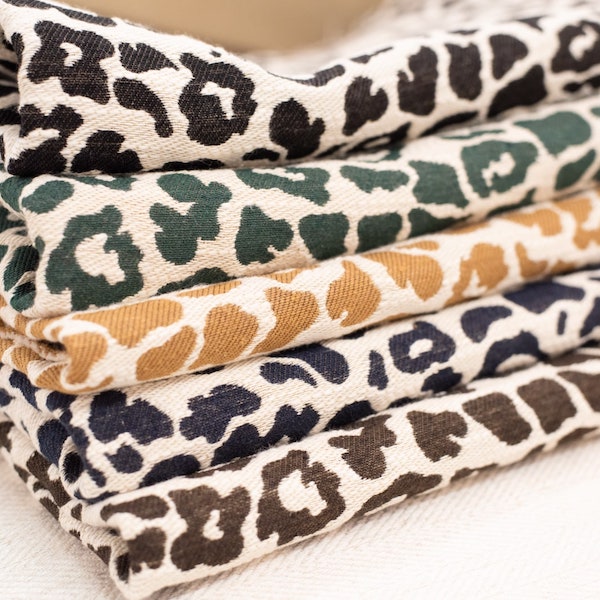
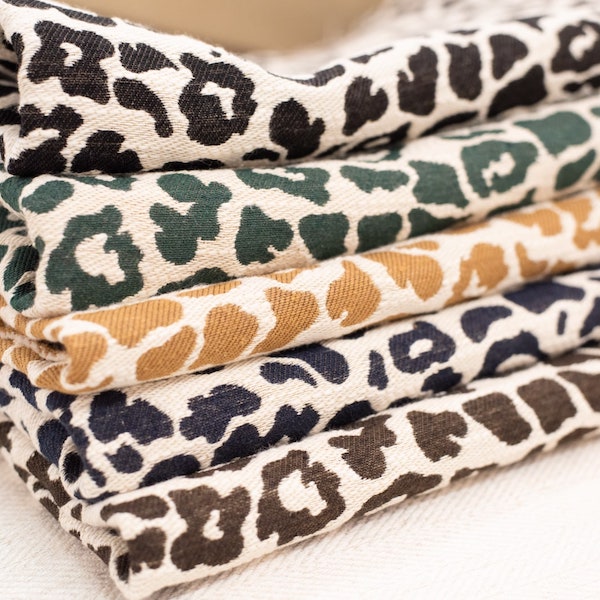
Hang samples beside the actual paint, flooring, and upholstery. Check them in daylight and lamplight. A large print can compete with statement furniture, so ask the workroom how pattern matching will affect the fabric order.
For measurable performance, ask the supplier for independently rated data on the window attachment. Lawrence Berkeley National Laboratory's window-reglazing ratings cover reglazing products. They do not establish the performance of a curtain or lining, so do not use them as proof of a drapery's insulation or solar-heat effect.
Fabric alone cannot stop substantial airflow around a window. Treat the curtain and its fit as separate parts of the order, and be wary of blanket energy-saving promises.
Specifying Heading Style, Hardware and Mounting
Choose the heading before calculating fabric. It determines the visible rhythm of the folds, the construction method, and the fullness your maker needs.
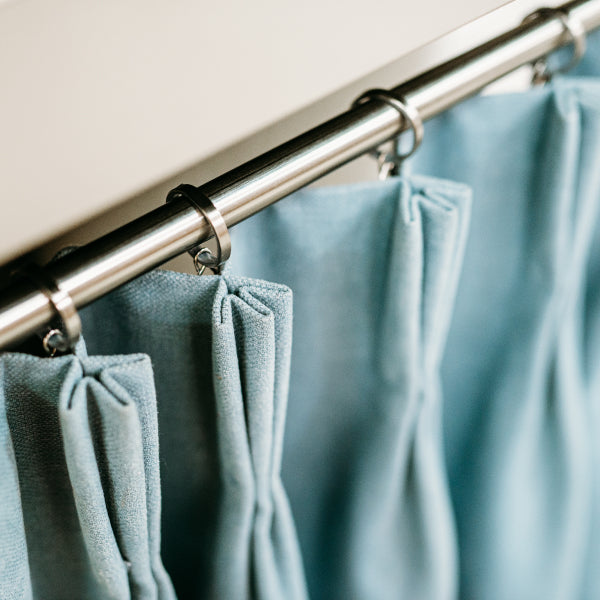
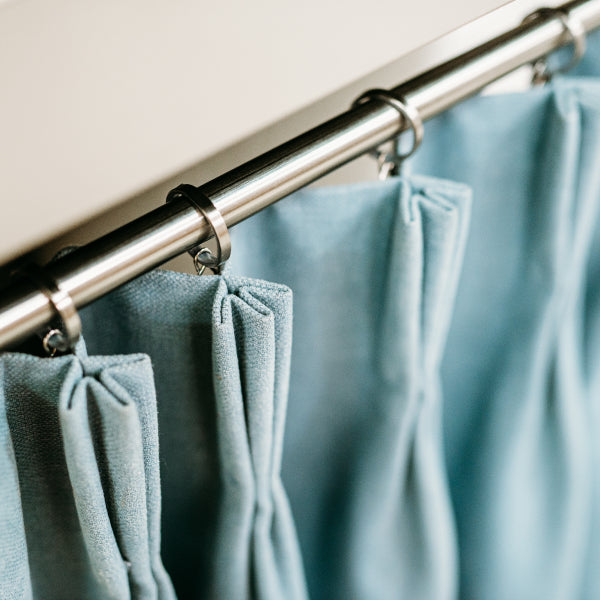
Pinch pleats suit a polished, formal room. Pencil pleats give a softer, classic appearance; grommets create a clean contemporary line. Rod pockets feel casual, while tab tops offer a relaxed silhouette. For curtains you'll operate daily, ask to test the proposed heading on its intended hardware rather than selecting from a photograph.
Match the hardware to movement
A decorative pole with finials makes the heading part of the design. A traverse rod suits panels that draw toward opposite sides, while a ceiling-mounted track can accommodate bays, long walls, and substantial linings when correctly supported and rated.
Consult the custom drapery hardware guide before committing to a finish. Bracket positions, panel travel, and weight capacity matter more than matching a metal accent on the coffee table.
Plan mounting and control together
Mount high and wide where the architecture allows, leaving room for the fabric to stack clear of the glass. Check crown molding, ceiling conditions, and nearby furniture before approving the location.
For someone with limited reach, strength, or vision, specify consistent control locations and an accessible wall switch or remote. Discuss low-force manual operation, battery replacement, smart-home compatibility, and power-outage arrangements. The accessible layered treatment described in Winsome Windows illustrates how automated functional layers can coexist with decorative side panels.
A daytime layer and a separate night layer can keep everyday adjustments independent of heavier decorative fabric. Carry the maker's approved heading ratio into the measurement sheet.
- Prefer cord-free controls: Keep any remaining cords inaccessible to children and pets.
- Clear the furniture: Position holdbacks so users don't have to reach behind seating.
- Check system capacity: Match the motor, track, brackets, and total fabric weight as a complete assembly.
How to Measure Hardware and Calculate Fabric Width
A living-room window can lose usable daylight if the panels stack across the glass, or feel draughty if they leave too much of the opening exposed. Measure the installed hardware and calculate fabric for the job each curtain needs to do.
Record dimensions in the order the maker needs them
-
Measure the usable span. Install the rod or track, then measure the span twice with a metal tape. Record any brackets, stops, or returns that limit panel travel. The full pole length may not be usable.
-
Check stack-back space. Open the panels and confirm they can clear the glass without covering switches or door trim. In general practice, allow about 15–30 cm beyond each side when the room permits. Treat this as a starting point: the window, wall space, and fabric weight determine what works.
-
Measure from the hanging point. Record the finished drop from the hook, carrier, or heading position to the intended hem. State whether the curtain should reach the floor, stop above it, or have a deliberate break. “Long” leaves too much open to interpretation.
-
Calculate finished flat width. Multiply usable track width by the fullness ratio approved for that heading and fabric. For example, a 240 cm track at 2.25× fullness requires 540 cm of finished flat fabric, before construction allowances. This is an illustrative calculation, not a cutting quantity.
Fabric width multiplier by heading style
Ratios are starting points, not universal specifications. Ask the workroom for its construction-specific ratio, especially for headings where fabric folds affect how the panels hang. Rod pockets and pleated headings do not necessarily use the same fullness.
| Heading style | Fullness ratio | Flat fabric for 240 cm track |
|---|---|---|
| Tab top | Confirm with maker | Calculate after approval |
| Grommet | Confirm with maker | Calculate after approval |
| Rod pocket | Confirm with maker | Calculate after approval |
| Pencil pleat | Often 2.0–2.5× | 480–600 cm |
| Pinch pleat | Often about 2.5× | 600 cm |
-
Separate coverage from construction allowances. Ask the maker to account for side returns, center overlap, seams, heading, hem, and possible shrinkage in natural-fiber fabric. These allowances serve different purposes. Some affect cut length rather than flat width.
-
Check usable roll width and pattern repeat. Divide the required flat width by the fabric's usable width to estimate the number of drops, rounding up to complete drops. The workroom then calculates cut lengths and pattern matching. Large repeats and railroaded fabrics need particular attention.
-
Send a complete measurement sheet. Include a hardware photo, heading, finished drop, and opening direction. Have the maker confirm the cutting quantity before you buy fabric.
Get the cutting quantity approved
Use this drapery yardage calculation guide to follow the workroom's calculation. Finished flat width is not the same as orderable yardage. Fabric width, pattern repeat, and construction determine how much to purchase, so don't order from the multiplication alone.
Common costly mistakes include measuring the window opening instead of the hardware, forgetting center overlap, and ordering before confirming the fabric width and repeat.
Ordering Through a Showroom and Booking a Visit
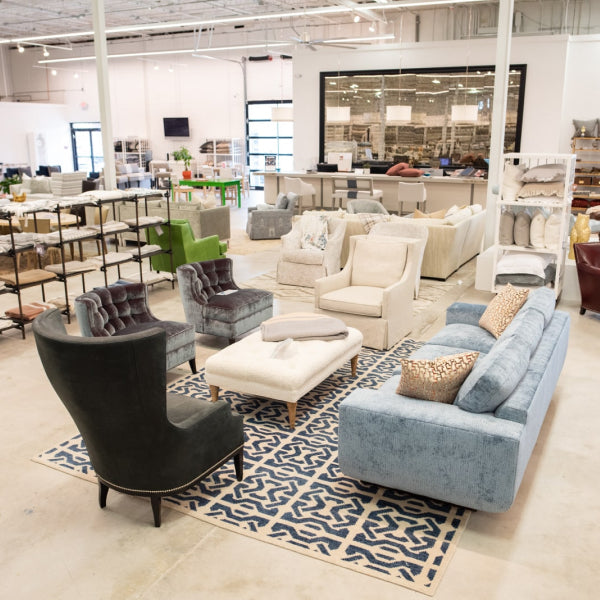
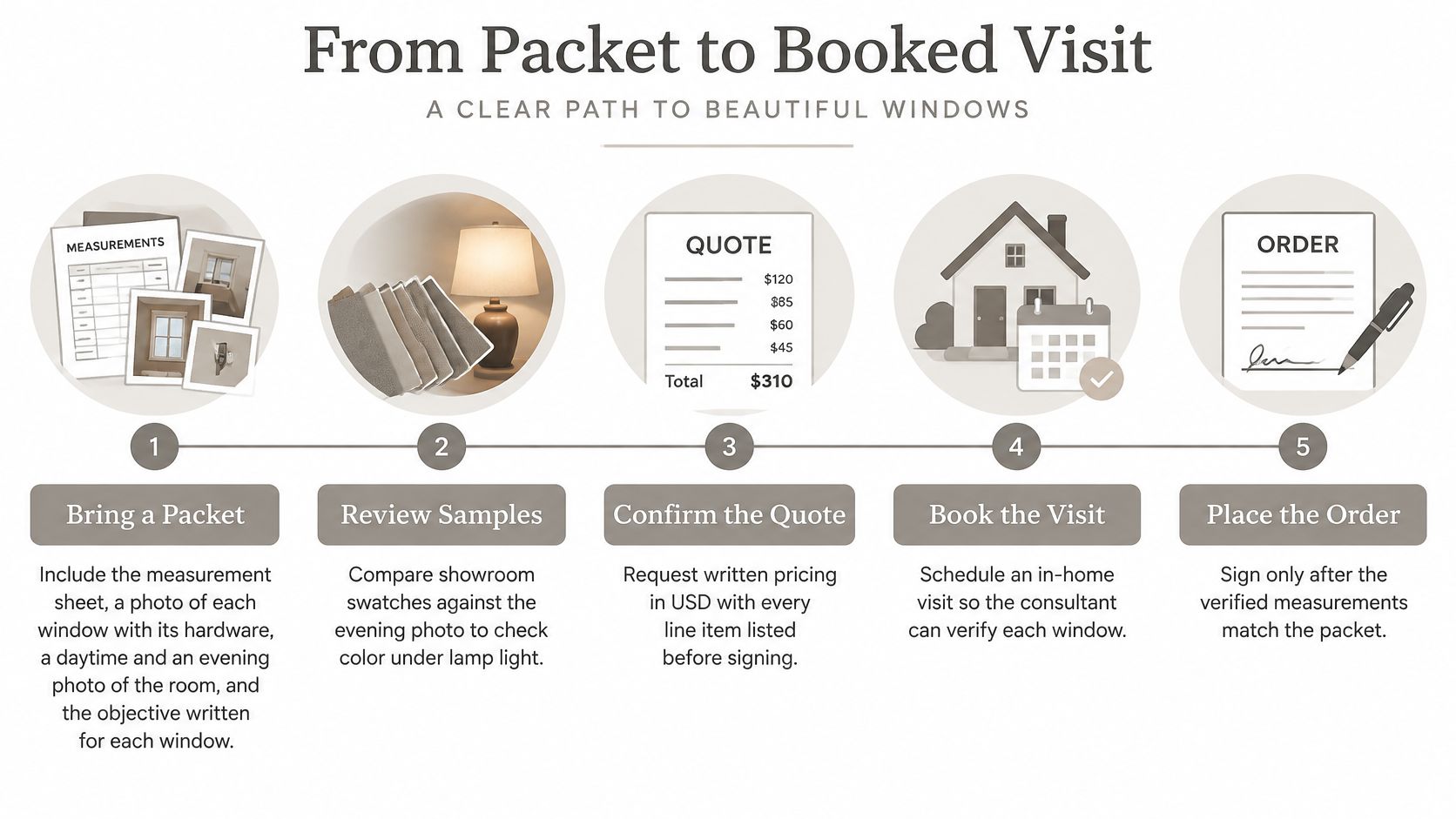
A window facing afternoon sun may need glare control, while a drafty opening calls for a different solution. Bring each window's purpose to the showroom appointment, along with your measurement sheet, photographs of the windows and hardware, and daytime and evening views of the room. This keeps the conversation focused on how the curtains must work, not only on a fabric swatch.
Take shortlisted swatches home before approving them. Hold each against the wall and floor, then check it around midday and under your usual lamps. A fabric that looks balanced in a showroom can read differently beside your furnishings or in changing light.
Buy a specification, not a description
Ask the consultant to record the details that will determine how the finished curtains look and operate:
- Construction: Which heading and fullness are included, and what lining is specified?
- Verification: Who checks the measurements, and who is responsible if they're wrong?
- Fabric handling: How will seams, shrinkage, and pattern matching be managed?
- Scope: Does the quote include hardware, delivery, installation, and adjustments?
- Timing and price: What is the lead time, and is every charge itemized in USD before signing?
Check that the written specification also reflects the job each window must do, such as limiting glare or reducing drafts. Ask the consultant to clarify any allowance or feature you do not understand before authorizing the order.
Approve the fabric, construction, dimensions, hardware, controls, and installation scope in writing. “Custom drapery” alone does not say what will arrive.
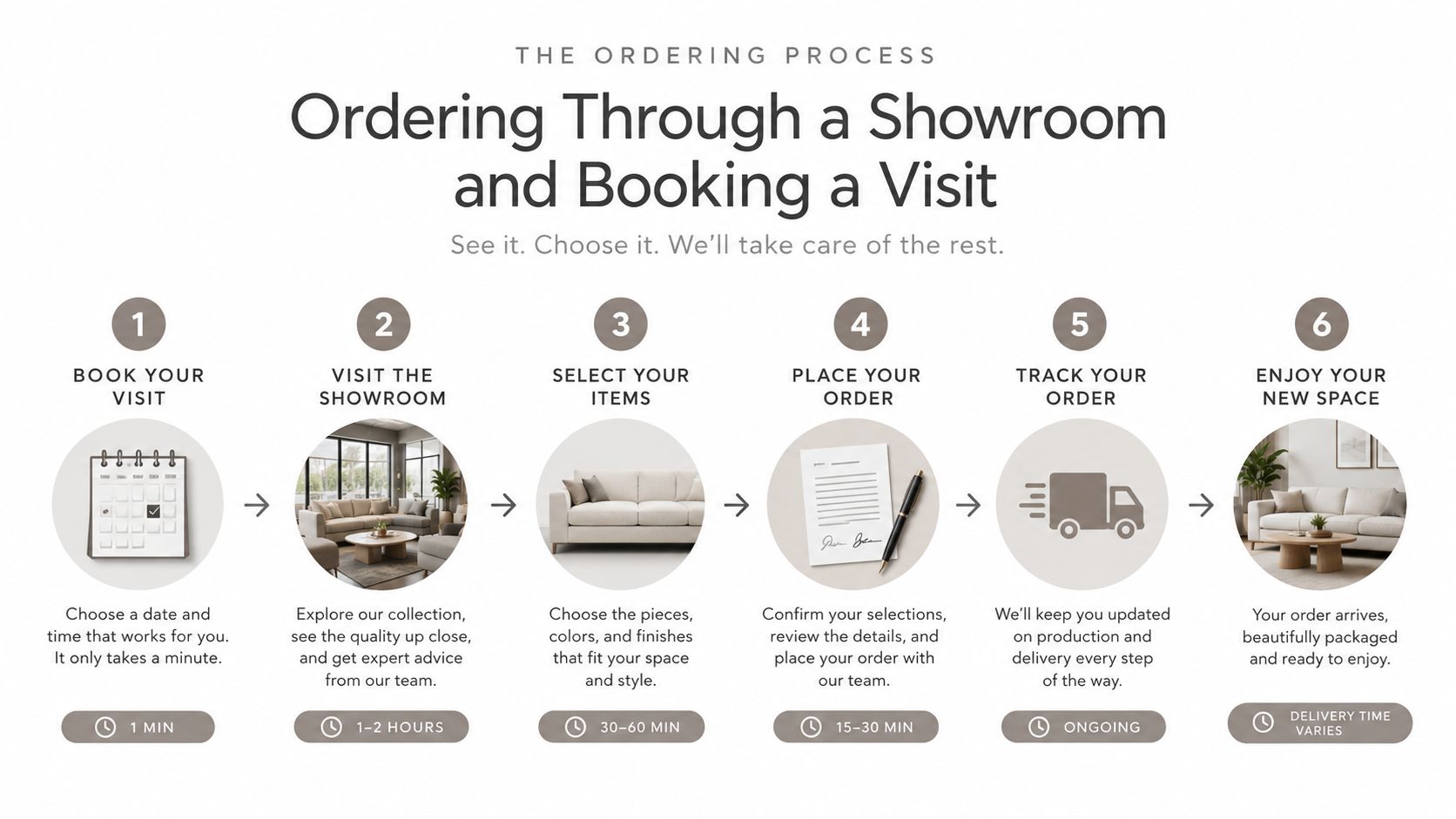
A common order problem is approving a sample without confirming that the full specification matches the room and the window's purpose. Keep the sequence clear: measure, sample, confirm the order sheet, fabricate, install. Before final approval, book an in-home measure-and-consult visit. Have the maker verify the site measurements and discuss the proposed fullness, seams, and hems against the actual windows and hardware. Approve the order only after the written details reflect what each curtain needs to do.
Installing Custom Curtains and Fixing Common Problems
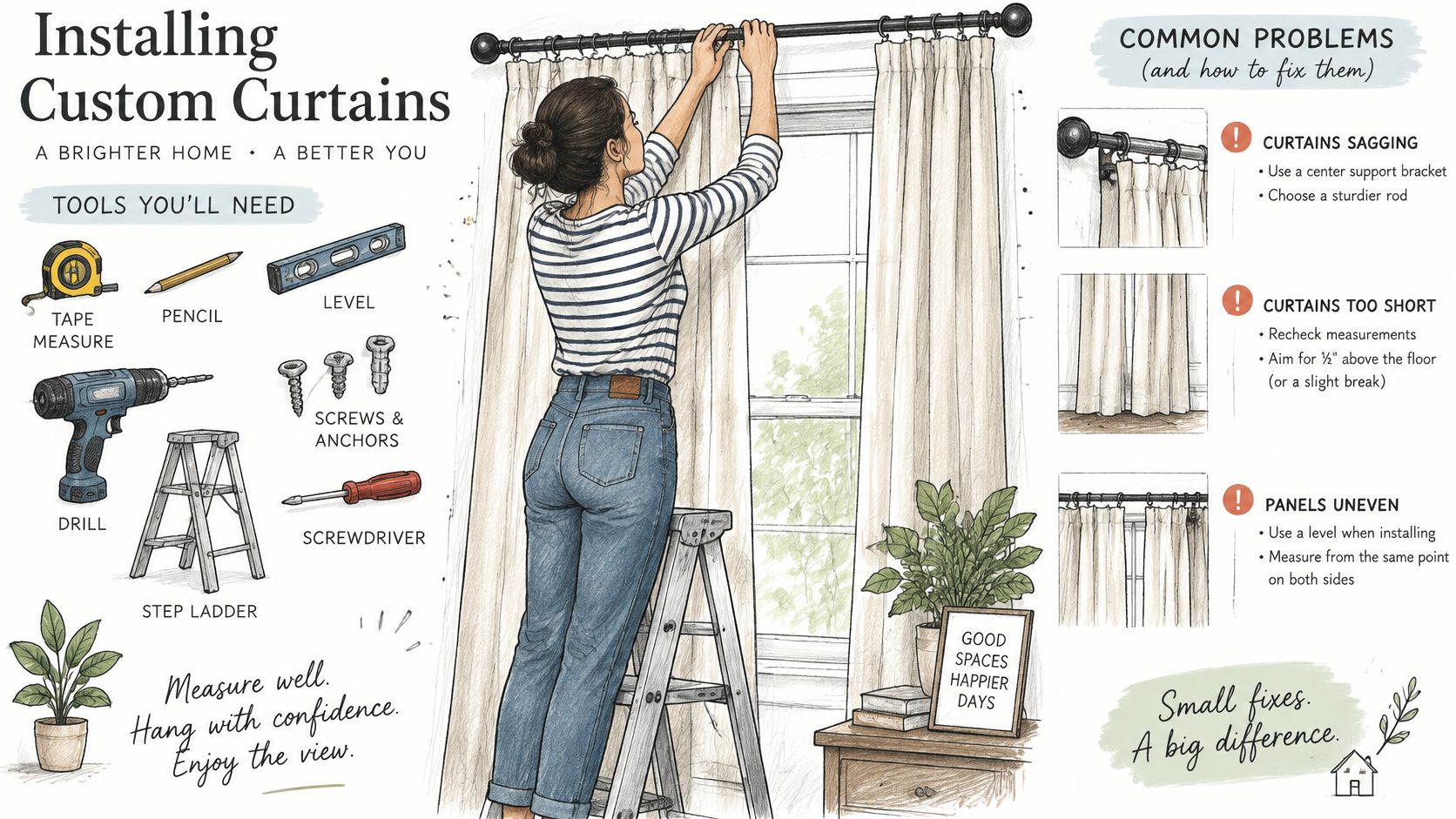
Use the hardware manufacturer's instructions, and arrange professional installation if the substrate or assembly is uncertain. Heavy luxury home furnishings need secure support, not improvised fixings.
- Secure the brackets into studs or anchors rated for the combined weight of fabric, lining, and hardware.
- Set the rod or track level, checking bracket locations with a level and tape.
- Attach rings or pleat hooks to the panels before placing them on the hardware.
- Check the hem against the approved finished position, then adjust the hooks or arrange alterations.
- Open and close the treatment repeatedly, checking that folds stack without binding or catching furniture.
Diagnose before altering
Common installation problems and fixes
| Symptom | Likely cause | Fix |
|---|---|---|
| Light and draft leaking at the sides | Insufficient coverage or unsuitable hardware position | Revisit the stack-back allowance and side returns specified during measurement |
| Panels puddle or hang short | Drop measured from the wrong point | Re-measure from the hanging point and re-hem |
| Top sags or bows | Underspecified rod or missing support | Use manufacturer-approved support and heavier-rated hardware |
| Pleats won't form evenly | Insufficient fullness or incorrect hook placement | Check heading construction before adding fabric |
| Room still overheats in afternoon sun | Interior treatment alone is inadequate | Evaluate exterior shading or a combined shading strategy for exposed glass |
Expensive blackout curtains aren't equivalent to exterior solar control. The residential shading research distinguishes exterior shading's ability to intercept solar heat before the glass from interior treatments' finer light control, and evaluates the advantages of combining shading with ventilation.
Close treatments before peak sun, open them when daylight is helpful, and consider nighttime ventilation when outdoor temperature, humidity, security, and air quality allow. For serious overheating, treat drapery as part of the solution rather than the whole climate-control plan.
Lewis and Sheron Textiles offers custom drapery, fabric selection, custom furnishings, and design support for coordinating windows with the rest of your living room. Visit Lewis and Sheron Textiles with your measurement packet and room photographs, and ask about arranging a measure-and-consult visit before approving your order.