












Drapery stack back begins at about one-third of the rod or window width, and in a two-way draw that total splits between the two sides. Heading style and fabric weight then adjust the figure up or down from that starting point.
You opened the drapes this morning and the glass still looks half dressed. The panels are as far back as the hardware allows, yet a thick column of cloth sits over the daylight you wanted. That column is a clearance problem you can measure before anyone orders a rod, both along the wall and out into the room.
The same arithmetic matters whether you are framing a view in Buckhead or clearing a quieter bedroom in Alpharetta. Get the parked fabric off the glass, and the window does the work you bought it for.
What Stack Back Means for Your Window
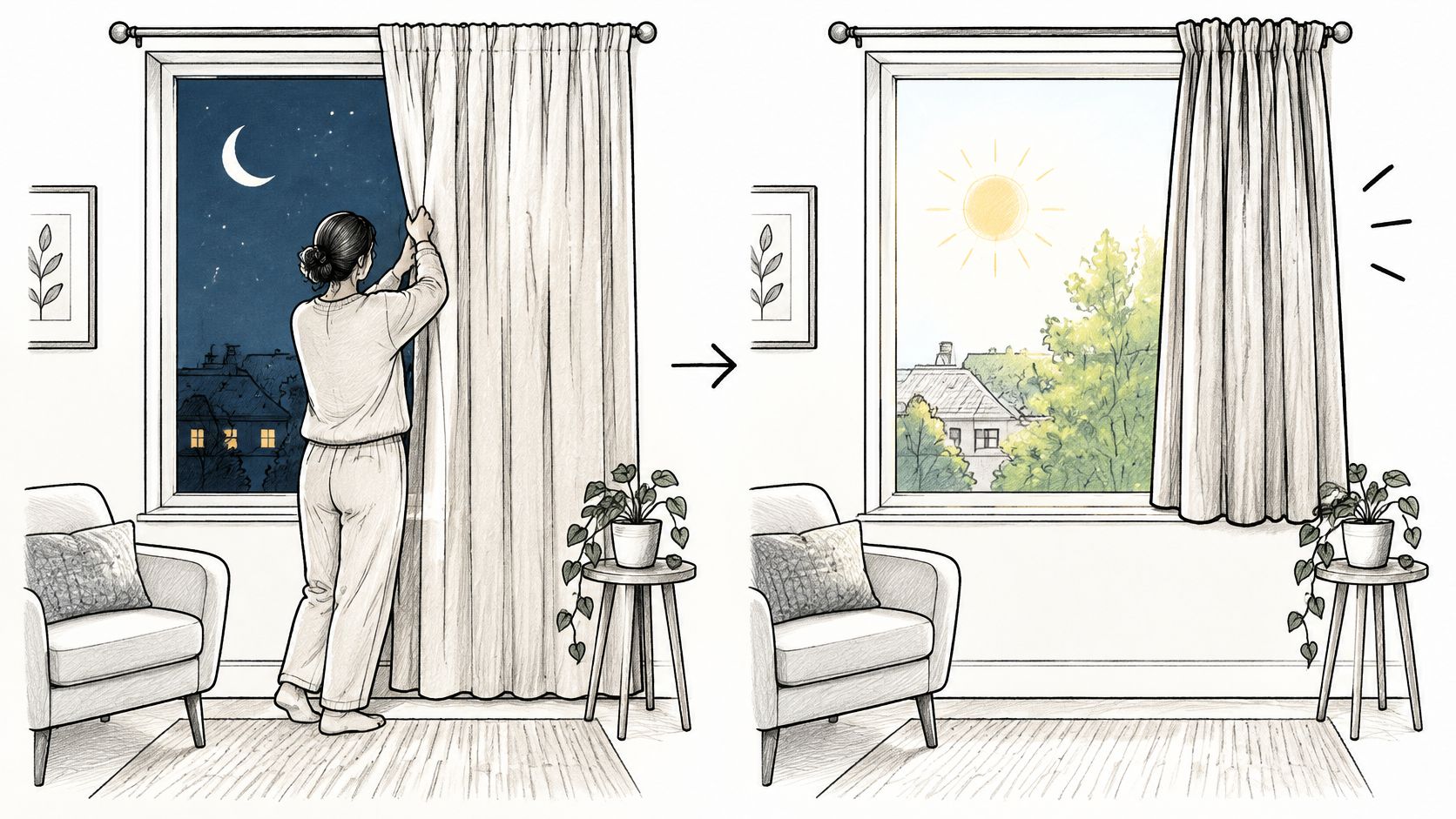
You close the drapes at night. In the morning you pull them open and find the cloth still gathered across a wide slice of the glass. The treatment is "open." The view is not.
Drapery stack back is the horizontal wall space that curtain fabric occupies beside the window when the panels are fully open. Its job is to park that fabric outside the glazed area so daylight and the view stay clear. A drapery hardware guide treats this as a measurable installation specification, not a styling flourish. Usable opening depends on glass width, adjacent wall, hardware placement, fabric fullness, and panel thickness.
Think of a folded fan pushed to one side of a doorway. More folds take more room. A 12-foot-wide treatment planned at that one-third allowance needs about 4 feet of stack back in total, roughly 2 feet of fabric on each side in a symmetrical two-way draw. In a center-draw layout, that same one-third splits between the sides, about one-sixth of the track length on each side.
If the stack sits on the glass instead of the wall beside it, part of the view stays blocked even when the draperies are open. Bay and bow shapes make that mistake easier, because the glass already turns. The bow window advice from Professional Window Cleaning is a useful companion when you are sorting how those curved openings face the room before you assign wall for the stack.
Practical rule: If you cannot point to bare wall where the open panel will sit, the glass will hold that fabric forever.
By the end of this walk-through you can estimate stack back for one window, read a heading table, and check the wall before you order.
Stack Back Width by Heading and Pleat Style
Look up the heading before you reach for a single percentage.
In 2026, RTZEN Decor reports that grommet-top drapes may use up to 15% of each panel's width for stack back, while pinch-pleat, rod-pocket, and tab-top curtains use approximately 20%. A 100-inch pinch-pleat panel therefore occupies about 20 inches when open. The same 100-inch grommet panel occupies up to 15 inches.
Those are panel-width lookups. Whole-window planning uses a different base. In 2025, Bali Blinds states that stack back is approximately one-third of the glass width. Read that as a total for the opening. An 84-inch opening at about 33% needs about 28 inches of stack in all, or 14 inches on each side of a split draw. The next section's arithmetic uses that total-width figure.
Two readings of the same 84 inches
In 2026, Philly Blinds states that stack back per side can be estimated as 33% of the rod width, and that for an 84-inch rod each panel stacks approximately 28 inches when fully open. That per-side reading is about twice the total-width plan above. The bases conflict. Do not average them. Verify the parked edge on your wall, and keep the total-width figure when you size the rod.
Rod length is a separate allowance. In 2026, Workroom Wisdom and Fabric Finds recommends allowing 4 to 12 inches of rod extension per side, with most rooms using 6 to 10 inches per side. In 2026, Fabric Formula presents planning comparisons of 25%, approximately one-third, and 40% of the opening width, while noting that the actual figure varies by fabric thickness, fullness, pleat depth, hardware, and other factors.
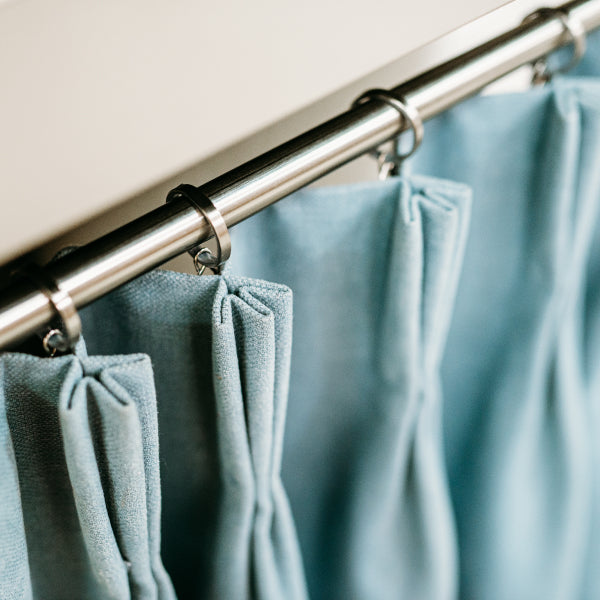
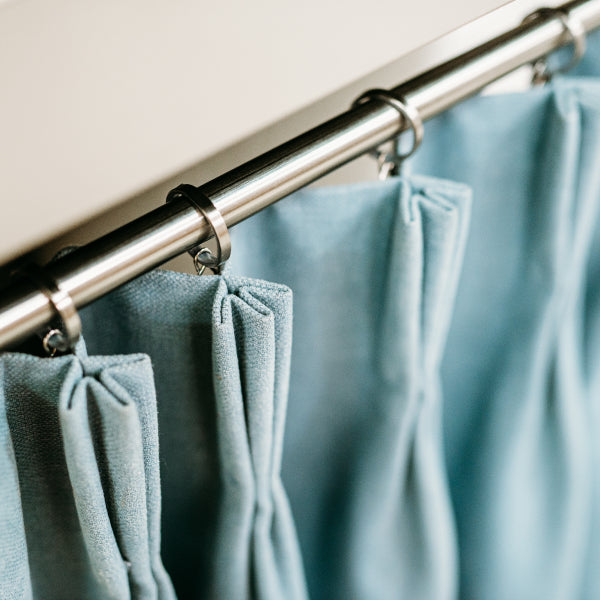
Pleat choice changes the row you start from. Our guide to curtain pleat styles shows how those headings look once the cloth is hung.
| Heading or method | Stack back allowance | Worked example | Source basis |
|---|---|---|---|
| Pinch-pleat, rod-pocket or tab-top | About 20% of panel width | 100-inch panel occupies about 20 inches when open | RTZEN Decor (2026) |
| Grommet-top | Up to 15% of panel width | 100-inch panel occupies up to 15 inches when open | RTZEN Decor (2026) |
| One-third planning rule, total width | About 33% of window or rod width | 84-inch opening: about 28 inches total, 14 per side in a split draw | Bali Blinds (2025); total-width planning figure |
| Per-side reading | About 33% of rod width per side | 84-inch rod: about 28 inches per side | Philly Blinds (2026); conflicts with total basis, verify on site |
| Rod extension per side | 4-12 inches, most rooms 6-10 inches | Extra width beyond the glass on each side | Workroom Wisdom and Fabric Finds (2026) |
| Comparison range | 25%, about one-third, or 40% of opening width | Low, middle, and high plans for one opening | Fabric Formula (2026) |
The table gives starting ranges, not a verdict. Find the row that matches your heading, then check it against the wall you have.
How to Calculate Stack Back Step by Step
Work in inches, and write each number down before you add the next.
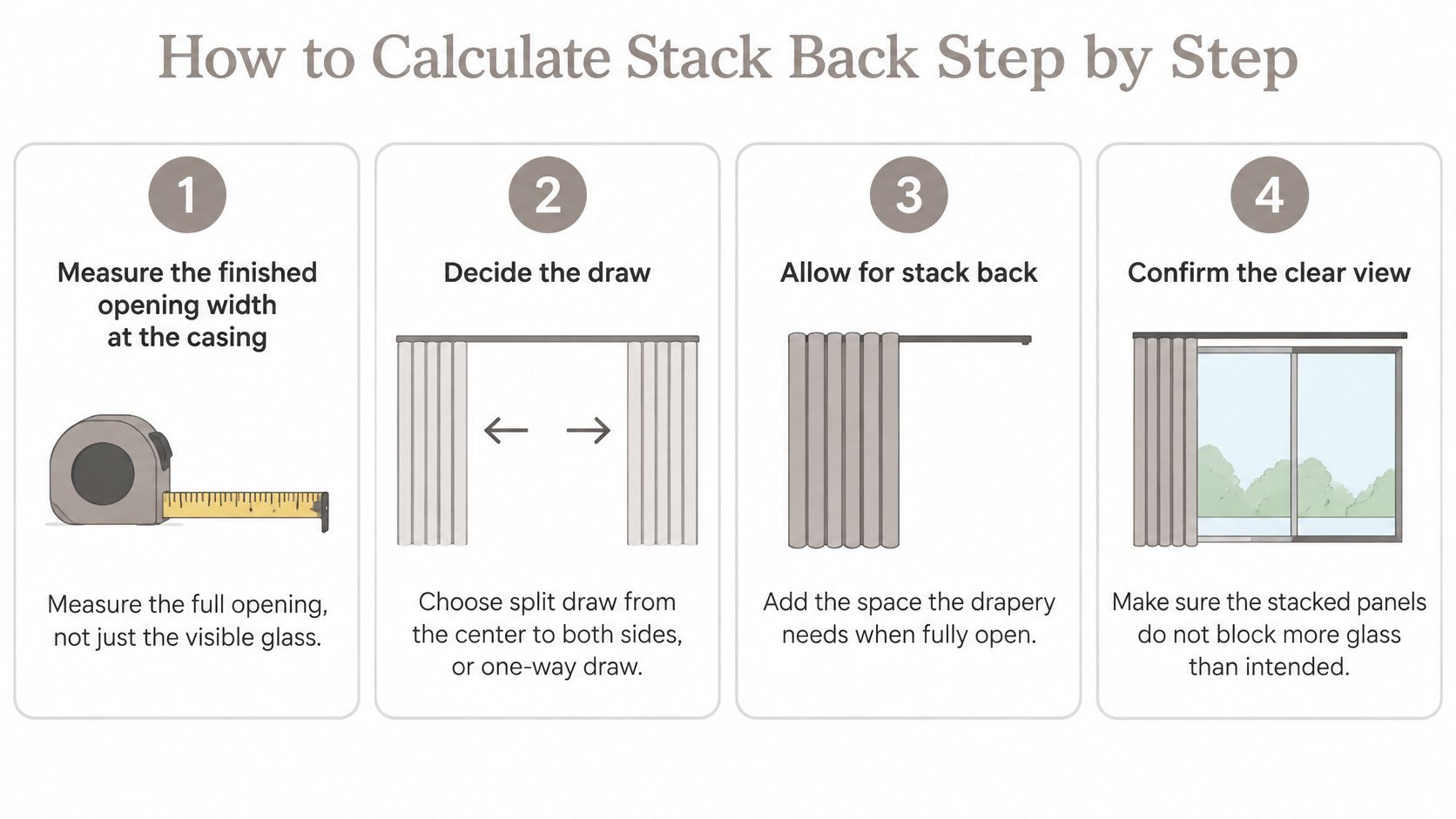
- Measure the finished opening. Take the width at the casing, not only the visible glass. Casing, shade pockets, and trim change where the parked edge has to land. A crooked tape reading here throws every later number. The tools for accurate window measurements from Breaking Glass Co. are worth using when the frame is out of square.
- Decide the draw. A split draw sends cloth to both sides. A one-way draw sends all of it to one side, so that side needs the full stack.
- Choose the allowance. Start with about one-third of the finished width as the default total, then move toward the heading row if the panel style is already chosen. Heavy cloth, blackout interlining, and higher fullness increase the compressed bulk, so one-third is only the start.
- Split or assign it. Divide the total between the two sides for a center draw. Put the whole total on one side for a single draw.
- Add stack to the opening. Opening width plus total stack is the minimum rod or track length.
- Confirm the parked edge. Check casing, adjacent walls, artwork, cabinetry, and corners before fabrication. Our notes on how to measure windows for curtains walk through that casing measurement in more detail.
Two worked widths
Say an 84-inch opening is planned with 30 inches of total stack back. A planning note on fabric stack puts the treatment width at approximately 114 inches, with 15 inches parked on each side in a split draw. The sum is 84 + 30. Each side is 30 ÷ 2.
A 60-inch window on a one-third allowance needs about 80 inches of rod or track overall, leaving roughly 10 inches beyond each side. Here 60 × 1/3 is 20 inches of total stack, and 60 + 20 is 80. Each side gets about 10 inches past the opening.
What happens when the percentage moves
The same 84-inch opening at 25%, 33%, and 40% needs about 21, 28, or 34 inches of total stack. At 25% you add 21 and the track is about 105 inches. At 40% you add 34 and the track is about 118 inches. That 13-inch swing is the difference between a stack that clears the casing and one that climbs onto the glass.
Also name the goal before you lock a percentage: full glass exposure, partial exposure, or decorative framing. For our projects, measure the intended finished opening, then specify that goal in writing.
If the overall treatment is wider than the wall you have, the stack will cover glass. Shorten the plan or change the draw before fabric is cut.
Lining, Fullness and Rod Placement Clearance
Width on the wall is only one axis. Projection is the distance from the wall to the rod center. Return is the fabric distance that turns from the rod toward the wall. Both decide how far the parked folds stick into the room, and whether side light leaks past the edge.
A return and projection measuring guide adds roughly 0.25–0.5 inch of depth allowance for standard lining and approximately 0.5–1 inch for blackout or velvet, then checks that the return does not force the face fabric forward. Typical single-layer rod returns are about 3–4 inches. Heavier assemblies may need more clearance.
Why some stacks get fat
Flat fabric width is finished width times the fullness ratio, divided across the drops, plus hems and returns. Double fullness means you are storing about twice the finished width in folds. Lining, interlining, blackout, and velvet add thickness to every fold, so fabric weight and bracket size have to be chosen together. Belgian linen with a light lining parks differently from interlined wool on the same track.
| Construction | Extra depth allowance | Typical return | Effect on stack |
|---|---|---|---|
| Unlined single-layer sheer or cotton | No extra lining allowance | 3-4 inches | Least bulk; folds sit closest to the wall |
| Standard lining | 0.25-0.5 inch | 3-4 inches, verify for heavier builds | Modest added bulk per fold |
| Blackout or velvet | 0.5-1 inch | More than 3-4 inches | Thickest folds; most wall space needed |
| Heavy interlined wool or multi-layer | Past the 1-inch blackout mark | More clearance than a single layer | Needs a full-scale mockup |
A deeper return blocks more side light and uses more airspace. That trade-off is real on a narrow reveal. How lining changes the hand of the cloth is covered in the role of drapery lining.
Brackets, then a tape mockup
A window can have enough side width and still bind. Undersized bracket projection lets the stack hit casing, blinds, handles, or a nearby chair.
- Set projection first. The rod center has to clear casing, crank handles, and any shade cassette.
- Check the return. If the return shoves the face cloth forward, the folds bow into the room and look thicker than the width math predicted.
- When the wall is short. Accept a partial cover of the glass, drop the fullness ratio, or move to a one-way draw toward the longer wall. Do not pretend a 6-inch pier can hold a 15-inch stack.
Before the order, record rod or track length, draw direction, number of layers, lining or interlining, fullness, return, and projection. Then mock the parked edge with painter's tape at full scale. A clean return cuts side light and spends wall and airspace you may not have.
On a deep custom treatment, the tape line tells you more than another percentage.
Stack Back Mistakes Worth Correcting
Most bad orders come from treating one shortcut as a law. A Crestron drapery track measuring guide notes that stack back is typically one-third of total track length and must sit so it does not obstruct the view. The same family of guidance warns that heavy or bulky fabrics may need more width. Consumer write-ups rarely separate unlined sheers, lined cottons, interlined wool, velvet, Belgian linen, blackout builds, pleat styles, and one-way versus center draw.
- One-third is a verdict. It is a starting default. Lining, fullness, and the goal you picked change the answer.
- Width and depth are the same measurement. Stack-back width is the wall length the fabric occupies. Stack depth is how far the folds project into the room, set by projection and return.
- One percentage fits every goal. Full glass exposure, partial exposure, a stack that must fit a pocket, and decorative framing each change the allowance. Set the goal before you choose a rate.
- A narrow pier can always be cleared. Sometimes the adjacent wall is too short. Accept the obstruction or change the layout. Hoping will not shrink the folds.
Premium rooms often pick the cloth before the hardware. That order is fine only if the next question is answered in inches, not in taste.
Can this particular fabric, with this heading and lining, stack clear of my window, or will it permanently cover part of the glass?
Confirm Your Stack Back Before You Order
Before ordering, record where the panels will sit when open. For example, if a panel parks beside the casing, mark its full stack width on the wall and check that the fabric will clear the glass, nearby corners, and any other obstruction. Stack width, projection into the room, and return to the wall all affect the fit.
Ordering sequence
- Name the goal. Decide whether you want full glass exposure, partial exposure, or decorative framing.
- Record the opening. Note the finished width at the casing, draw direction, heading, lining, and fullness.
- Set the allowance. Record the chosen stack width, plus projection and return.
- Check the available space. The opening and total stack need to fit the wall, with the parked edge clear of the casing and corners.
- Mock it up. Use painter's tape to mark the planned stack at full scale before ordering.
A marked wall makes the clearance easier to judge than a sketch alone. Check the parked edge from the room, including how far the folds project and whether the return can sit as planned.
Lewis and Sheron Textiles' Design Studio Associates can discuss custom drapes, and professionals can measure the space at your home or office. Available pleat styles include two-finger pinch, three-finger pinch, two-finger Euro, three-finger Euro, inverted pleat, and grommets. Custom drapes take 4 to 6 weeks to produce, so settle the stack allowance before production begins.
Measure, mark, and confirm that the parked fabric clears the glass before you order.
Lewis and Sheron Textiles offers custom drapery, with design details such as pleat style, lining, and trim considered as part of the order. To discuss custom drapes for a home or office in the Atlanta area, visit Lewis and Sheron Textiles.