
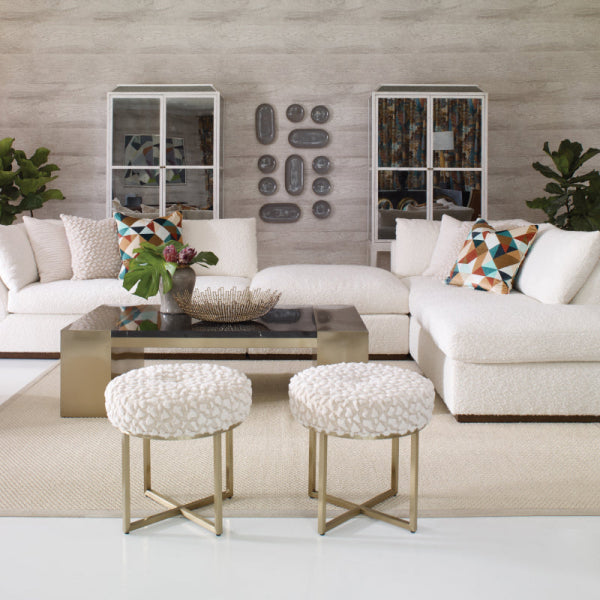
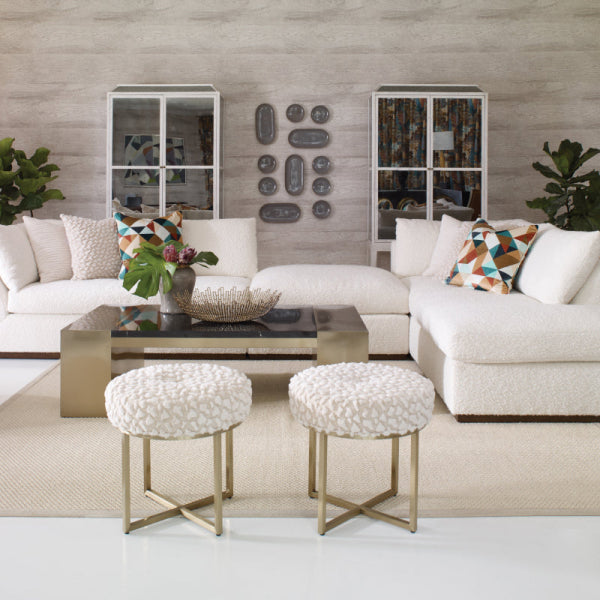
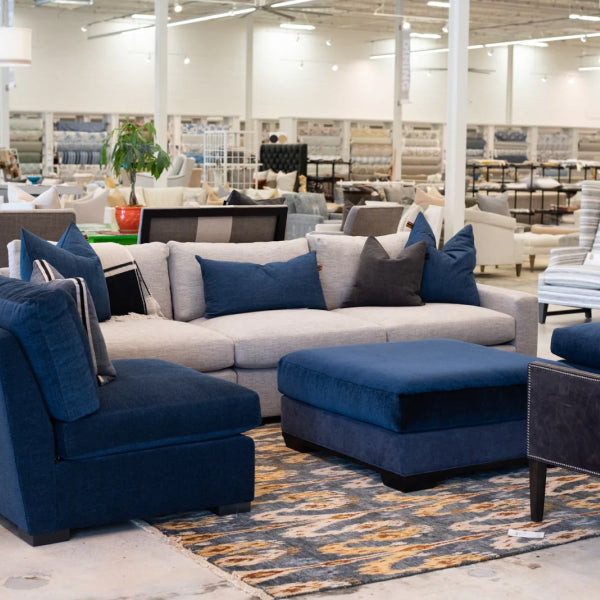

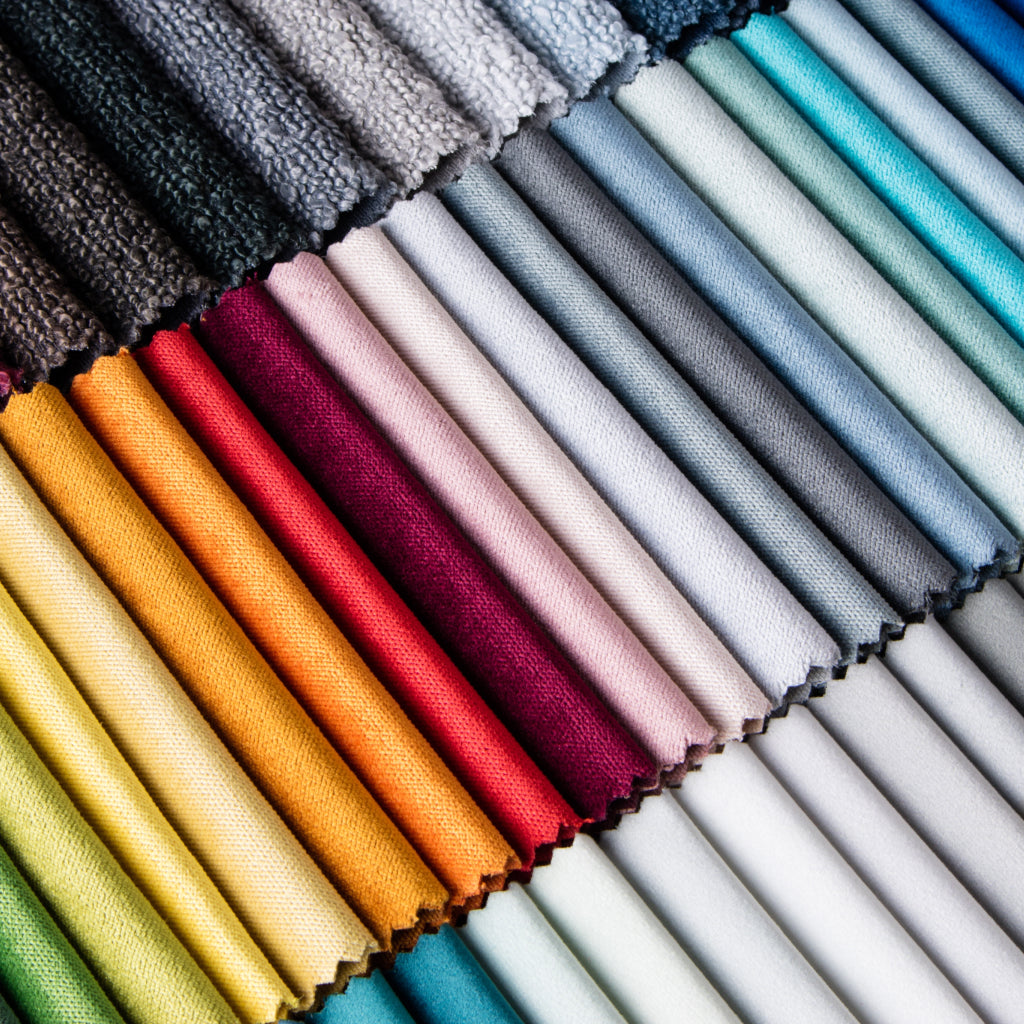



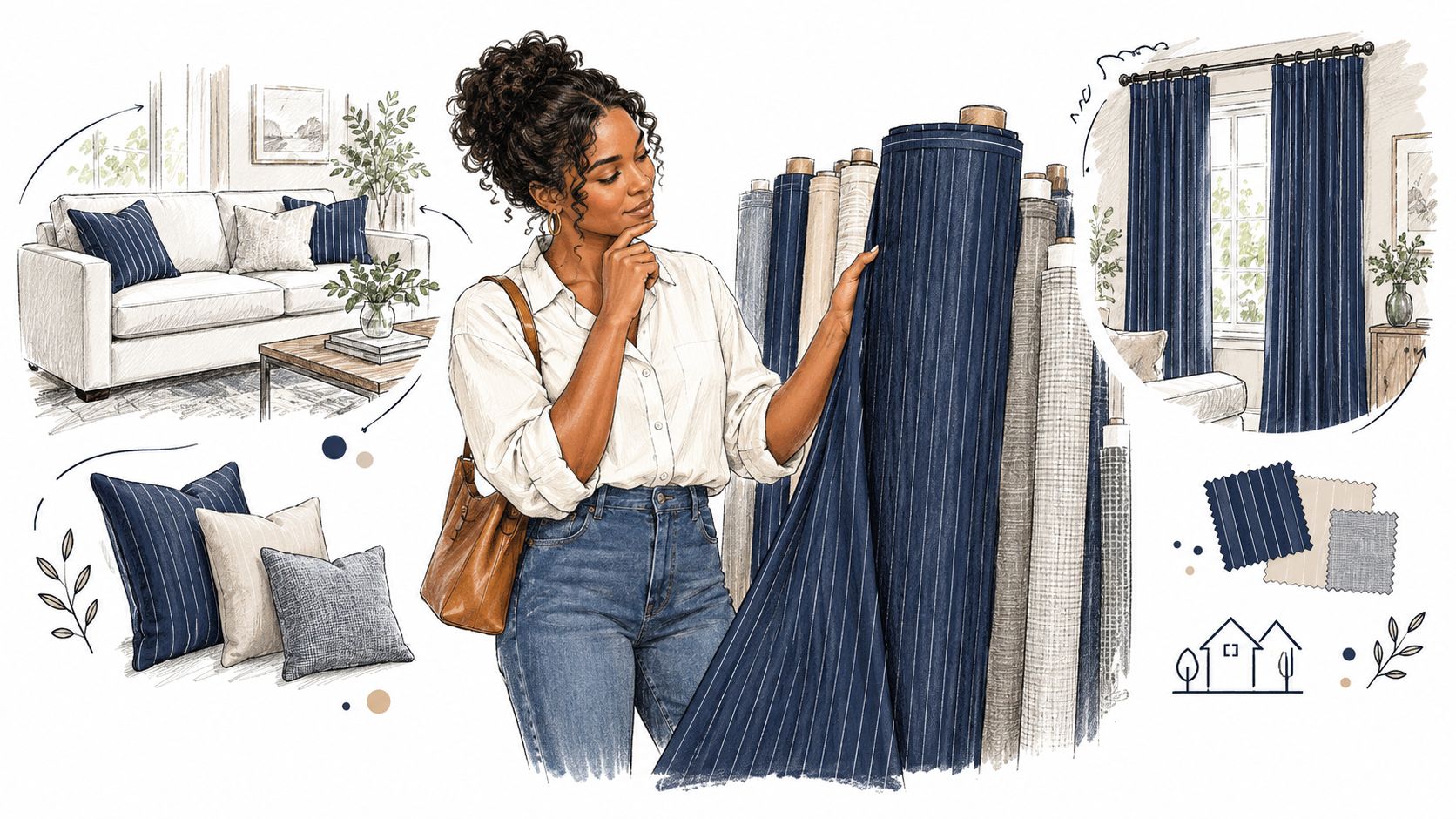
An Atlanta homeowner pauses in front of a navy blue pinstripe fabric bolt, imagining it on a sofa, then wondering whether the pattern belongs on drapery or only on accent pillows. The right choice depends on more than the photograph. It depends on the weave, fiber content, performance testing, stripe repeat, and the way the finished piece will be used.
Why Navy Blue Pinstripe Fabric Endures
Solid navy can anchor a room with calm. Navy blue pinstripe fabric does something more defined. Its narrow, repeated lines introduce rhythm and direction, giving a sofa, chair, ottoman, or curtain panel a more architectural outline. The pattern can feel polished without becoming formal in the way a large motif sometimes does.
That balance makes it useful for high-end furniture and custom upholstered furniture. A navy pinstripe sofa can hold its own as a statement furniture piece, while a pair of custom chairs can use the same pattern more selectively. On drapery, vertical stripes emphasize height. On pillows, a smaller application adds structure without asking the entire room to follow a new pattern.
What makes the pattern different
Pinstripes work because the eye reads the spacing as a system. Even a subtle contrast between the navy ground and lighter yarns can make the upholstery appear more refined, much like a finely cut suit. The effect is especially effective on furniture with clear geometry, such as a tuxedo-style sofa, a squared armchair, a bench, or a structured sectional.
The pattern also coordinates naturally with white, camel, gray, brass, natural wood, and lighter blues. That gives a homeowner in Buckhead, Alpharetta, or Sandy Springs room to change accessories without replacing the foundational upholstery.
Practical rule: Choose navy pinstripe for the piece that needs definition, then let solids provide the visual rest.
What to decide before ordering
A beautiful showroom sample doesn't answer every practical question. Before specifying fabric for a luxury sofa or premium sectional, confirm:
- Construction: Find out how the stripe is woven and whether the pattern has a defined repeat.
- Performance: Request abrasion, lightfastness, crocking, seam-slippage, and cleaning information.
- Scale: Check whether the stripe feels refined on the furniture's proportions or too busy.
- Workroom planning: Ask how the upholsterer will center and match the stripes across cushions, seams, and panels.
By the time you compare those details, the decision becomes clearer. You're not choosing between “classic” and “modern.” You're choosing the right combination of structure, comfort, performance, and craftsmanship for a specific room.
The Heritage Behind the Stripes
Walk through a showroom and navy pinstripe can feel familiar before you know why. The response is partly decorative, but it is also historical. Navy blue comes with a long record of military use, trade, and workwear, which helps explain why it often reads as steady and intentional instead of passing or ornamental.
Part of that impression goes back centuries. Indigo was already a major textile commodity by about 1620, with European imports reaching at least 500,000 pounds. Later, the Royal Navy set officer uniform regulations in 1748 around dark blue and white, and by about 1780 the term “navy blue” was appearing in the British press. Historically, indigo helped produce the deep blue shades valued for hiding dirt, wear, and fading, which is one reason the color became tied to service and discipline. (Historical background on navy blue)
For interiors, that background matters because color is never just color. Navy tends to carry ideas of service, durability, authority, and order. On upholstery, it often feels grounded in the same way a well-made front door feels solid when it closes. You notice the assurance first, then the style.
How pinstripes became a mark of professional dress
Pinstripes built their reputation through uniforms and business clothing before they became a design choice for homes. Early pinstripe suits were linked with bank uniforms, where stripe variations could help distinguish one institution from another. Blue-and-white striping also gained a broader public identity through maritime dress. In 1858, the French navy adopted the marinière as an official undergarment, a knitted wool jersey said to use 21 blue stripes and 15 white stripes, with the blue stripes traditionally connected to Napoleon's victories. Those were horizontal stripes, not the vertical pinstripes used in suiting or upholstery, but they strengthened the wider association between stripes, utility, and disciplined dress. (History of stripes)
By the 1920s, 1930s, and 1940s, pinstripes had also become closely tied to American business culture and the Prohibition era. That shift gave the pattern a specific visual language. A narrow stripe suggests order because the lines repeat with control. It suggests care because any misalignment is easy to spot. And it suggests identity because stripes have long marked uniforms, clubs, regiments, and firms.
That is why navy pinstripe works so well in a room. A solid navy can feel calm and weighty. Add a fine stripe and the fabric gains rhythm without turning busy. For a homeowner choosing upholstery, this history is useful. It explains why the pattern often looks appropriate in a traditional study, a transitional living room, or an eclectic Atlanta home, and why good judgment should go beyond photos to the fabric's actual specification and construction.
Weave Types and Fiber Content Explained
A good navy pinstripe starts at the loom. In most cases, the stripe is woven into the cloth instead of printed on top, so the line is part of the fabric's structure, not a surface effect. The warp yarns are the lengthwise yarns held under tension on a loom, and the stripe appears when specific yarn groups repeat at fixed intervals across the width.
That matters in a showroom and even more in a workroom. A pinstripe only looks sharp when the repeat stays consistent, the yarn count is even, and the seams are planned so the lines meet cleanly across cushions, skirts, and upholstered panels. If the stripe drifts at a seam, your eye catches it right away. That is one reason specification sheets and cutting plans matter as much as the color itself. (Textile quality standards)
Match the fiber to the job
Fiber content changes how a navy pinstripe feels, folds, wears, and cleans. Cotton often feels familiar and breathable. Wool usually has more body and spring. Linen blends bring visible texture. Polyester is often chosen for consistency and easier care. Performance-treated constructions can help with specific maintenance needs, but the treatment does not replace good base cloth.
If you want a simple outside reference before committing to yardage, compare quilt fabric fibers and weave. For visual examples of structure, this guide to woven fabrics helps show how construction affects the finished surface.
| Fiber Type | Typical Feel | Durability Character | Best Use |
|---|---|---|---|
| Cotton | Soft to crisp, depending on weave | Comfortable, but performance varies by construction and finish | Drapery, pillows, lighter-use upholstery |
| Wool | Dense, resilient, and structured | Strong hand with a structured appearance | Luxury sofas, custom chairs, formal seating |
| Linen blends | Textured, natural, and relaxed | Attractive texture, with performance dependent on the blend | Drapery, pillows, occasional seating |
| Polyester | Consistent and practical | Can support demanding use when properly engineered | Family-room upholstery, sectionals, high-use pieces |
| Performance-treated constructions | Varies by base fiber and finish | Designed around specific cleaning or wear needs | Busy homes, entertaining areas, selected upholstery |
Read the sample with your hand
Photos flatten a lot of information. Pick up the sample and test it the way an upholsterer would. Turn it sideways under the light to see whether the stripe stays crisp. Rub the face lightly to check for fuzzing. Fold the edge to see whether the line breaks cleanly or goes soft.
One more point often gets missed. Ask whether the fabric is railroaded or up-the-roll, because stripe direction affects cutting layout, seam placement, and waste. A dense weave can feel promising in the hand, but performance still comes from the full specification, the finish, and the way the furniture will be used.
How to Judge Durability Before You Buy
A navy pinstripe can fool you in the showroom. The sample looks sharp, the stripe looks crisp, and the color feels rich. Then it lands on a hard-working sofa, catches afternoon sun, and starts showing wear in ways the photo never hinted at. That is why a smart buy starts with the specification sheet, not the beauty shot.
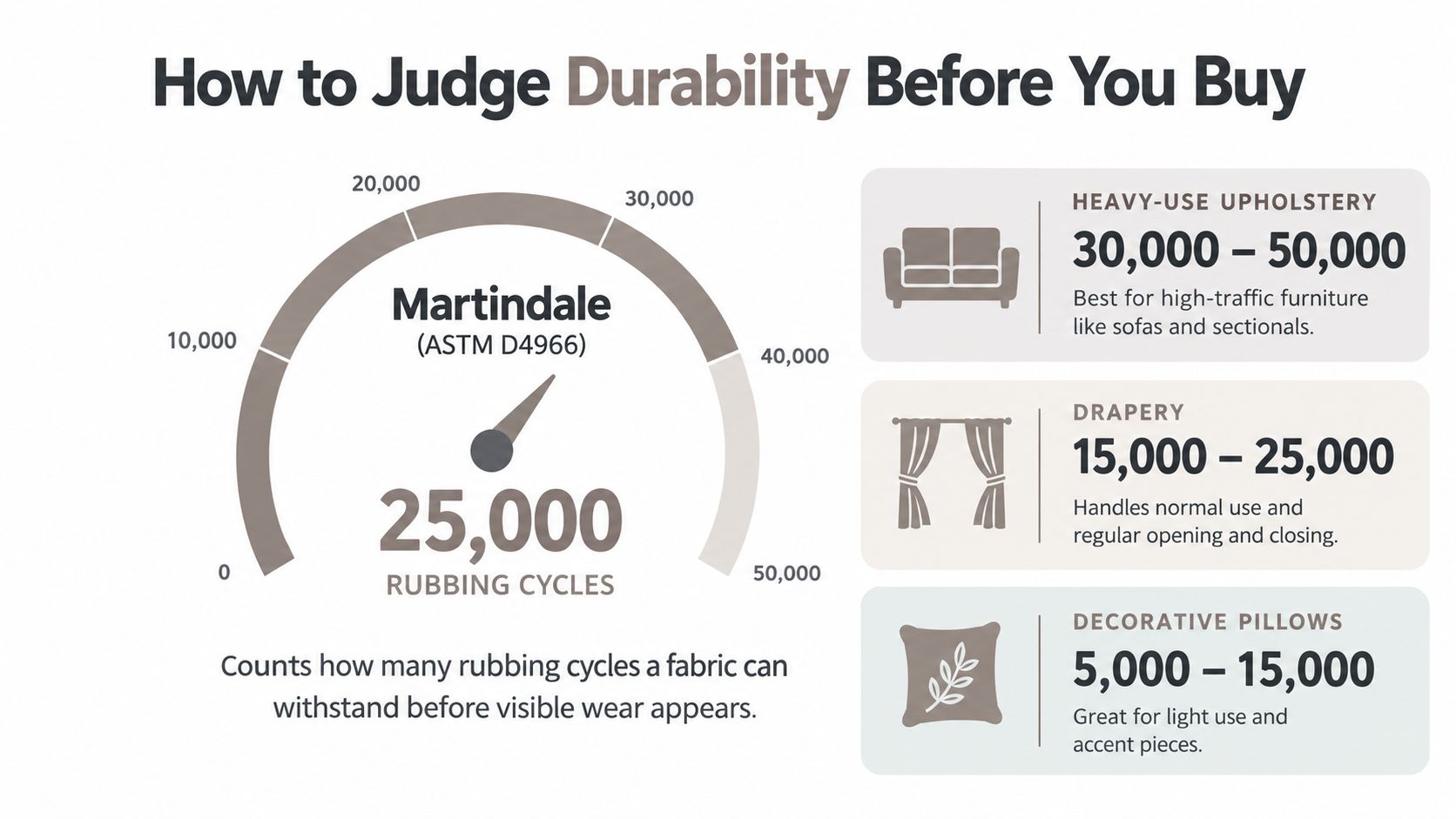
Begin with abrasion, but read the label carefully. The Martindale test, identified as ASTM D4966, measures rubbing in a multidirectional motion and reports the result in abrasion cycles. Guidance for upholstery places general contract use near 20,000 Martindale cycles and heavy-duty use near 40,000 cycles. Wyzenbeek double rubs are a different test on a different scale, so compare like with like. Residential upholstery often looks for at least 15,000 double rubs, while commercial-grade fabrics commonly start around 30,000 double rubs. (Upholstery quality guidance)
Use a complete specification sheet
Abrasion is only one line on the page. With navy fabric, the rest of the page matters just as much because dark grounds make fading, lint, and dye transfer easier to spot.
The ISO 105 framework breaks color performance into separate tests, including light fastness and perspiration fastness. That matters in real rooms. Sunlight can shift the shade over time, and moisture or body contact can encourage transfer or uneven color change. The framework also recognizes navy-blue/light as a standard depth category for evaluation. (ISO textile colorfastness catalogue)
Ask for these details in writing:
- Fiber blend and fabric weight: These help you compare two pinstripes that look similar on the hanger but behave differently in use.
- Abrasion result and method: Confirm whether the supplier is quoting Martindale cycles or Wyzenbeek double rubs.
- Lightfastness and crocking grades: Upholstery guidance recommends a minimum lightfastness rating of 4, and upholstery benchmarks also call for dry crocking Grade 4 and wet crocking Grade 3 as minimums. (Colorfastness guidance)
- Seam-slippage result, pattern repeat, railroading, and cleaning code: These tell your workroom how the stripe can be aligned, whether seams are likely to hold cleanly, and how much cutting flexibility you have.
One weak line can spoil the whole fabric. A high abrasion score does not make up for poor lightfastness, unstable seams, or a stripe that cannot be matched cleanly across cushions.
That last point gets missed often. Pinstripes are unforgiving. If seam alignment is off, your eye catches it immediately, the way a crooked picture frame jumps out on a straight wall. In a sunlit room, ask about lining, UV-filtering window treatments, and approved cleaning methods if you want to preserve the contrast between the navy ground and the lighter stripe yarns.
Best Uses From Sofas to Drapery and Pillows
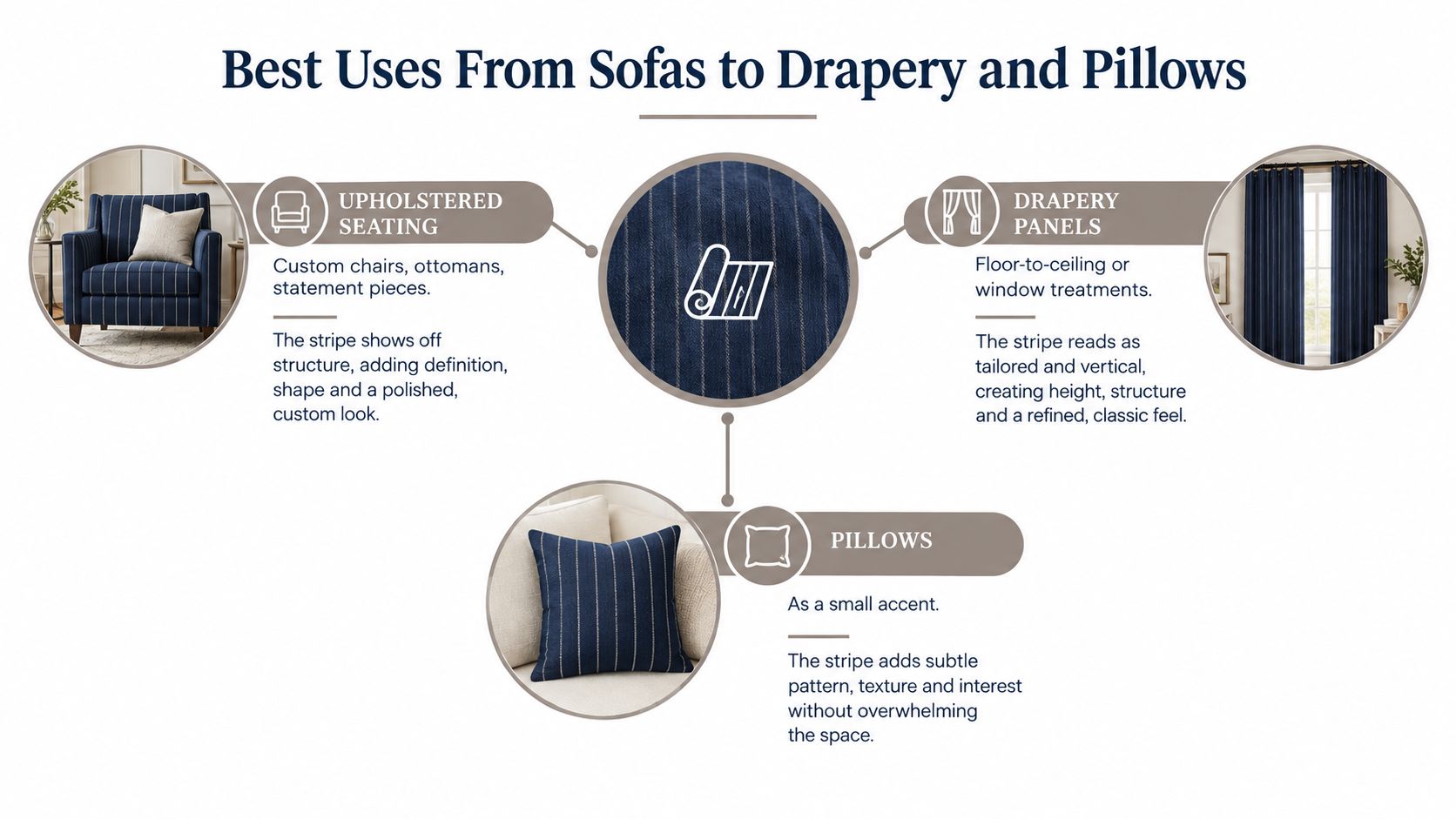
The same navy pinstripe can create different impressions depending on where you place it. On a sofa, the pattern follows the furniture's mass and seams. On drapery, the stripe becomes a vertical architectural element. On pillows, it works as a controlled accent.
Upholstered seating
A pinstripe is particularly effective on custom chairs, ottomans, benches, and statement furniture pieces with clean lines. The repeated stripe can emphasize a chair's back, sharpen a cushion's border, or make a traditional silhouette feel more architectural. On a large luxury sofa, the scale of the stripe matters. A very fine line may recede into the room, while a more assertive stripe can become the central pattern.
For a sofa that will see daily use, compare the complete performance profile rather than choosing by appearance. This guide to the best fabric for reupholstering a sofa offers useful context for weighing texture, construction, and service conditions.
Drapery and window treatments
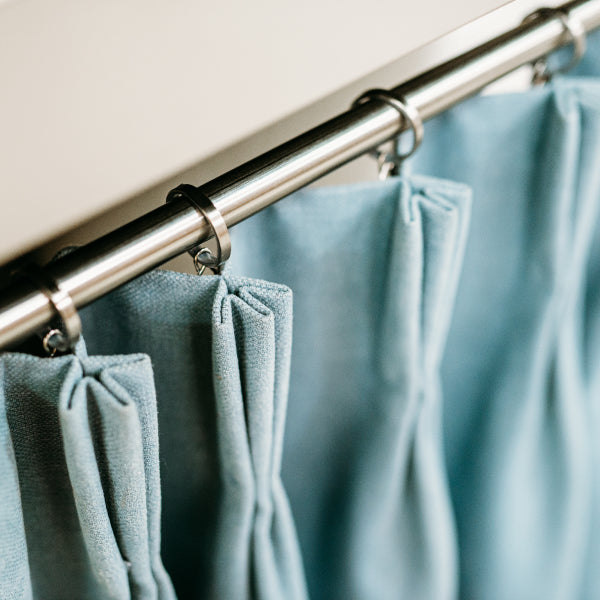
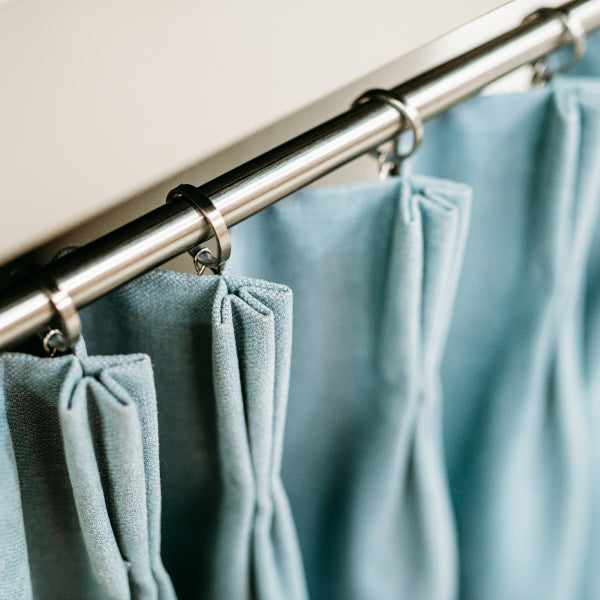
Vertical navy pinstripes can make a window treatment feel taller and more polished. In a North Atlanta home with generous glazing, use the fabric with an appropriate lining or a UV-filtering treatment. A strong abrasion result doesn't guarantee that the navy ground and lighter stripe yarns will retain their contrast in prolonged sunlight.
Care also affects longevity. Follow the manufacturer's cleaning code rather than applying an improvised treatment. For general upholstery-care context, homeowners can review how to clean upholstery with baking soda, but a navy pinstripe should still be cleaned only in a way approved for its specific fiber and finish.
Pillows and layered pattern
Pillows are the lowest-commitment way to introduce the pattern. Pair navy pinstripe with solids in white, camel, gray, or lighter blue, then bring in brass or natural wood through lighting, tables, and accessories. If the room already contains a large floral or geometric pattern, use the pinstripe as the quiet linear layer rather than adding another dominant motif.
A useful arrangement combines different pattern scales and related color intensities. Let the pinstripe provide rhythm, the solid provide rest, and the larger pattern provide personality.
Cutting and Sewing Tips for Custom Projects
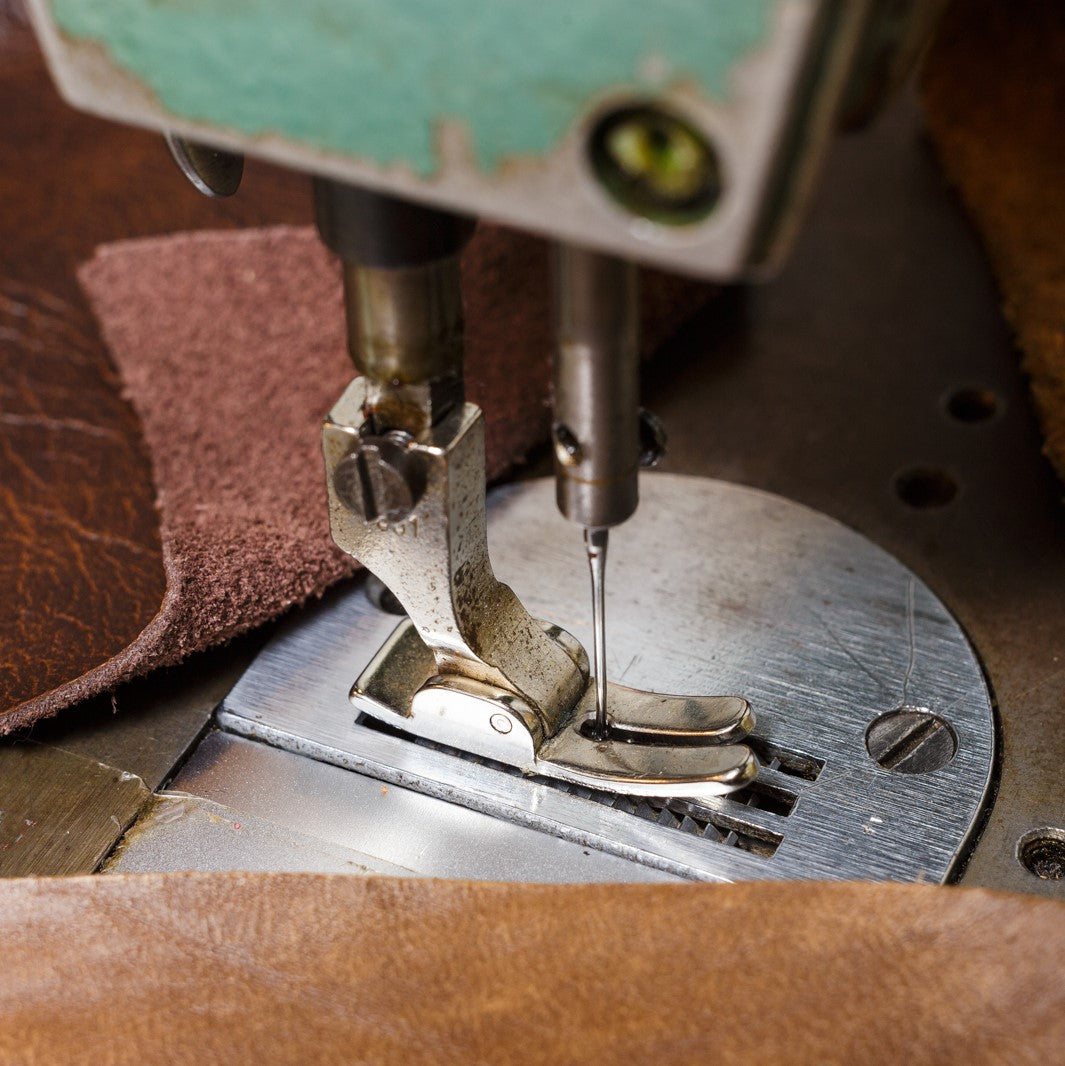
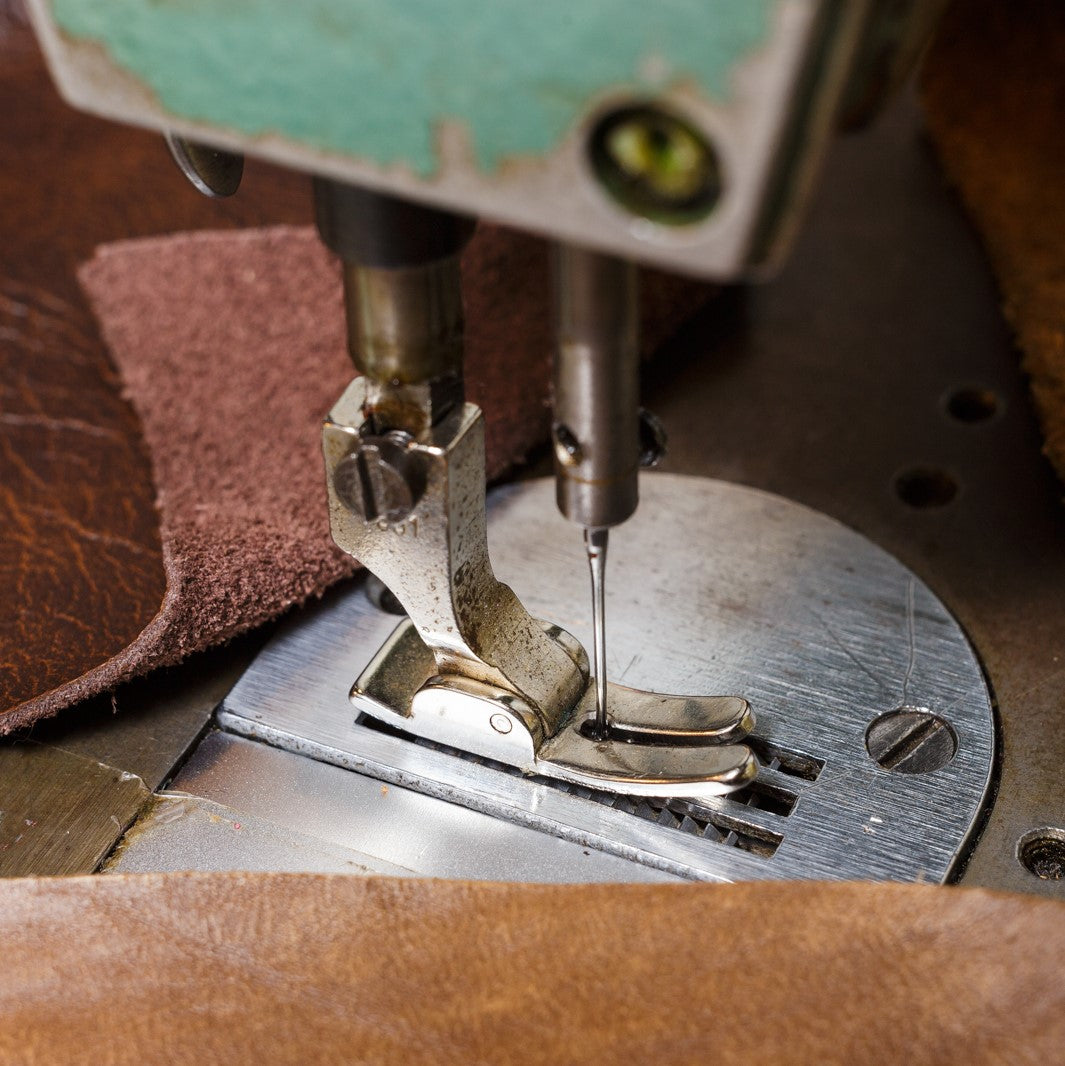
Pinstripe upholstery succeeds or fails at the worktable. A stripe that looks perfectly centered on the bolt can drift across a cushion, break at a seam, or appear crooked on a chair back if the workroom doesn't plan the layout first.
Pre-cut checks
Start with the pattern repeat. Measure the distance before cutting, then decide where the stripe should land on each visible panel. Because the stripe is woven into a repeating structure, a small cutting error can become obvious once several panels sit beside one another.
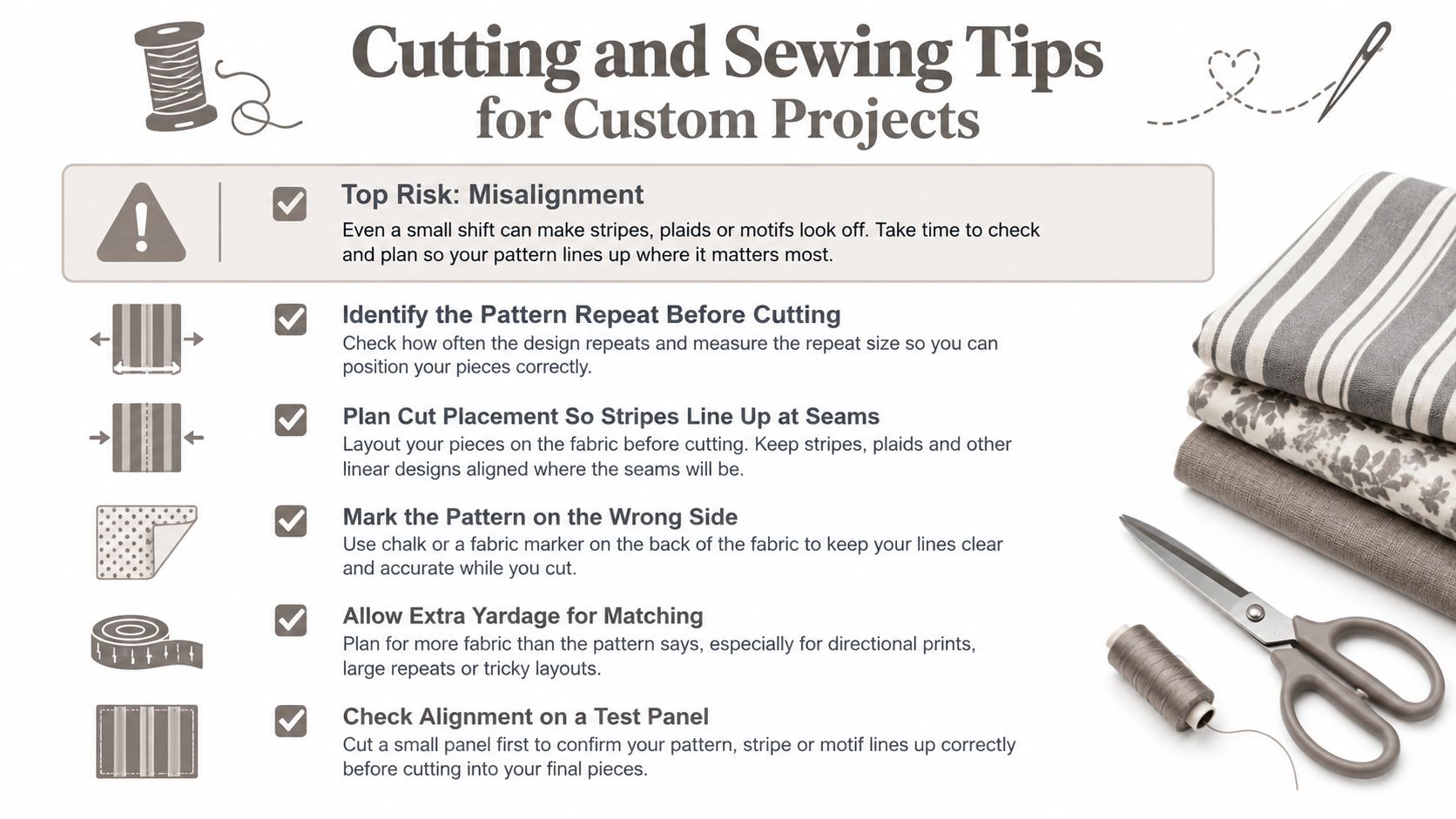
Use this checklist with your upholsterer or sewing workroom:
- Identify the repeat: Mark the exact stripe sequence before placing pattern pieces.
- Ask about railroading: Confirm whether the fabric can be applied across the roll width rather than along its length. “Railroaded” describes the usable direction of the design, and it affects yardage and seam planning.
- Center visible stripes: Choose a reference stripe for each cushion, back, arm panel, and front rail.
- Plan seam continuity: Place seams so the stripe meets cleanly instead of stopping abruptly at a join.
- Allow matching yardage: Extra material may be necessary when several panels must align.
- Test before final cutting: Lay out a sample panel and inspect it from the room's main viewing position.
Mark the stripe lines on the wrong side of the fabric, and check every panel rather than assuming one successful placement guarantees the next. A practical seam allowance guide can help the workroom preserve the intended alignment through construction.
The same care applies to drapery. Decide whether the stripes should line up across paired panels, and confirm how the fabric's face, nap, and repeat behave before sewing the hems.
Workroom habit: Never let the scissors touch the bolt until the upholsterer has approved the layout on paper or on a full-size test panel.
Choosing Quality That Lasts Generations
The most sustainable upholstery decision isn't always the fabric marketed with the most fashionable environmental language. A durable, repairable textile on a well-made frame can remain useful for years, especially when the cushions, suspension, and covering can be serviced separately.
One technical comparison estimates that a well-built upholstered furniture frame may last 10 to 25 years, suspension systems approximately 8 to 20 years, and foam or filling roughly 2 to 12 years, depending on specification and use. (Upholstered furniture service-life comparison) That distinction matters when comparing a disposable out-of-the-box couch with heirloom-quality furniture. A frame may remain sound while the comfort layers eventually need replacement or refurbishment.
Buy for serviceability
Ask whether the furniture maker can replace cushions, repair suspension, and reupholster the frame without compromising its structure. Also request transparent information about fiber percentages, finishes, manufacturing origin, recycled content where applicable, cleaning guidance, and whether the fabric can be matched for future work.
The European Union is developing textile-related Digital Product Passport requirements intended to improve access to material composition, care, repair, refurbishment, reuse, recycling, and disposal information. (European Commission textile Digital Product Passport information) That direction reflects a sensible buying principle for luxury home furnishings: understand not just how a textile looks on delivery day, but how it can be maintained and renewed.
For homeowners and designers in Atlanta, Buckhead, Alpharetta, Roswell, Sandy Springs, Fulton County, and surrounding affluent markets, navy blue pinstripe fabric offers a strong foundation when its construction and performance suit the project. It can give a premium sectional, custom chair, or reupholstered sofa the authority of tailoring without making the room feel rigid.
Lewis and Sheron Textiles offers in-stock and cut-yardage home fabrics, custom drapery, expert reupholstery, and made-to-order American-crafted upholstery for homeowners and designers specifying distinctive interiors. Visit Lewis and Sheron Textiles with your room measurements, furniture details, or inspiration samples, and work with a specialist to choose and plan your navy pinstripe project correctly.