



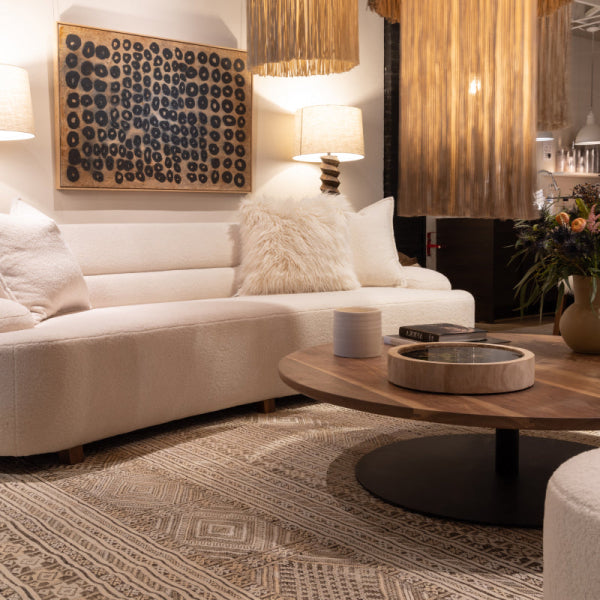
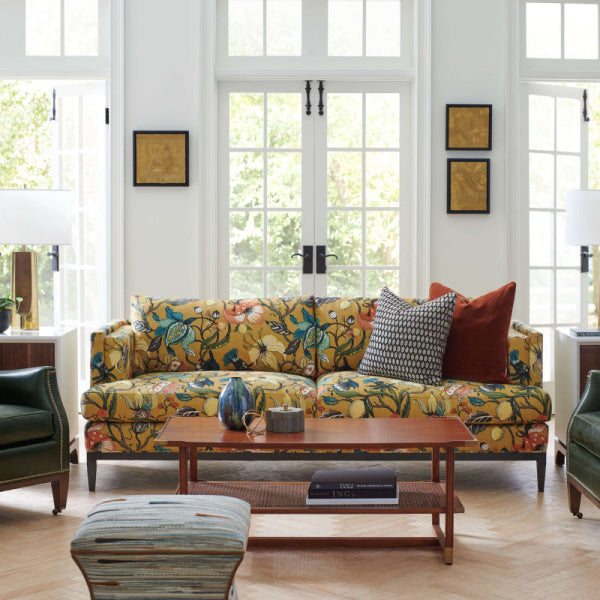
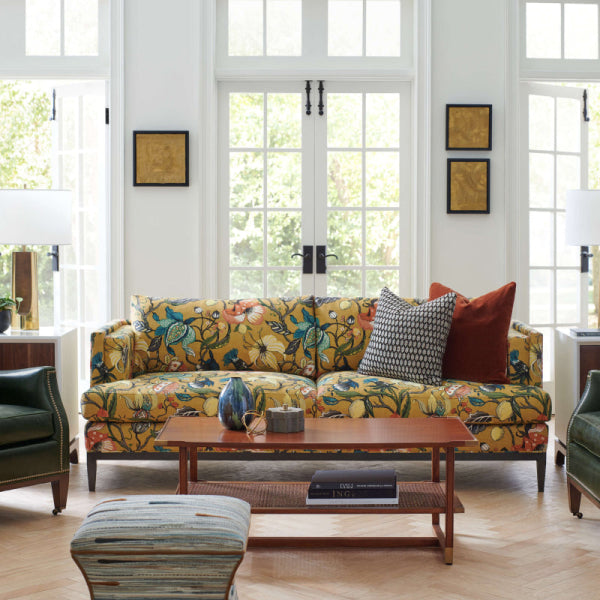
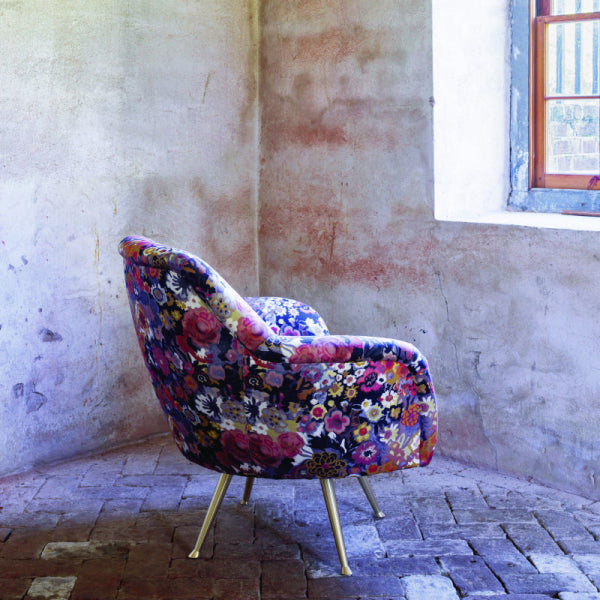









The afternoon sun is turning your living room into a bright, reflective box. You want privacy without losing daylight, a custom treatment that suits a luxury sofa, and enough texture to keep the windows from feeling flat. A roller shade may solve one problem, while heavy drapery may overwhelm the trim. Belgian linen Roman shades offer a more nuanced answer, combining a softly architectural fold with the irregular beauty of premium flax.
The best result depends on more than choosing a beautiful fabric. Fold style, lining, mounting position, window proportions, and fabrication all influence how the shade looks and performs. That's especially true in Atlanta, Buckhead, Alpharetta, Roswell, Sandy Springs, and other Fulton County homes where strong sun, changing humidity, and large windows can expose weaknesses in an otherwise expensive treatment.
Introduction to Belgian Linen Roman Shades
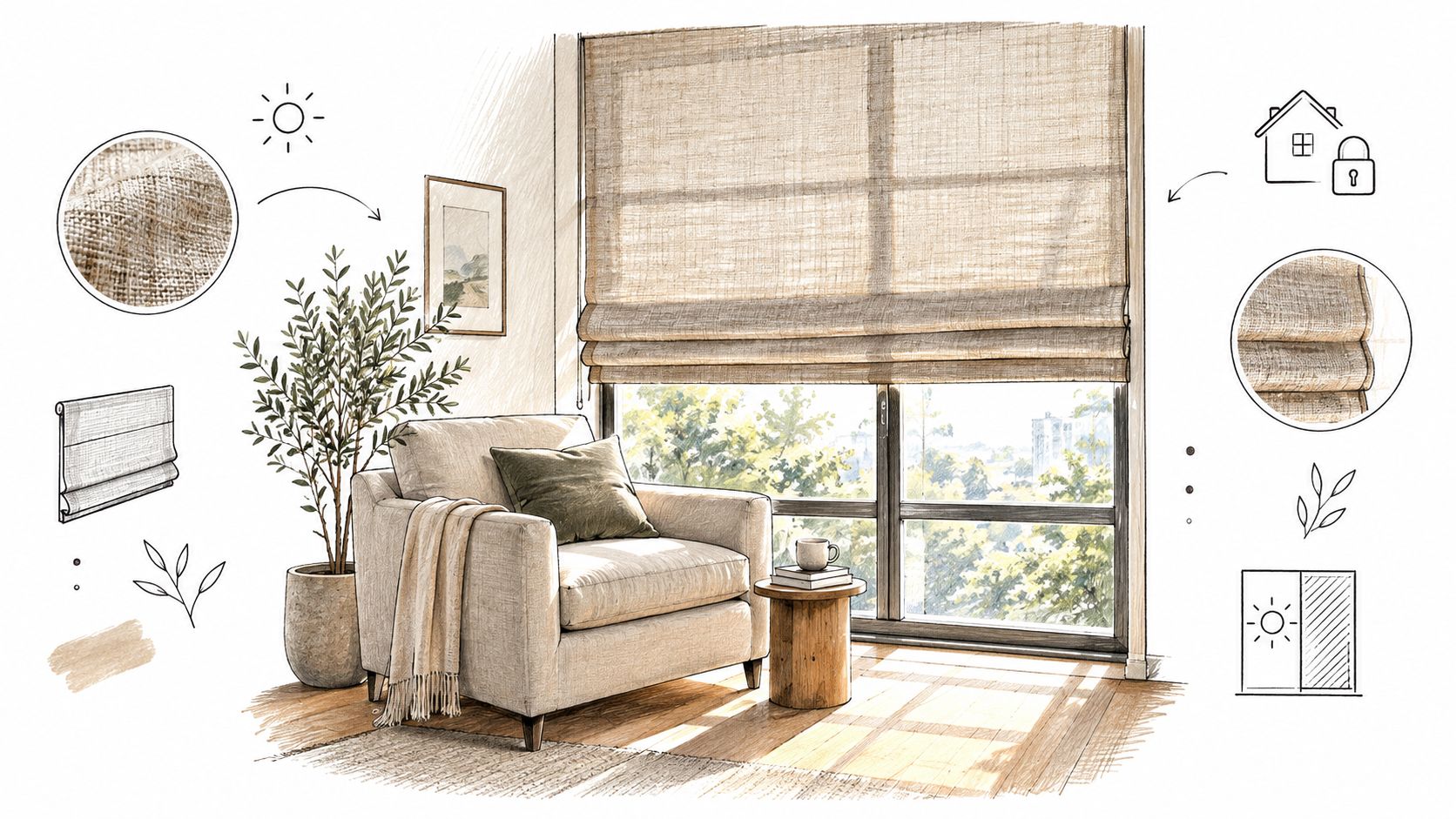
Belgian linen Roman shades have become a prominent design choice for interiors seeking warmth, natural texture, and a softer alternative to hard window treatments. Trend coverage identifies Roman shades in natural fabrics, including flat-fold and hobbled styles, as part of the direction for 2026, while also pointing toward outside mounting and more relaxed forms (Creative Blinds and Drapes' 2026 window treatment coverage). The appeal isn't limited to fashion. A well-made linen shade can make a wide window feel calmer, more finished, and more connected to the rest of the room.
Consider a Buckhead bedroom with a custom upholstered bed, a high-quality couch in an adjoining sitting area, and tall windows facing the morning sun. An unlined linen shade might look wonderfully airy, but it won't provide the sleep environment the room requires. A blackout-lined flat fold, mounted with enough coverage around the opening, creates a cleaner and more restful solution while preserving the tactile character of the face fabric.
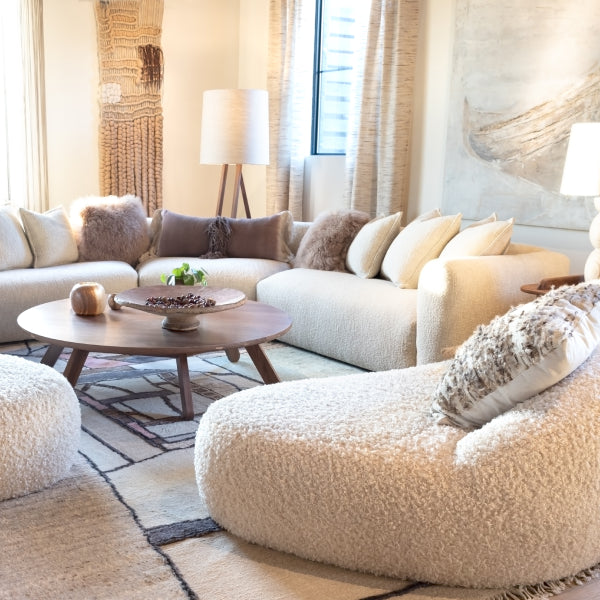
In an Alpharetta living room, the priorities may be different. The homeowner may want to soften glare across a premium sectional, protect artwork from harsh daylight, and maintain an open view during the day. A relaxed fold with a light-filtering lining can provide a gentler appearance than a rigid treatment, while the weave diffuses sunlight instead of turning the window into a stark visual block.
This guide treats Belgian linen as a material with both aesthetic strengths and practical limitations. You'll see how flax origin and fiber length affect cloth, how flat, relaxed, and hobbled folds change the mood, and why lining often matters more than the face fabric for privacy and insulation. Measuring, mounting, hardware, and bespoke fabrication complete the picture, helping homeowners, interior designers, and design-conscious buyers make decisions that support heirloom-quality furniture rather than competing with it.
What Makes Belgian Linen Different for Window Treatments
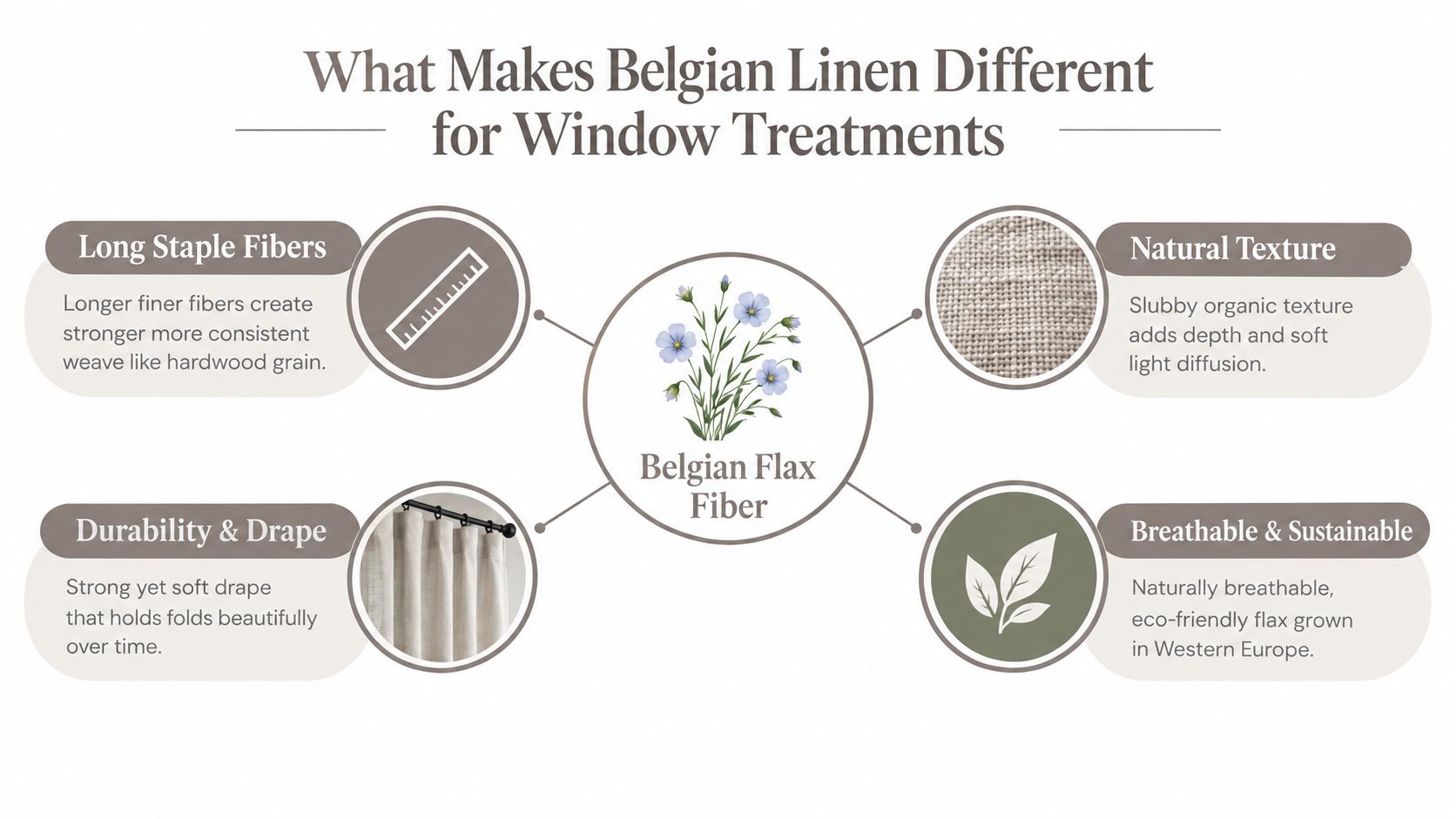
A useful way to understand premium linen is to compare its fiber structure with the grain of fine hardwood. Longer, more consistent fibers can support a smoother, stronger yarn, just as a well-selected board produces a more even surface in custom furniture. Belgian linen is typically made from flax fibers measuring 60 to 90 centimeters, and longer fibers are valued for producing finer, stronger yarns (Selvane's regional linen comparison).
The word “Belgian” also carries a formal meaning when it refers to Belgian Linen™. The trademark standard requires at least 85% EU-grown flax and weaving in Belgian mills (Clothing Digest's Belgian linen overview). That distinction gives designers a clearer basis for evaluating provenance than a vague label such as “European-inspired linen.” It connects the fabric to specified fiber sourcing and Belgian weaving rather than treating geographic language as decoration.
The regional context is unusually concentrated. Belgium sits within the core European flax belt alongside France and the Netherlands, where climate, agricultural knowledge, and textile expertise support premium linen production. Europe produced over 610,000 metric tons of flax fiber in 2023, with France and Belgium together accounting for more than 75% of that output, according to a 2024 industry report (Textile Today's flax industry report). Historical specialization remains part of the story. By 1840, 71% of households around Tielt were involved in linen production, while in Meulebeke more than 65% of the population worked in flax, as documented in the same source.
Why fiber behavior matters at the window
Flax isn't prized only for its appearance. It has high vapor permeability and can absorb up to about 20% of its weight in moisture without feeling damp (Clothing Digest's explanation of Belgian linen fiber properties). In an Atlanta room near a sun-exposed window, that ability can help the textile buffer humidity around the opening. It won't replace climate control, but it contributes to the comfortable, breathable character that makes natural fabric appealing in living spaces.
The weave also creates a subtle visual variation across a broad shade. Instead of reflecting light with the uniform surface of many synthetic fabrics, linen's slubs and matte finish scatter daylight gently. That quality can make a large panel feel more dimensional, especially beside designer furniture with substantial upholstery, sculptural custom chairs, or a statement furniture piece that needs a quiet backdrop.
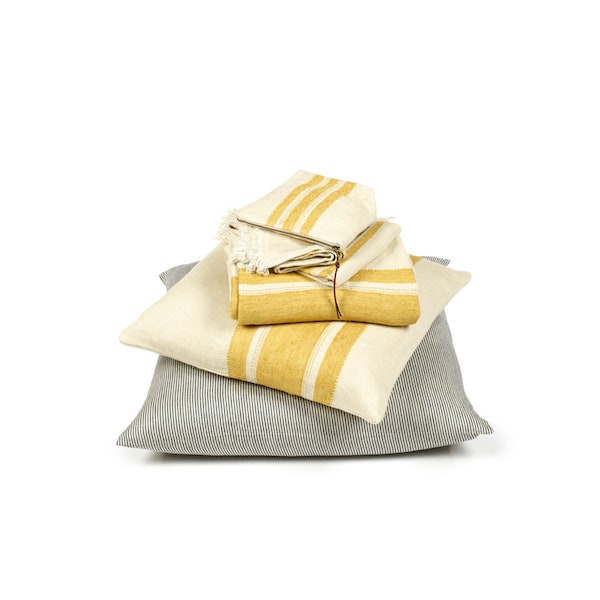
For homeowners comparing a premium linen from Libeco with a mass-produced linen-look fabric, ask about fiber content, mill origin, weave density, and fabrication suitability. A credible fabric description should help you understand what you're buying. Lewis and Sheron's explanation of Libeco linen and its textile character is a useful reference when you're evaluating linen for custom window treatments.
Choosing Your Fold Style and Texture
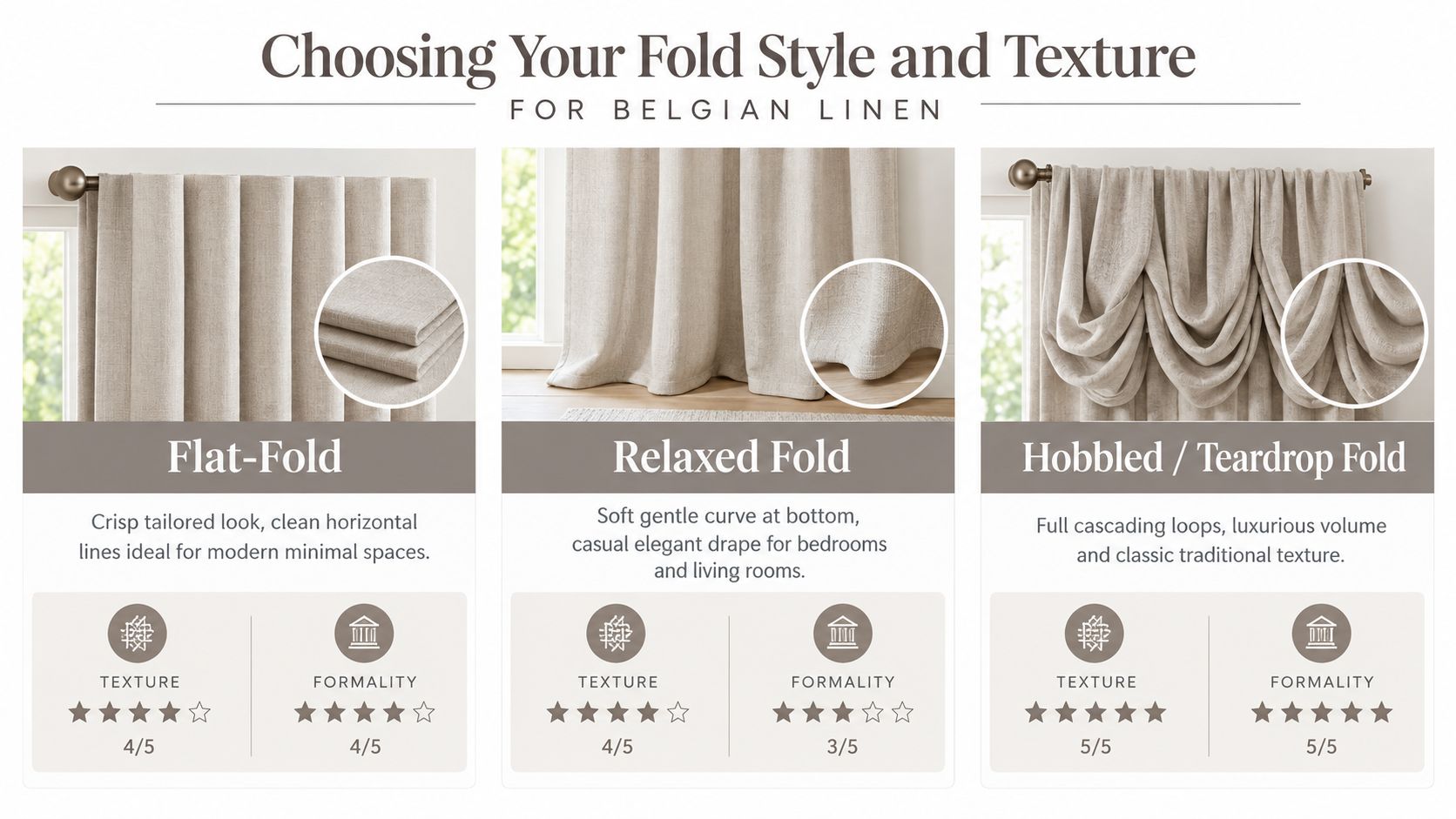
Fold style determines whether Belgian linen Roman shades read as relaxed softness, or layered luxury. The same fabric can look remarkably different depending on how the workroom constructs and supports it.
Flat fold for controlled modernity
A flat-fold shade presents a clean face when lowered and crisp horizontal sections as it rises. Its restrained geometry suits contemporary interiors, transitional rooms, and windows framed by strong architectural lines. Belgian linen softens the structure by adding slub, depth, and a matte surface, so the result won't feel as severe as a smooth technical fabric.
Choose flat fold for a bedroom where the shade should sit unobtrusively behind a custom bed, or for a dining room where the window treatment needs to support, rather than compete with, a sculptural table and designer chairs. With a structured lining, the folds remain more defined and the overall treatment feels closer to custom upholstery.
Relaxed fold for casual elegance
A relaxed shade falls into a gentle curve at the bottom. That curved hem gives linen room to express its natural drape, making the style especially effective in bedrooms, breakfast areas, and informal living rooms. It's softer than a flat fold and less visually elaborate than a hobbled shade.
The tradeoff is maintenance of the shape. Relaxed shades may require dressing, meaning the folds are adjusted by hand after operation so the bottom curve remains intentional. They're often better for decorative or lightly operated windows than for openings used repeatedly throughout the day.
Hobbled fold for layered volume
A hobbled, or teardrop, fold creates cascading loops that emphasize fullness and traditional luxury. It works well in formal living rooms, libraries, and rooms with premium sectionals, custom upholstered furniture, or heirloom-quality casegoods. The shade becomes a statement piece in its own right, particularly when the linen has a pronounced weave.
This style also creates more visual and physical volume. On a narrow casement, the layered folds may feel busy or consume valuable glass area when raised. A fully raised Roman shade can stack roughly 6 to 9 inches high, so smaller windows need a careful review of headrail placement and available clearance (Martha Stewart's 2026 window treatment trends).
For a deeper comparison of construction, fabric weight, and shade style, consult this guide to Roman shade fabric selection. The practical rule is simple: select the fold for the room's operating habits first, then choose the linen texture that supports that shape.
Lining and Light Control That Actually Performs
The linen facing establishes the shade's visible character, but the lining controls much of its practical performance. A lining sewn to the back can protect the face fabric from sunlight, add body, improve insulation, and reduce transmitted light (Restoration Hardware's Roman shade specifications).
That distinction prevents a common mistake. A homeowner may choose a beautiful Belgian linen and expect it to provide privacy, glare reduction, and temperature control on its own. In reality, those outcomes depend heavily on the weave, the shade's construction, the window's exposure, and the selected liner.
Match the liner to the room
| Lining Type | Light and Privacy Result | Best Use Case |
|---|---|---|
| Unlined | Keeps the fabric breathable and preserves the most natural light, with limited privacy after dark | Airy living rooms, decorative windows, and spaces where daylight matters most |
| Privacy lining | Softens transmitted light and improves daytime privacy without creating a fully dark room | Street-facing rooms, dining areas, and living spaces |
| Light-filtering lining | Reduces glare and gives the shade more body while maintaining a gentle daylight glow | South-facing windows, media-adjacent spaces, and rooms with reflective floors |
| Blackout lining | Provides the strongest control of transmitted light and privacy; one manufacturer specifies that a lined Roman shade can block 99% of light (Restoration Hardware's Roman shade specifications) | Bedrooms, nurseries, guest rooms, and windows requiring near-darkness |
| Thermal lining | Adds insulation and reduces the effect of heat transfer at the glass | Sun-exposed Atlanta windows and rooms with noticeable temperature swings |
A Buckhead primary suite generally benefits from a blackout or combined lining, especially if the shade covers a bright east-facing opening. An unlined shade may be attractive in an open-plan living room where the purpose is to soften glare while retaining a connection to the outdoors. Bathrooms and persistently humid spaces need extra caution. Linen's breathability is appealing, but moisture, ventilation, and cleaning requirements can make another material more suitable.
Check the reverse side before approving fabric
Ask to see the linen with the proposed lining behind it. The liner can alter the shade's color, fold definition, opacity, and perceived weight. A thick blackout layer may make a relaxed fold look more substantial, while a lighter lining can preserve the easy movement of a loosely woven face fabric.
For a fuller explanation of how lining affects custom window treatments, review the role of drapery lining. The right decision isn't “lined or unlined” in the abstract. It's whether the shade supports the room's actual needs for privacy, glare control, insulation, and sleep.
Measuring and Installation Considerations for a Perfect Fit
A linen shade can look refined in the sample and still feel wrong on the window. Uneven spacing, a visible side gap, or an oversized headrail becomes especially noticeable against Belgian linen's natural texture. In an Atlanta home, accurate measuring and a thoughtful mounting plan matter as much as the fabric's heritage and fiber character.
Decide how the shade relates to the frame
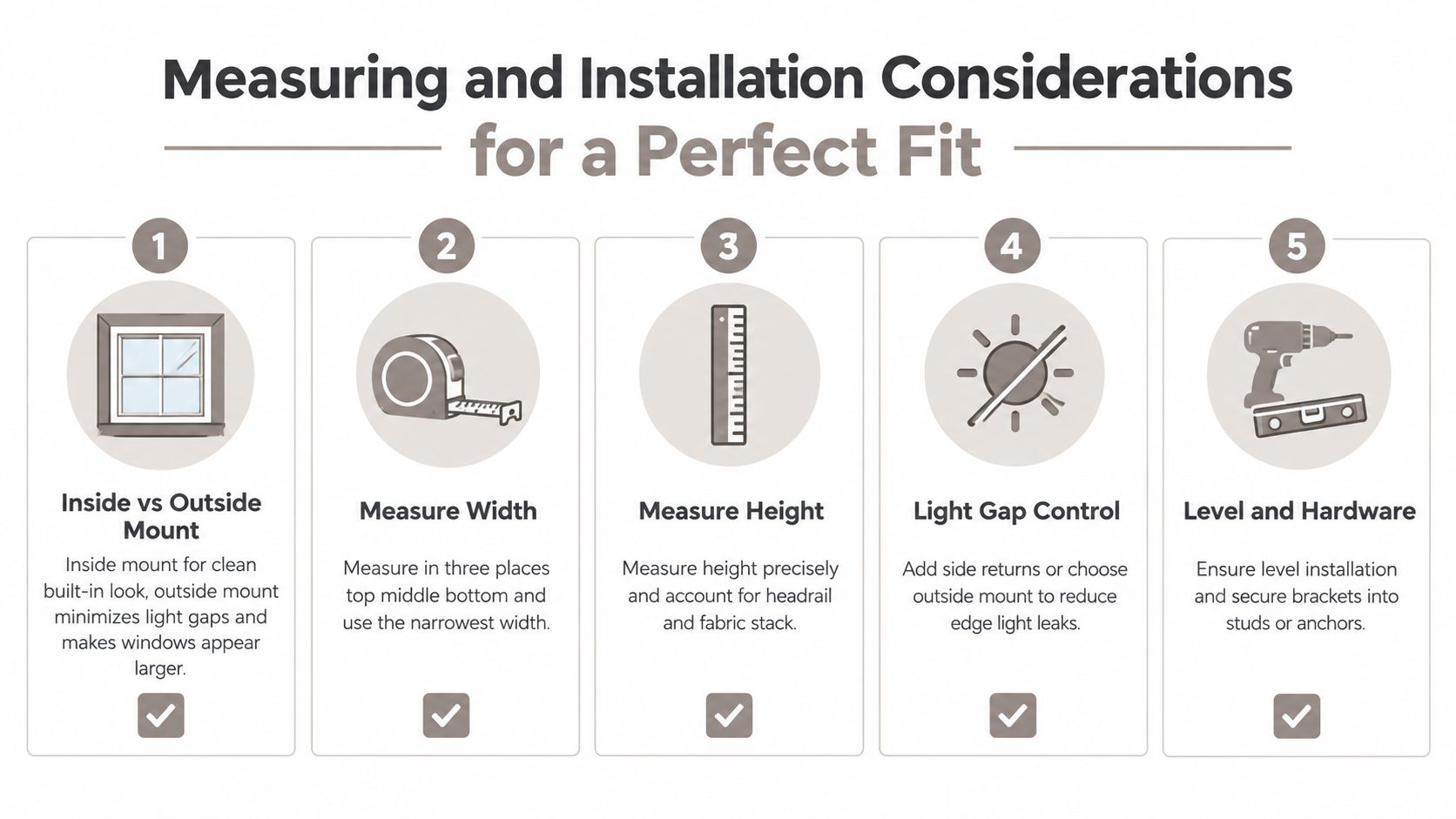
An inside mount fits within the recess and gives the window a built-in appearance. Choose it when the opening has enough depth and the frame is straight, square, and worth showing. The fit must be precise. Even small errors can create uneven side gaps, and those gaps may admit more light than expected.
An outside mount sits on or beyond the frame. It can make the window appear larger, conceal irregular trim, and reduce light leakage at the edges. This approach often suits textured Belgian linen when privacy or a fuller treatment matters. The mount can influence performance as much as the fabric itself.
Measure the raised position too
Check the shade when it is fully open, not only when it covers the glass. A Roman shade may stack roughly 6 to 9 inches high, depending on its construction and fabric weight. On a narrow window, that stack can cover a noticeable section of the glass or obstruct a casement handle.
Use this checklist during the site visit:
- Width: Measure the opening in multiple places and record the smallest usable dimension for an inside mount.
- Height: Include the headrail, mounting brackets, and fabric stack. Do not measure only the visible glass.
- Light gaps: Consider outside mounting, side returns, or added coverage when privacy or darkness matters.
- Hardware: Select a corded, cordless, or motorized lift according to access and household needs.
- Access: Confirm that the shade can be removed or reached for dusting, inspection, and professional cleaning.
Linen will wrinkle and shift with use. That movement reflects the fiber's natural character, not a failed installation. Mounting also depends on the surrounding trim. If painted trim or older wood frames need preparation, this guide to painting wood window frames can help coordinate surface work with the shade schedule.
Practical rule: Approve the treatment from more than a front-facing elevation. Review the lowered face, raised stack, side gaps, and hardware clearance before fabrication.
Customization Lead Times and Designer Support in Atlanta
Custom Roman shades require more decisions than an off-the-shelf treatment, but those decisions are what make the finished window feel integrated with high-end furniture. A workroom must coordinate the selected linen, pattern direction, fold style, lining, dimensions, operating hardware, and installation requirements. Each choice can affect the shade's weight, appearance, and handling.
Start with the fabric, then build the specification around the room. A warm natural linen may support a neutral rug and a luxury sofa, while a deeper tone can frame a window beside walnut casegoods or a bold statement chair. Trim introduces another layer of definition. A narrow edge can sharpen a relaxed shade, while a more substantial border may suit a hobbled treatment in a formal sitting room.
What to settle before fabrication
- Colorway: Evaluate the linen in the room's morning, afternoon, and evening light.
- Lining: Choose based on privacy, glare, insulation, and sleep requirements.
- Fold: Confirm whether the room needs crisp retraction, a decorative curve, or layered volume.
- Hardware: Review lift access, control placement, and clearance from handles or nearby furniture.
- Fabric quantity: Allow the workroom to determine yardage, pattern alignment, and any repeat requirements.
Lead times vary with fabric availability, lining selection, fabrication queues, approvals, and installation coordination. A premium mill fabric that's in stock may move through the process differently from a special-order textile or a shade requiring detailed trim work. Ask for a written sequence covering sample approval, final measurements, fabrication, delivery, and installation rather than relying on a casual estimate.
In Atlanta, Lewis and Sheron Textiles offers Belgian linens from Libeco Home, in-house designer collaboration, in-stock bolts, cut-yardage options, made-to-order American-crafted upholstery, custom drapery, and nationwide shipping. That combination is relevant when Roman shades must coordinate with custom upholstered furniture, designer furniture, premium sectionals, and high-quality couches rather than being selected in isolation.
The same planning logic applies to reupholstery. If a cherished chair or sofa is being restored, select the shade and upholstery fabrics together so texture, scale, and undertone remain coherent. A designer can help determine whether the linen should blend into the room or serve as a contrasting statement furniture piece.
Finished Room Inspiration and Next Steps
In a Buckhead primary suite, a blackout-lined flat-fold Belgian linen shade establishes a calm, uniform plane behind the bed. The fabric adds quiet texture, while the lining handles the practical need for privacy and darkness. A custom upholstered bench at the foot of the bed, a hand-knotted rug, and restrained brass hardware can complete the room without making the window treatment feel decorative for its own sake.
An Alpharetta kitchen calls for a different balance. Relaxed unlined shades over a breakfast nook can temper morning glare and preserve the room's natural brightness. Their curved lower edge works comfortably with painted cabinetry, a custom chair, and a durable designer fabric on nearby seating, creating a softer composition than a strictly geometric shade.
In a Sandy Springs living room, hobbled linen shades bring layered texture to tall windows beside custom Verellen upholstery. The folds echo the depth of a luxury sofa without copying it, while a hand-knotted rug grounds the palette. The shade becomes part of the room's material conversation, alongside wood, wool, metal, and carefully selected upholstery.
These examples share a central principle: Belgian linen Roman shades should be specified as part of the interior, not added after the furniture is finished. The fabric's origin, fold, liner, and mounting position should support the room's use. That approach helps a homeowner distinguish designer quality from a mass-produced substitute and makes a thoughtful purchase feel more like a lasting furnishing than a temporary accessory.
Bring window dimensions, photographs, and upholstery samples to a design consultation. Review the linen in natural light, handle the fabric, and discuss how often the shade will operate. For homeowners and designers in Atlanta, North Atlanta, Roswell, and surrounding affluent markets, that process creates a clearer path toward a custom result.
Lewis and Sheron Textiles offers premium Belgian linens from Libeco Home, custom drapery and Roman shade fabrication, and complimentary in-house designer collaboration for coordinated interiors. Visit Lewis and Sheron Textiles to review fabrics, discuss lining and fold options, and plan Belgian linen Roman shades that complement your luxury furniture and custom upholstered pieces.