


















You find the damage at the worst possible moment, just before guests arrive. A split has opened along the seat cushion of your premium sectional, or a cigarette ember has left a dark mark in the arm of a designer chair. The instinct is understandable: reach for a needle, adhesive, or patch kit and make the problem disappear.
Luxury upholstery rarely works that way. A high-end sofa may use a tightly engineered performance weave, hand-finished velvet, bouclé, linen, or a discontinued textile that behaves nothing like fabric from a local craft store. Successful sofa fabric repair begins with diagnosis, then material matching, then a decision about whether a localized repair, partial reupholstery, or complete restoration will preserve the piece's appearance and value.
The market gives that decision useful context. The U.S. furniture repair and reupholstery industry is projected at $2.0 billion in 2026, with 18,834 businesses operating in the sector, while the number of businesses declined at a compound annual rate of 1.4% from 2021 to 2026, according to IBISWorld's furniture repair and reupholstery industry profile. This is a substantial but fragmented trade, so workmanship and textile knowledge can vary widely, particularly for luxury sofas, custom upholstered furniture, and heirloom-quality furniture.
When a Premium Sofa Needs More Than a Patch
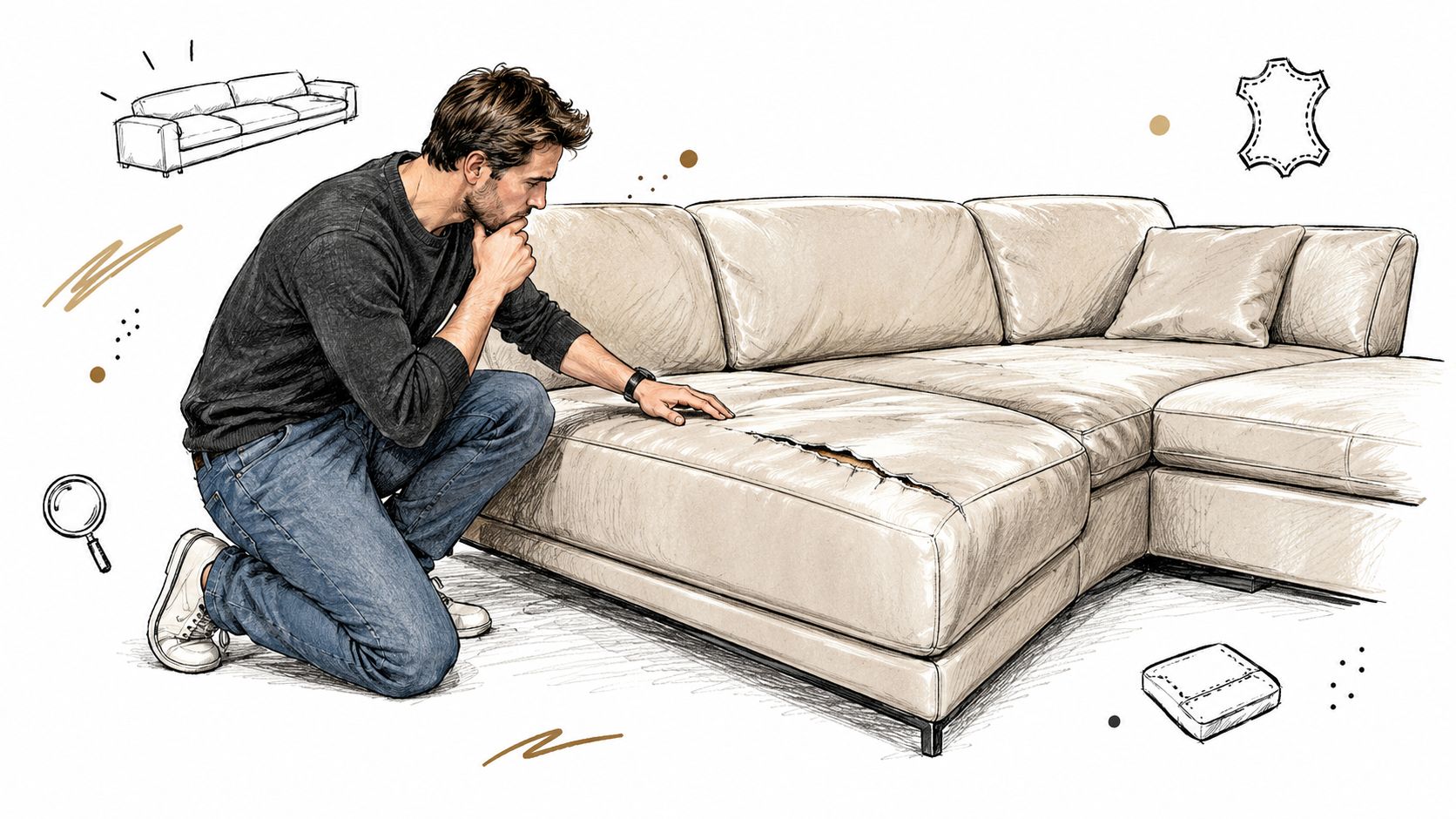
A homeowner recently notices a split running across the seat cushion of a premium Italian sectional. The tear is about six inches long, the fabric is a soft, textured neutral, and the sofa represents a serious investment. The obvious question is whether a needle and thread will solve it.
The better question is what caused the opening. A clean separation in a strong seam is a different problem from a torn face fabric with crushed fibers. If the cushion has settled, the cover may be under abnormal tension. If the backing has weakened, a neat stitch can pull through the surrounding cloth. If the entire seam allowance is fatigued, repairing the visible opening alone may just move the failure a few inches away.
The material changes the repair
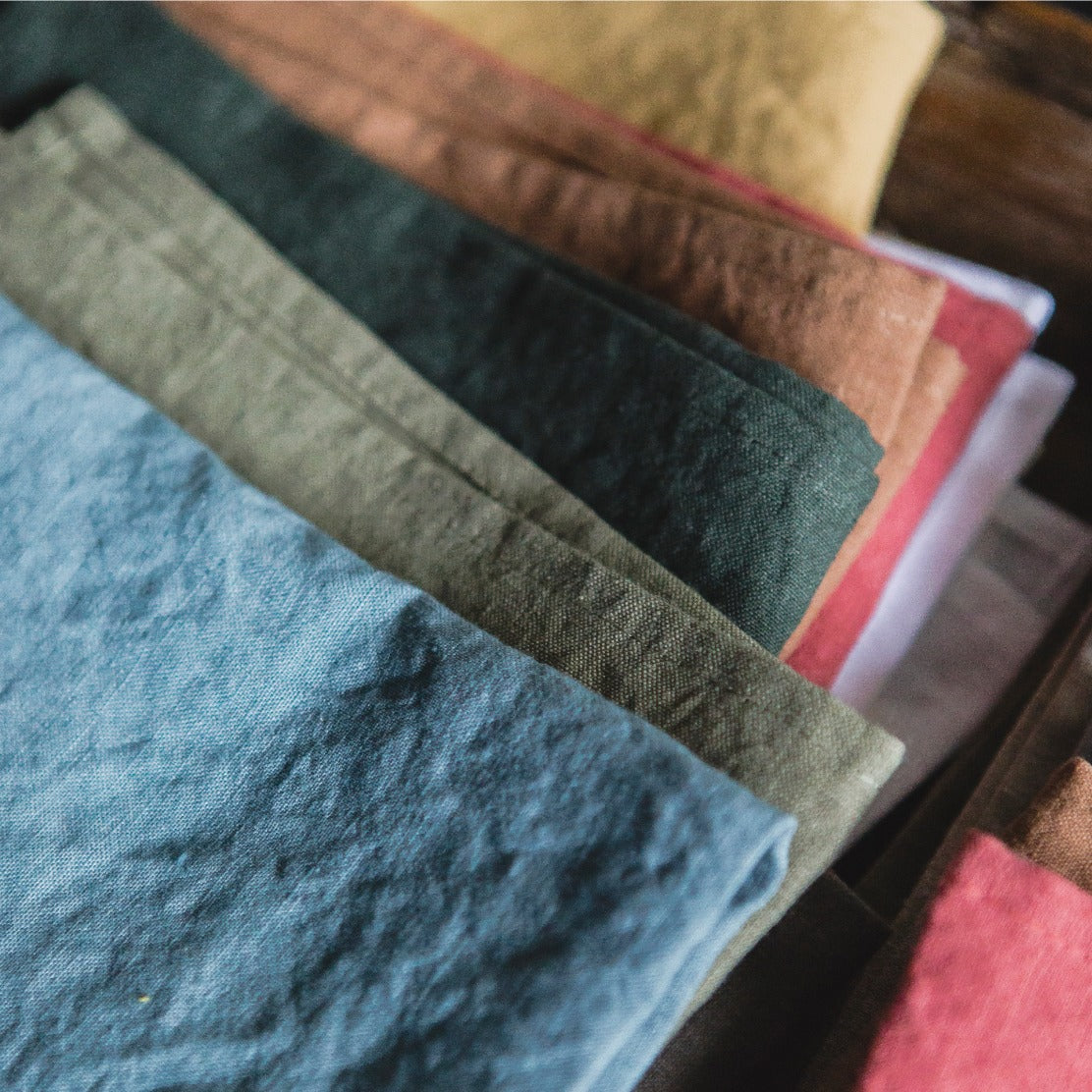
Commodity upholstery often tolerates a quick patch better than a premium textile. Bouclé can lose its characteristic loops when trimmed too aggressively. Velvet shows directional shading, so a replacement piece can look darker or lighter even when the color seems identical. A performance fabric may have a coating or backing that resists ordinary glue, while linen can reveal every puncture and tension mark.
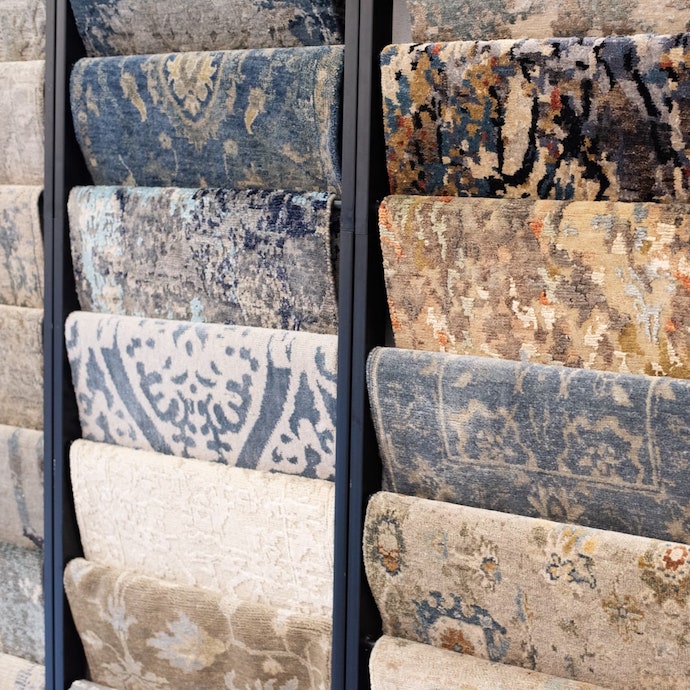
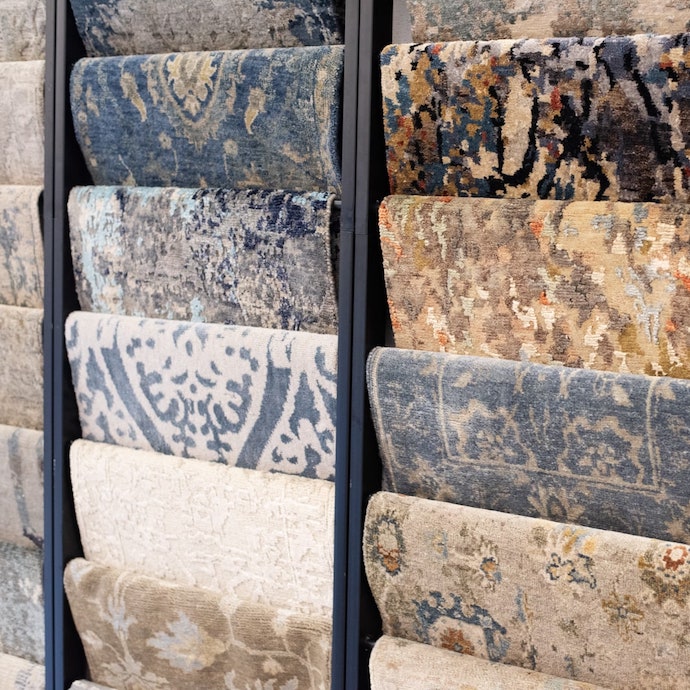
A fabric-store match also isn't necessarily a real match. Designer upholstery may be discontinued, mill-run exclusive, or altered by sunlight and use. The closest available sample can still differ in texture, sheen, pattern scale, and hand-feel.
Practical rule: Treat the tear as evidence. Inspect the fabric, cushion, seam, and structure before deciding how to close it.
The repair decision should protect three things:
- Fabric value: Can the original textile be matched, harvested from a hidden area, or carefully blended?
- Frame integrity: Is the sofa structurally sound, or is the cover hiding spring, webbing, foam, or frame trouble?
- Long-term appearance: Will the repair remain invisible from normal viewing distance and hold under daily use?
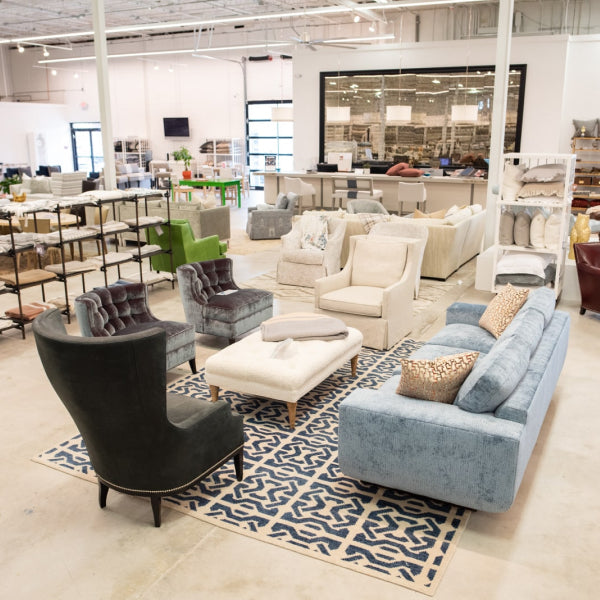
A professional reupholstery process typically considers the entire relationship between cover, padding, and frame, rather than treating upholstery as a detachable skin. Lewis and Sheron Textiles describes that broader approach through its art of professional reupholstery, which is especially relevant when restoring statement furniture pieces in Atlanta, Buckhead, Alpharetta, Roswell, or Sandy Springs.
Diagnosing the Damage Before You Decide
Start by photographing the damage in natural light. Don't stretch the cloth to make the opening look smaller, and don't apply water or adhesive before you know whether the face fabric is bonded to a separate backing. Luxury upholstery needs to be read at the surface and underneath.
Read the tear itself
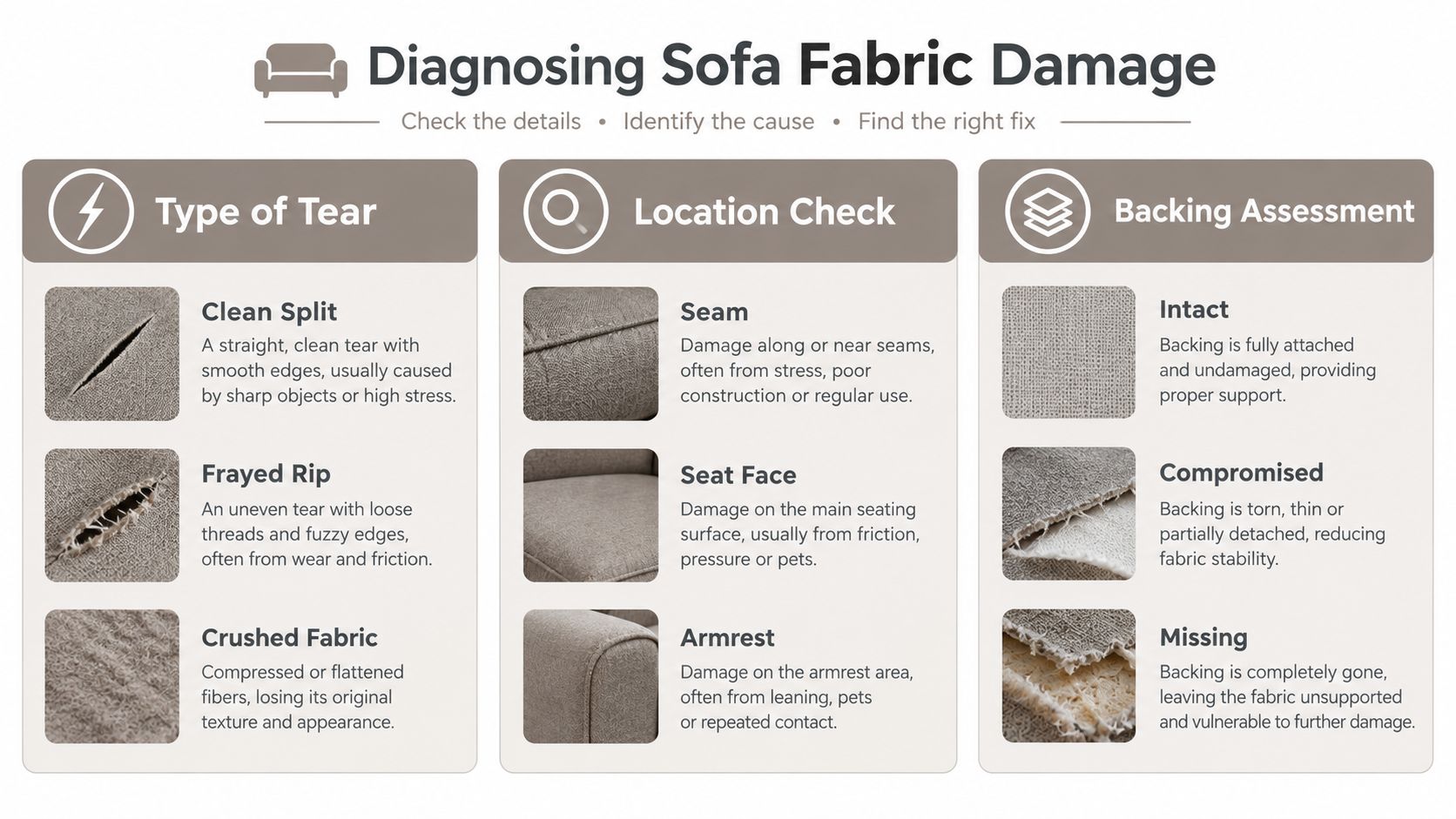
A clean split has relatively stable edges and may follow a seam, fold, or existing stitch line. A frayed rip has loose yarns extending beyond the opening, which means the surrounding weave may already be compromised. Crushed fabric looks flattened, glazed, or distorted around the damage. This is common in pile fabrics and can make a visually small defect more difficult than a larger tear in a stable plain weave.
Check the reverse side where possible. If the backing is intact, a properly sized support patch can distribute tension. If it's separating, brittle, or missing, stitching only the face fabric will concentrate force at the punctures and encourage another failure.
Check location and movement
A popped stitch in a seam can be straightforward if the seam allowance remains generous and the thread is sound. A pulled seam allowance means the cloth itself has migrated out of the stitching line. On older upholstery, inspect nearby thread for brittleness or powdering. One broken thread may be isolated, while widespread degradation calls for opening and reinforcing the whole seam.
Sagging should be treated as a symptom, not automatically as a fabric defect. Compressed foam, stretched webbing, tired serpentine springs, or loosened attachments can change the shape of the seat and place continual strain on the cover. Before addressing sagging sofa cushions, press through the cushion and inspect the deck beneath it.
Stains and burns also need material-specific handling:
- Velvet: Liquid can create shading or pile distortion, and aggressive rubbing can permanently alter the nap.
- Linen: Water rings and uneven drying can remain visible, especially on undyed or lightly colored cloth.
- Leather-blend upholstery: Solvents and excess moisture can affect the finish differently from the textile fibers.
- Treated performance weaves: A harsh cleaner can remove or weaken the stain-resistant treatment even when the mark disappears.
If the damage changes texture, exposes backing, or sits on a high-contact seat face, a specialist assessment is usually safer than a cosmetic experiment.
Repair, Partial Reupholstery, or Full Restoration
The right intervention depends on more than the hole's size. Assess damage location, fabric availability, visual exposure, and value preservation before choosing a method. A tiny defect in the center of a patterned chaise may be harder to disguise than a longer split concealed within a seam.
A localized repair suits an isolated defect when the surrounding textile remains strong. Upholstery guidance recommends a backer patch extending at least 1 inch beyond the damage on all sides, with rounded corners to reduce lifting. For sewn closures, stitches of about 1/8 inch provide a practical benchmark. Simple seam tears no longer than 5 to 6 inches may sometimes be repairable, although the result can be temporary and may need further attention within about three months. These benchmarks come from upholstery repair guidance on torn fabric. They do not guarantee that a premium sofa is suitable for home repair.
Partial reupholstery often gives a sectional the best balance between preservation and appearance. A workshop can replace a chaise cushion cover, seat panel, or back panel while retaining sound original panels and the existing frame. The difficult part is matching a discontinued textile. Fabric may be taken from a concealed section, paired with a deliberate contrast, or applied across a visually balanced group of panels. The goal is a designed result, not an isolated patch.
Full restoration suits widespread fabric failure, degradation across several panels, or a sofa whose frame and construction justify continued preservation. Heirloom-quality furniture, limited-edition designer pieces, and luxury sofas with strong internal components often fall into this category. Restoring the cover alone is not enough if the underlying structure no longer supports it.
| Criterion | Repair | Partial Reupholstery | Full Restoration |
|---|---|---|---|
| Damage location | Isolated defect, preferably near a seam or hidden area | Concentrated wear on cushions, chaise, seat, or back panels | Damage across multiple visible panels |
| Fabric availability | Original fabric is available or stable enough to support | Original is discontinued, but a close match or coordinated contrast is possible | Matched, harvested, or equivalent textile must be sourced throughout |
| Visibility | Low to moderate visibility after blending | Visible area is redesigned or re-covered as a complete panel | Every visible surface can be renewed consistently |
| Value preservation | Preserves original cover with minimal intervention | Retains sound structure and character | Best for significant, heirloom, or structurally valuable pieces |
Before comparing a repair quote with replacement furniture, assess the frame, cushion construction, proportions, and design identity. A practical discussion of whether it's cheaper to reupholster or buy new should include the loss of a custom silhouette, a discontinued fabric, or a sofa that fits the room precisely. Repair is worthwhile when it preserves those qualities. Replacement may be the sounder decision when fabric failure is widespread and restoration cannot protect the sofa's remaining value.
Tools and Materials That Respect Luxury Fabric
Generic upholstery kits are built for convenience, not for every premium textile. A sharp needle and thick thread can make a repair stronger while leaving conspicuous punctures, and a stiff iron-on patch can turn a flexible cushion edge into a hard rectangle.
Choose tools according to the fabric's weight, surface, and construction.
- Curved upholstery needles: Sizes 18 to 22 help reach internal seams without forcing the face fabric into an awkward angle.
- Long tapestry-point needles: Useful for chenille and other textured weaves because the point can pass between yarns rather than slicing through them.
- Polyester or bonded nylon thread: Match the thread to the fiber content and the expected tension. A color match alone isn't enough.
- Fray-check solution: Apply sparingly to exposed woven edges after testing on a hidden section.
- Sharp fabric scissors: Use these for controlled trimming. Utility blades can crush pile and create a harsher edge.
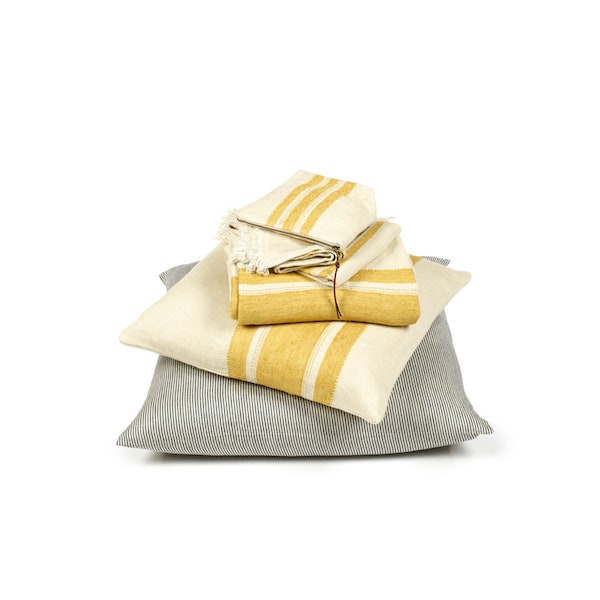
A backer patch should have a compatible weight and flexibility. Matching-weight calico or a clean selvedge offcut is generally more appropriate than iron-on mender fabric, which can stiffen the repair zone and create a visible change in drape.
For adhesive work, textile-grade contact cement or 3M Fastbond is preferable to household superglue. Superglue can crystallize, discolor natural fibers, and leave a rigid spot that cracks as the cushion moves. Adhesive also needs restraint. Too much saturates the face and may create a dark halo.
Keep a seam ripper, upholstery pins, a magnetic tack hammer, and a staple gun fitted with 22-gauge staples available for reattachment work. These tools help with access and controlled fastening, but they don't compensate for poor diagnosis. On a silk velvet arm, a professional repair may be safer than trying to force a thick needle through the pile.
Lewis and Sheron Textiles is one Atlanta option for sourcing upholstery yardage, custom furnishings, and expert reupholstery when the required textile or workroom skill exceeds a home repair. A material specialist can also help compare a replacement fabric's texture, hand, and durability before the sofa is opened.
Repair Techniques for Tears, Seams, Sagging, and Burns
Begin at the frame side whenever access allows. Upholstery covers are tensioned parts, so pulling from the visible face can distort the weave. A repair may look neat while the fabric remains under an uneven load. Diagnose how the cover is attached before choosing stitches, adhesive, or structural work.
Closing a tear without hardening the surface
Trim only loose, unstable fibers with sharp shears. Preserve sound yarns, even if the opening looks less tidy. Place a matching-weight calico patch behind the tear, extending at least 1 inch beyond the damage on every side. Round the corners to reduce lifting, following the patch-extension benchmark noted earlier.
Use a small amount of 3M Fastbond, or hand-baste the patch before closing the face. A ladder stitch can draw clean edges together with limited visual disturbance. Work with single-strand thread and follow the pile direction on velvet or another directional fabric. For a seam closure, stitches around 1/8 inch provide a useful reference, but the weave determines the final spacing and tension.
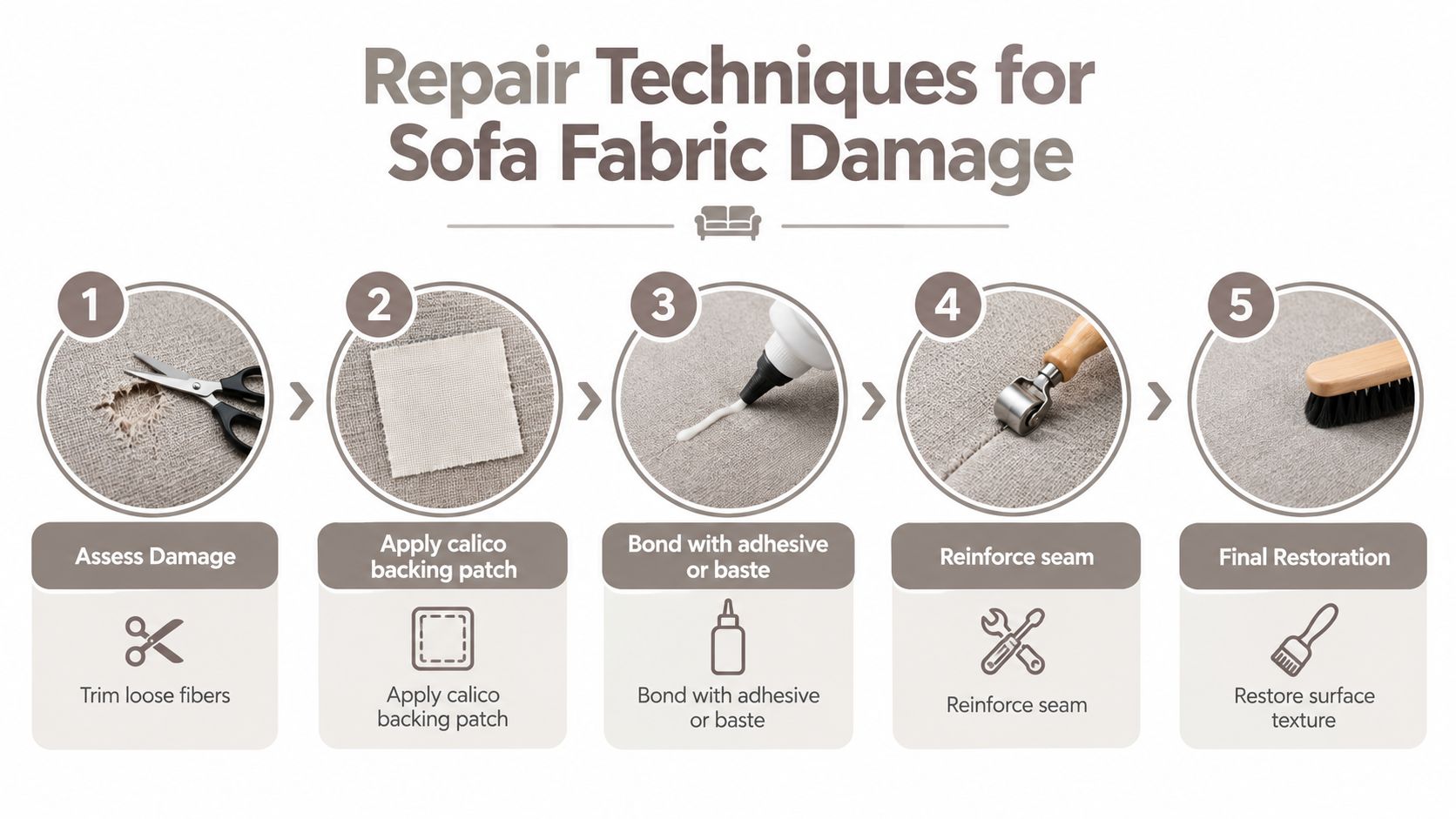
Do not pull a repair tight merely to close the gap. A rigid or over-tightened area will show as a puckered spot when the cushion flexes.
Handling burns and seam failure
A small burn calls for clean removal of charred fibers, followed by a donor patch cut from identical fabric. Match the nap direction before securing it. Suitable donor cloth may come from beneath the sofa, inside a skirt, or another concealed area. Blend the surface with a fine brush or careful hand work so the transition does not form a hard outline.
Luxury sofa seams often fail because thread has degraded rather than because the original stitch was misplaced. Open the affected area carefully, restitch with a back-tack at regular intervals, and choose slightly heavier thread only when the fabric and seam allowance can handle it. Reinforce the allowance with compatible seam tape. Stiff tape can change the fold and create a new stress line.
Sagging seat decks need structural correction before cosmetic correction. Retie jute webbing or serpentine springs at 8-inch centers where the construction calls for it, then redress the cushion and check cover tension. Restuffing alone hides the symptom. The cover will continue moving against an unstable base and may wear faster.
Test first: Apply every adhesive and dye treatment to a hidden seam, donor scrap, or underside. A change in color or hand-feel cannot be reversed cleanly.
Treat stains conservatively. Blot instead of scrubbing, identify whether the mark is water-based or oil-based, and avoid saturating velvet, linen, or treated performance cloth. Leather and leather blends require products suited to their finish. For adjacent leather components, guidance on how to prevent leather sofa from worsening helps keep textile methods away from a different upholstery system.
Deciding Between DIY and a Professional Upholsterer
A self-repair is reasonable only when the risk is limited. I use four questions before allowing a needle near a luxury piece: How is the sofa built? Can the fabric be sourced? How visible is the damage? What happens to the piece's long-term value if the repair fails?
Eight-way hand-tied spring construction deserves particular caution. Each coil is tied by hand in eight directions to the frame and neighboring springs, a method described as distributing weight more evenly and resisting permanent deformation more effectively than a sinuous spring system in this guide to luxury sofas. Down-wrapped cushions, sculpted edges, delicate pile, and limited-edition textiles also justify professional handling because the cost of an irreversible mistake can exceed the labor saved.
DIY makes sense in a narrow range
A homeowner may reasonably handle a loose thread or small tear on a hidden seam when the fabric is a mid-tier performance cloth available by the yard and the sofa is relatively new. The repair should be reversible, supported from behind, and away from a pattern focal point or exposed seat face.
Professional work is the safer route when:
- Construction is complex: Hand-tied springs, unusual frames, channel backs, and down cushions require controlled dismantling and redressing.
- The fabric is scarce: A discontinued mill-run textile may need archive research, donor harvesting, or a coordinated panel plan.
- The damage is prominent: A visible arm, front rail, or central cushion demands pattern, nap, and tension control.
- The value is high: Designer furniture and heirloom pieces deserve a restoration plan rather than an experiment.
A hybrid approach often works well. The homeowner can document the damage, remove loose objects, and approve samples, while an upholsterer handles deck sagging, frame work, cushion rebuilding, or panel replacement.
Request a fabric sample approval and a written quote that separates labor, materials, and disposal. Ask whether the shop carries liability coverage for designer-grade pieces and whether the team photographs each stage for your records. Those details matter when you're restoring premium furniture in Atlanta, North Atlanta, Fulton County, or the surrounding affluent markets.
Preventative Care That Extends the Life of a Designer Sofa
Good maintenance starts before the sofa is delivered. Abrasion resistance is commonly expressed in Wyzenbeek double rubs, where one double rub represents a full back-and-forth motion against upholstery. Industry guidance identifies roughly 15,000 double rubs as a common residential benchmark, 30,000 as heavy-duty, and 50,000 as a higher-end rating for coated fabrics, as explained by FiberGuard's abrasion-testing guide.
Another upholstery guide classifies 9,000 to 15,000 double rubs as light residential use, 15,000 to 30,000 as general daily-use upholstery, and 30,000 to 50,000 as heavy residential use, with active households and family sectionals often needing the higher range, according to this performance fabric guide. Rub count doesn't predict every behavior. Fiber type, weave, pilling, stain treatment, and surface texture still matter.
Match care to the textile
Performance fabrics can tolerate practical spot-cleaning routines, but follow the mill's instructions and don't assume a stain-resistant finish makes the cloth maintenance-free. Linen, bouclé, chenille, velvet, and other natural or texture-forward luxury textiles need gentler vacuuming and controlled moisture.
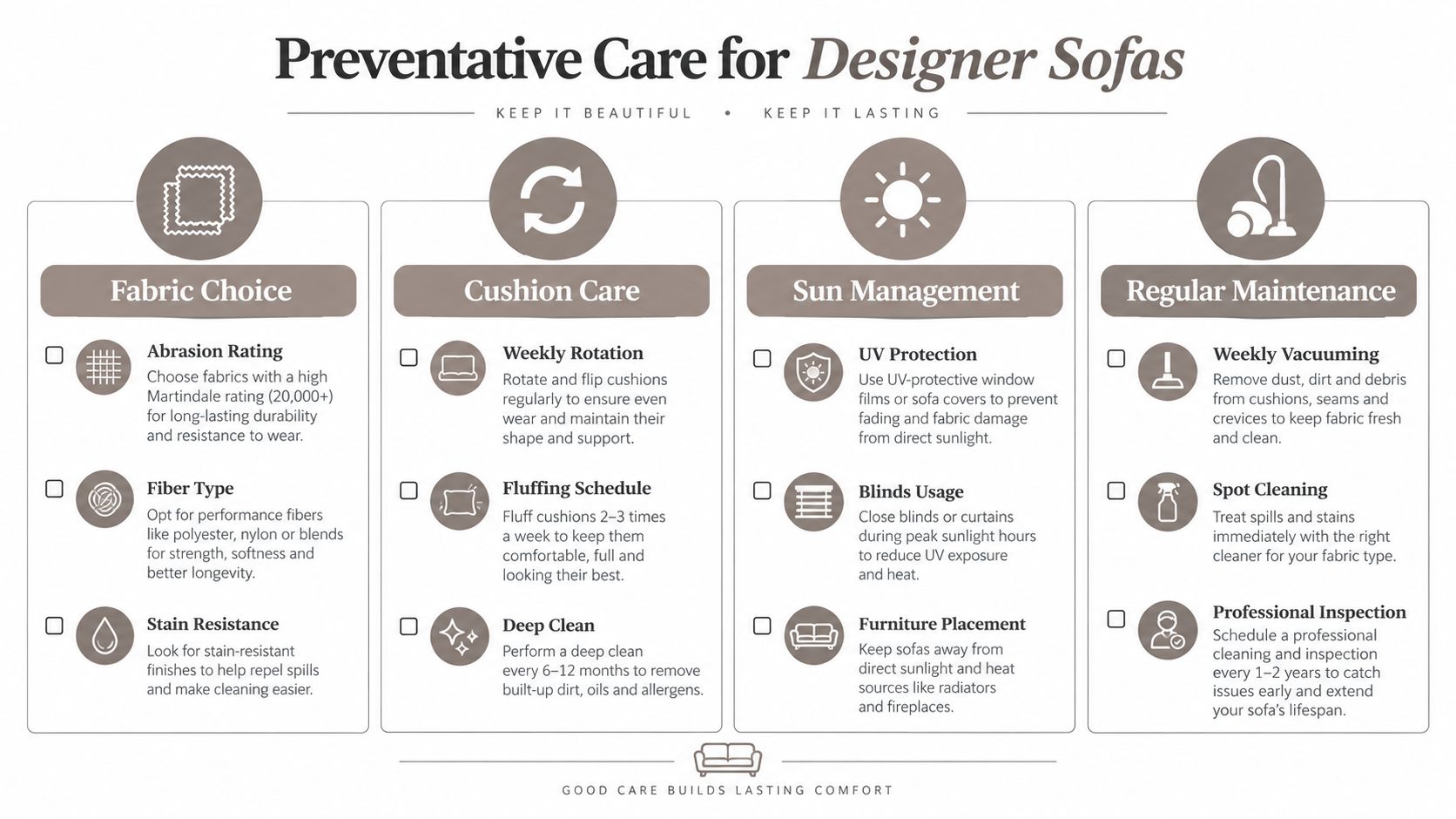
Use a soft upholstery attachment, keep the nozzle from dragging across raised loops, and remove dust before it becomes embedded. Rotate and fluff loose cushions regularly, manage direct sun with blinds or thoughtful furniture placement, and blot spills promptly instead of working them deeper into the weave.
A simple care rhythm protects both fabric and structure:
- Vacuum gently: Remove surface grit without pulling loops or flattening pile.
- Rotate cushions: Spread wear across usable faces and positions.
- Control sunlight: Reduce prolonged UV exposure to limit uneven fading.
- Treat marks early: Use the approved cleaner and test an inconspicuous area.
- Inspect seams: Catch loose stitching, shifting panels, and cushion distortion early.
- Schedule cleaning thoughtfully: Use a qualified upholstery cleaner when surface care no longer restores the finish.
Leather sections need a different routine from textile panels. Use a finish-compatible product and follow specialist guidance on leather conditioning from Grainmark Leather, rather than transferring fabric-cleaning habits to leather.
For homeowners and designers comparing luxury furniture in Atlanta, Lewis and Sheron Textiles offers upholstery fabrics, custom upholstered furniture, made-to-order pieces, and reupholstery services for cherished sofas and chairs. Visit Lewis and Sheron Textiles to review premium textiles, discuss a repair or restoration path, and make a material decision that protects the character of your furniture.